Have you ever wondered whether to use which or that in a sentence? You’re not alone! Many English learners and writers confuse these two words because they can both introduce information about a noun. The good news is that learning the difference between which vs that becomes much easier when you understand a few simple grammar rules. Whether you’re writing an email, a school assignment, or a blog post, choosing the right word can make your sentences clearer.
In this guide, you’ll learn when to use which and that, how commas change meaning, and how to avoid common mistakes. We’ll also cover easy examples, American and British English differences, and practical tips to help you write with confidence.
Quick Answer — Which vs That
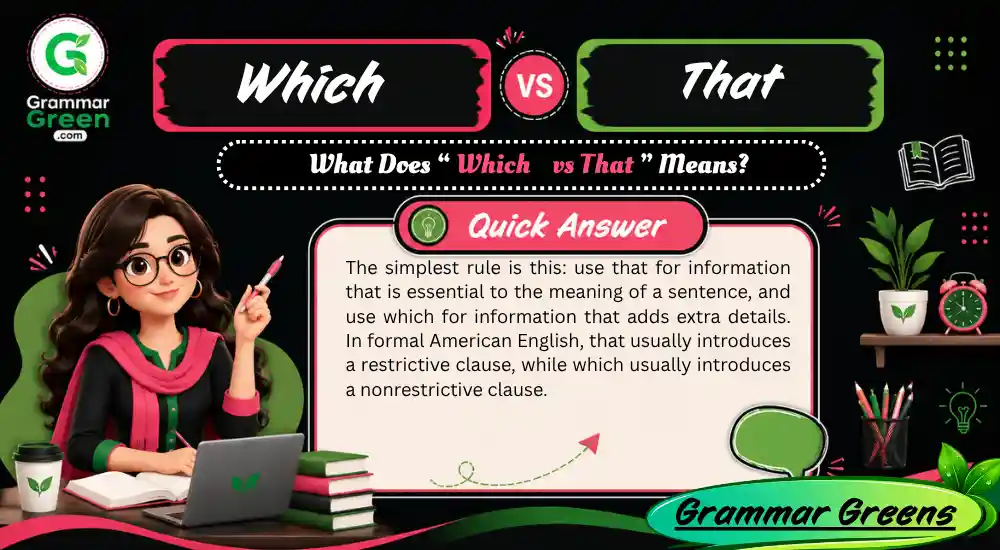
The simplest rule is this: use that for information that is essential to the meaning of a sentence, and use which for information that adds extra details. In formal American English, that usually introduces a restrictive clause, while which usually introduces a nonrestrictive clause.
For example, “The book that I bought is expensive” identifies which book you mean. “The book, which I bought yesterday, is expensive” adds extra information. 📝 Remember this basic pattern:
- That → essential information 🔑
- Which → extra information ➕
- That → usually no comma
- Which → usually uses commas
TL;DR
- 🔑 That usually introduces essential information.
- ➕ Which usually introduces extra information.
- ✍️ Restrictive clauses usually use that in formal American English.
- 📝 Nonrestrictive clauses usually use which.
- 🚫 Restrictive that clauses normally do not use commas.
- ✅ Nonrestrictive which clauses normally use commas.
- 🇺🇸 American English commonly follows this distinction.
- 🇬🇧 British English can use which more freely in restrictive clauses.
- 💡 Ask whether the information identifies the noun or simply adds detail.
You Might Also Like That: WSG Meaning
What Is the Difference Between Which and That?
The main difference between which and that comes down to the type of information each word introduces. That normally points to information that helps identify the noun. Without that information, the reader may not know exactly which person, place, thing, or idea you mean.
Which normally introduces information that the reader does not need to identify the noun. It simply adds more detail. This difference also explains why punctuation matters. In standard American English, a restrictive clause usually takes that, while a nonrestrictive clause usually takes which and commas.
| Word | Main Use | Comma? |
| That 🔑 | Essential information | Usually no |
| Which ➕ | Extra information | Usually yes |
When to Use That in a Sentence
Use that when the information after it is necessary to understand exactly which noun you mean. This type of clause is called a restrictive relative clause or defining clause. The clause restricts or narrows the meaning of the noun.
For example, “The shoes that are on sale are mine.” The words “that are on sale” tell us which shoes you mean. If you remove that information, the sentence changes or becomes less clear. In this use, that normally appears without a comma. This is one of the most useful grammar rules for choosing which or that.
That for Essential Information
When a detail is essential 🔑, use that to connect it to the noun. Consider this sentence: “The phone that has a cracked screen belongs to me.” The clause identifies the exact phone. If you simply say, “The phone belongs to me,” the reader may not know which phone you mean.
Another example is “Students that study regularly often improve their grades.” Here, the clause identifies the students being discussed. The key question is: Does this information identify the noun? If the answer is yes, that often works best in formal American English.
That in Restrictive Relative Clauses
A restrictive clause provides information that the sentence needs. It limits the noun to a particular person, place, object, or group. For example, “The website that offers free lessons is popular.” The clause “that offers free lessons” tells us which website we mean.
Notice that we do not put a comma before that in this structure. You can remember the rule with a simple trick: That = necessary detail 🔑. If removing the clause changes which noun you mean, you likely need a restrictive clause with that.
Examples of That in Everyday Sentences
You can find that in many everyday sentences. For example: “The movie that we watched last night was funny.” “I need the document that you sent yesterday.” “The restaurant that opened nearby serves Italian food.”
In each sentence, that connects the noun with information that helps identify it. These examples show how naturally the word works in everyday English. When deciding when to use that in a sentence, ask yourself whether the following information is important for identifying the noun. If it is, that is often the right choice. ✅
When to Use Which in a Sentence
Use which when you want to add information that is not necessary to identify the noun. This information gives the reader an extra detail, but the sentence remains clear without it. In formal American English, this use is called a nonrestrictive relative clause or non-defining clause.
For example, “My laptop, which I bought last year, still works perfectly.” The phrase “which I bought last year” gives additional information. We already know which laptop the speaker means. Because the information is extra, commas separate the clause. This is the basic rule for when to use which in a sentence.
Which for Extra Information
Use which when the information adds an interesting or useful detail but does not identify the noun. For example, “My car, which is very old, still runs well.” The phrase “which is very old” gives extra information about the car.
If you remove the clause, the main idea remains complete: “My car still runs well.” That makes the information nonessential. Think of which as a signal for an added detail ➕. When you see a nonessential clause in formal American English, commas usually surround it.
Which in Nonrestrictive Relative Clauses
A nonrestrictive clause adds information without changing which noun the sentence refers to. For example: “Sarah’s new laptop, which she bought online, arrived today.” We already know which laptop belongs to Sarah. The extra clause simply tells us where she bought it.
Notice the commas around the clause. These commas help readers see that the information is optional. A useful memory trick is: Which = extra information + commas ✨. This makes it easier to remember how to use which and that correctly in formal American writing.
Examples of Which in Everyday Sentences
Here are some simple examples of which in everyday English: “Our house, which is near the park, has a large garden.” “The meeting, which lasted two hours, finally ended.” “My phone, which I bought last month, needs an update.”
In each example, the sentence already identifies the noun. The which clause simply gives more information. This pattern appears often in formal writing, emails, articles, and school assignments. When you ask, “Which or that?” first decide whether the information is essential or simply additional.
Which vs That Examples With Meaning Changes
Sometimes choosing that or which can change the meaning of a sentence. Compare these examples:
- “The books that are on the table are mine.” 🔑
- “The books, which are on the table, are mine.” ➕
The first sentence means only the books on the table belong to me. Other books may not belong to me. The second sentence suggests that the books are already identified, and being on the table is extra information.
This shows why commas with which and that matter. Punctuation can change the meaning, not just the appearance, of your sentence.
Restrictive vs Nonrestrictive Clauses
Understanding restrictive and nonrestrictive clauses makes the difference between which vs that much easier. A restrictive clause identifies the noun and is essential to the sentence. A nonrestrictive clause simply adds information.
| Clause Type | Purpose | Common Word | Commas |
| Restrictive 🔑 | Identifies the noun | That | No |
| Nonrestrictive ➕ | Adds extra information | Which | Yes |
For example, “The cookies that contain chocolate are mine” identifies specific cookies. “The cookies, which contain chocolate, are mine” gives chocolate content as extra information. Once you understand this difference, many confusing grammar choices become much easier.
Comma Rules for Which and That
Commas play an important role in which vs that grammar. In standard American English, a restrictive clause with that normally does not need a comma. A nonrestrictive clause with which normally requires commas.
Compare: “The dress that I ordered arrived today.” No comma is needed because the clause identifies the dress. “The dress, which I ordered last week, arrived today.” The clause adds extra information.
⚠️ Avoid placing a comma before that when it introduces a restrictive clause. A simple rule is: That = no comma; which = comma when it introduces extra information.
Can You Use Which Instead of That?
In some situations, people use which instead of that, especially in British English and informal writing. However, formal American English usually follows a clearer distinction between restrictive that and nonrestrictive which.
For example, “The book that I bought is interesting” follows the traditional American rule. Using “which” in that sentence may appear in some varieties of English, but many American style guides prefer that for restrictive clauses. So, if you’re writing for an American audience, using that for essential information is usually the safer choice. 📚
Which vs That in American and British English
English usage can vary between regions. In American English, writers commonly use that for restrictive clauses and which for nonrestrictive clauses. This distinction appears frequently in formal American writing.
British English can be more flexible. British writers may use which in restrictive clauses where American style often prefers that. This does not mean one variety is always correct and the other is wrong. 🌍 The important point is to follow the style expected by your audience. If you’re writing formal American English, the that for essential information rule provides a clear and reliable choice.
Common Mistakes With Which and That
Many writers make a few common mistakes when choosing between these words. One mistake involves adding a comma before that in a restrictive clause. Another mistake involves using which for essential information in formal American writing.
Common errors include:
- ❌ “The car, that I bought, is red.”
- ✅ “The car that I bought is red.”
- ❌ “My car that is red is parked outside.” when the clause is only extra information
- ✅ “My car, which is red, is parked outside.”
💡 Always ask whether the clause identifies the noun or simply adds information.
Which vs That in Other Grammar Roles
The words which and that do not always work as relative pronouns. They can also have other grammar roles. For example, that can work as a demonstrative pronoun: “I want that.” It can also introduce a clause: “I know that she is busy.”
Which can work as a question word: “Which color do you prefer?” It can also introduce a relative clause: “The color, which looks bright, is popular.” So, don’t apply the restrictive/nonrestrictive rule to every use of these words. First, identify the grammar role.
Quick Practice Quiz
Test your understanding with these examples. Choose that or which:
- The laptop ___ I bought yesterday is fast.
- My laptop, ___ I bought yesterday, is fast.
- The shoes ___ are on sale look comfortable.
- My shoes, ___ are brand new, look comfortable.
Answers:
- that 🔑
- which ➕
- that 🔑
- which ➕
Remember the main question: Does the clause identify the noun, or does it simply add information? If it identifies the noun, use that in formal American English. If it adds extra information, use which with commas.
FAQs
What is the difference between which and that?
That usually introduces essential information, while which usually introduces extra information in formal American English. This difference often determines whether you need commas.
When should I use that instead of which?
Use that when the clause identifies or limits the noun. For example, “The book that I bought is new.”
When should I use which?
Use which when the clause adds extra information that the sentence can live without. Commas normally surround this clause.
Can which and that be interchangeable?
Sometimes, especially across different varieties of English. However, formal American English generally follows the that for restrictive clauses and which for nonrestrictive clauses pattern.
How can I remember the rule?
Think: That = necessary 🔑; Which = extra ➕. Then check whether the clause needs commas.
Final Thought
The difference between which vs that becomes much easier once you stop trying to memorize complicated grammar terms. Just ask one simple question: Is this information necessary to identify the noun? If yes, that usually works best in formal American English. If the information only adds an extra detail, choose which and use commas.
With regular practice, choosing which or that will start to feel natural. Keep the simple rule in mind: That = essential 🔑, which = extra ➕. Use that pattern as your starting point, and your writing will become clearer and more confident.