Have you ever wondered whether to write lose or loose? 🤔 These two words look similar, but they have different meanings and uses. Lose is a verb that can mean misplacing something, failing to win, or no longer having something. Loose usually describes something that is not tight or firmly fixed. Learning the difference between lose vs loose can help you avoid common spelling and grammar mistakes.
The confusion becomes even greater with losing or loosing. Both words exist, but they do not mean the same thing. In this guide, you will learn the difference between lose, loose, losing, and loosing, explore simple examples, and discover easy memory tricks that can help you choose the right word every time. ✍️
Quick Answer — Lose vs Loose
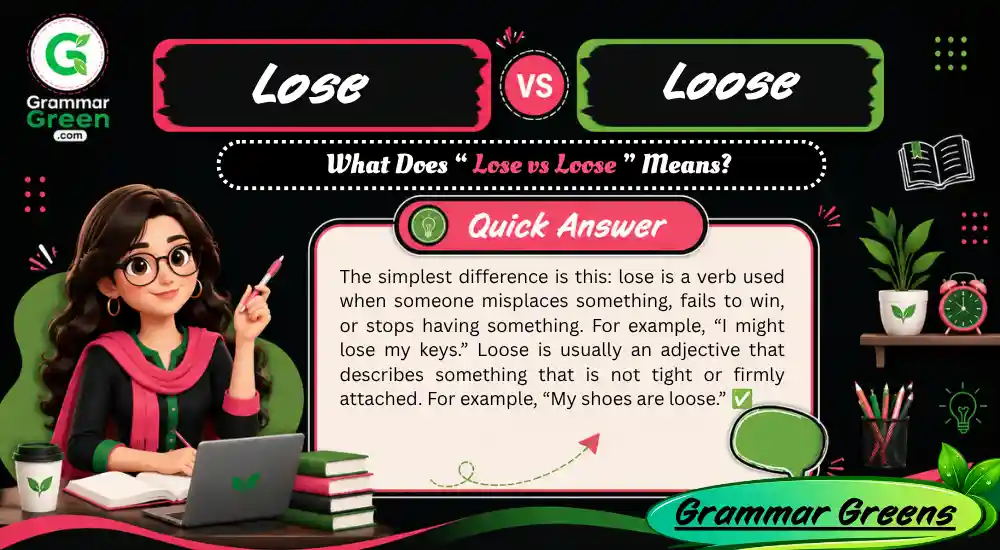
The simplest difference is this: lose is a verb used when someone misplaces something, fails to win, or stops having something. For example, “I might lose my keys.” Loose is usually an adjective that describes something that is not tight or firmly attached. For example, “My shoes are loose.” ✅
If you are asking about lose or loose, remember this basic rule: lose describes an action or situation, while loose describes something with extra space or freedom. The word losing comes from lose, while loosing comes from the less common verb loose.
TL;DR
- 🔤 Lose = misplace, fail to win, or no longer have something.
- 👕 Loose = not tight or firmly attached.
- ⚖️ Lose is mainly a verb.
- 📌 Loose is usually an adjective.
- ✍️ Losing = the -ing form of lose.
- 🏹 Loosing = releasing or setting something free.
- 🏃 Lose weight is correct.
- 🏆 Lose a game is correct.
- 👕 Loose clothes is correct.
- 🔑 Lose your keys is correct.
- 📚 The past tense of lose is lost.
- 🔓 Loosen means to make something less tight.
You Might Also Like That: Which vs That
What Is the Difference Between Lose and Loose?
The main lose loose difference comes from their meanings and grammar. Lose works mainly as a verb, while loose usually works as an adjective. You can lose a game, lose your phone, lose weight, or lose interest. You can describe a shirt, screw, tooth, or connection as loose. 📌
| Word | Part of Speech | Meaning | Example |
| Lose | Verb | Misplace or fail to keep/win | I may lose the game. |
| Loose | Adjective | Not tight or firmly fixed | My shirt is loose. |
Lose vs Loose Pronunciation
Lose and loose also have different final sounds. Lose ends with a /z/ sound, while loose ends with an /s/ sound. This pronunciation difference can help you remember them when speaking. Lose sounds like the word “choose” at the end, while loose sounds like “goose.” 🔊 Learning the sound along with the meaning makes the lose vs loose difference easier to remember.
What Does Lose Mean?
Lose is a verb with several common meanings. You can use it when you cannot find something, fail to win something, stop having something, or reduce something. For example, you might lose your keys, lose a game, lose your job, or lose weight. These examples show why lose describes an action or change. ✍️
The word lose appears in many everyday expressions, including lose interest, lose your temper, and lose track of time. Its past tense is lost, not “loosed.” When you need the -ing form, use losing, such as “She is losing weight.”
Lose Means to Misplace Something
Use lose when you cannot find something because you misplaced it. For example, “I do not want to lose my phone.” You can also say, “She always loses her keys.” 🔑 In these sentences, lose describes the action of no longer knowing where something is. This meaning makes phrases such as lose your keys, lose your wallet, and lose your phone common examples of correct usage.
Lose Means to Fail to Win
Use lose when someone fails to win a game, race, match, contest, or competition. For example, “Our team may lose the game,” or “He could lose the race.” 🏆 The word loose does not work in these sentences. If you mean that someone did not win, always choose lose. This simple rule can help you avoid one of the most common lose or loose mistakes.
Lose Means to Stop Having Something
Lose can also mean to stop having something or to no longer keep it. For example, “She could lose her job,” or “He does not want to lose his friendship.” You can also lose control, lose hope, or lose interest. In each case, something leaves your possession or changes. These common expressions make lose an important everyday English verb.
Lose Means to Get Rid of Something
You can also use lose when you want to reduce or get rid of something. The most common example is lose weight. For example, “She wants to lose weight before summer.” 🏃 Another example is, “He is trying to lose a few pounds.” Remember that lose weight is correct. Loose weight is incorrect when you mean reducing body weight.
What Does Loose Mean?
Loose usually works as an adjective and describes something that is not tight, firmly attached, or controlled. You can have loose clothes, a loose tooth, a loose screw, or a loose connection. 👕 The word often suggests extra space or movement.
The word loose can also work as a verb, although this use appears less often in everyday English. As a verb, it can mean to release or set something free. This less common meaning explains why the word loosing exists. Understanding both uses makes the loose vs lose difference much clearer.
Loose Means Not Tight
Use loose when something does not fit tightly. For example, “My shirt is too loose,” or “These shoes feel loose.” 👟 You can also describe loose clothing, loose pants, or a loose belt. Here, loose describes the amount of space around something. Do not use lose because lose does not mean “not tight.”
Loose Means Not Firmly Attached
Loose can also describe something that has become partly detached or is not firmly fixed. For example, “The screw is loose,” or “The door handle feels loose.” 🔧 You can also describe a loose tooth, loose connection, or loose wire. In each example, the object has more movement than it should. This meaning clearly separates loose from lose.
Loose Means Free or Unrestrained
The word loose can describe something that is free or not controlled. For example, “The dog got loose from its leash.” 🐕 You may also hear expressions such as let loose, which means to release someone or something or allow them to act freely. This meaning connects loose with freedom rather than losing or misplacing something.
Loose as a Verb
Although loose usually works as an adjective, it can also act as a verb meaning to release or set free. For example, “The archer is loosing an arrow.” 🏹 This use is much less common than the adjective form. However, it explains why loosing is a real English word. It should not be confused with the much more common losing.
Loosing or Losing — Which Is Correct?
The answer depends on what you want to say. Losing is the -ing form of lose, while loosing is the -ing form of the less common verb loose. If you mean misplacing something, failing to win, or reducing something, use losing. For example, “I am losing my keys” or “She is losing weight.” ✅
Loosing means releasing or setting something free. You might see it in a sentence such as “The archer is loosing an arrow.” Because this meaning is uncommon, many people mistakenly think loosing is simply an incorrect spelling of losing. The words have different meanings and should not replace each other.
Losing — The Correct Form of Lose
Losing is the present participle of lose. Use it when you talk about something happening now or around the present time. For example, “I am losing my patience,” “They are losing the match,” or “He is losing weight.” 📚 If your sentence means misplacing, failing to win, or no longer having something, losing is usually the correct word.
Loosing — Is It a Real Word?
Yes, loosing is a real word, but people use it much less often. It comes from the verb loose, which can mean to release or set free. For example, “The soldier was loosing the animals.” However, do not use loosing when you mean losing something. Loosing weight, loosing a game, and loosing your keys are incorrect when you mean those common meanings.
Losing vs Loosing Comparison Table
| Word | Meaning | Example |
| Losing | The -ing form of lose | She is losing weight. |
| Loosing | The -ing form of loose | He is loosing the arrow. |
The easiest rule is to connect losing with the verb lose and loosing with the less common verb loose. 💡
Lose or Loose in Common Sentences
Many mistakes become easier to understand when you see lose or loose in everyday sentences. Use lose for actions such as misplacing something, failing to win, or reducing something. Use loose when you describe something that is not tight, firmly attached, or controlled. 📖
| Common phrase | Correct word | Example |
| Weight | Lose | I want to lose weight. |
| Game | Lose | We could lose the game. |
| Keys | Lose | Do not lose your keys. |
| Clothes | Loose | These clothes are loose. |
| Screw | Loose | The screw is loose. |
Lose Weight or Loose Weight?
The correct phrase is lose weight. Use lose because the phrase describes reducing your body weight. For example, “She wants to lose weight by exercising regularly.” 🏃 Loose weight is incorrect when you mean weight loss. This mistake happens because loose has two “o”s and looks similar to lose. Remember: you lose weight, but your clothes can be loose after you lose weight.
Lose a Game or Loose a Game?
The correct phrase is lose a game. Use lose because the sentence describes failing to win. For example, “Our team may lose the game tonight.” 🏆 You should never use loose a game when you mean failure. On the other hand, loose can describe something that is not tight, such as “The net is loose.” Keeping the meaning in mind makes the choice simple.
Lose Your Keys or Loose Your Keys?
Use lose your keys when you cannot find them. For example, “I always worry that I will lose my keys.” 🔑 Use loose only when you describe something that is not tight or firmly fixed. You could say, “The key is loose in the lock.” The difference depends on the meaning: lose describes misplacing something, while loose describes freedom or movement.
Loose Clothes or Lose Clothes?
Use loose clothes when you mean clothes that do not fit tightly. For example, “She prefers loose clothing during hot weather.” 👕 Use lose only when you mean getting rid of or no longer having something. These two words can appear close together in meaning but serve different grammar roles. Loose describes the clothes; lose describes an action.
Lost vs Loosed — What Is the Difference?
Lost is the past tense and past participle of lose. For example, “I lost my phone yesterday.” 📱 You should use lost when you talk about something you misplaced or failed to keep. Loosed comes from the verb loose and can mean released or set free. For example, “The animal was loosed from its cage.” Because “loosed” is uncommon, many writers use it incorrectly or avoid it altogether.
Lose, Loose, and Loosen — Related Word Forms
Lose, loose, and loosen look similar, but they have different meanings. Lose means to misplace something or fail to win. Loose means not tight or firmly attached. Loosen means to make something less tight. 🔓 For example, “Do not lose your keys,” “Your shoelaces are loose,” and “Please loosen the knot.” Learning these three words together can prevent several common spelling mistakes.
| Word | Meaning | Example |
| Lose | Misplace or fail to win | Do not lose your wallet. |
| Loose | Not tight | The knot is loose. |
| Loosen | Make less tight | Loosen the knot. |
Common Mistakes to Avoid
Writers often confuse these words because their spelling looks similar. The best way to avoid mistakes is to check the meaning before choosing a word. 📝 If you describe an action such as misplacing something or failing to win, choose lose. If you describe something that has extra space or is not firmly fixed, choose loose.
- ❌ I am loosing weight. → ✅ I am losing weight.
- ❌ My shirt is lose. → ✅ My shirt is loose.
- ❌ We might loose the game. → ✅ We might lose the game.
- ❌ The screw is lose. → ✅ The screw is loose.
Easy Memory Tricks for Lose vs Loose
A few simple tricks can help you remember the lose vs loose difference. 💡 First, think about the number of “o”s. Loose has two “o”s, which can remind you of extra space. A loose shirt has extra space, while a person can lose something. You can also remember the sounds: lose has a /z/ sound, while loose has an /s/ sound.
Another useful trick is to connect lose with “choose.” Both have a similar ending sound. Connect loose with “goose.” 🪿 These small memory links can make spelling easier, especially when you write quickly or use these words in everyday messages.
FAQs
What is the difference between lose and loose?
Lose is a verb that means to misplace something, fail to win, or no longer have something. Loose usually describes something that is not tight or firmly attached. For example, you can lose your phone, but your shirt can be loose.
Is loosing a word?
Yes. Loosing is a real word. It comes from the verb loose and means releasing or setting something free. However, people use it much less often than losing.
Is losing or loosing correct?
Both can be correct, but they have different meanings. Use losing for the verb lose, such as “I am losing weight.” Use loosing when you mean releasing something.
Do you lose weight or loose weight?
The correct phrase is lose weight. “Loose weight” is incorrect when you mean reducing body weight.
Do you lose or loose a game?
You lose a game when you fail to win it. For example, “Our team may lose the game.”
What is the past tense of lose?
The past tense of lose is lost. For example, “She lost her keys yesterday.”
What is the difference between loose and loosen?
Loose describes something that is not tight. Loosen means to make something less tight. For example, “The knot is loose” and “Please loosen the knot.”
How do you remember lose vs loose?
Remember that loose has two “o”s and can describe extra space. Lose has one “o” and describes an action such as misplacing something or failing to win.
Final Thought
The difference between lose vs loose becomes simple when you focus on meaning. Use lose when someone misplaces something, fails to win, or stops having something. Use loose when something is not tight, firmly attached, or controlled. Remember losing for the common -ing form of lose, while loosing has the less common meaning of releasing something. 💡
When you are unsure, look at the sentence and ask what you mean. If you mean misplace or fail to win, choose lose. If you mean not tight or free, choose loose. This simple check can help you use these commonly confused words correctly and confidently.