Compliment vs. complement can be confusing because these words sound alike but have different meanings and spellings. A compliment is an expression of praise, admiration, or approval, while a complement is something that completes, matches, or enhances something else. Knowing this simple difference can help you choose the right word when writing or speaking.
If you are unsure whether to use compliment or complement, think about what you mean. If you are praising someone or saying something nice, use compliment. If you mean that something completes or goes well with another thing, use complement. The examples and usage rules below will make the difference easy to remember.
Quick Answer
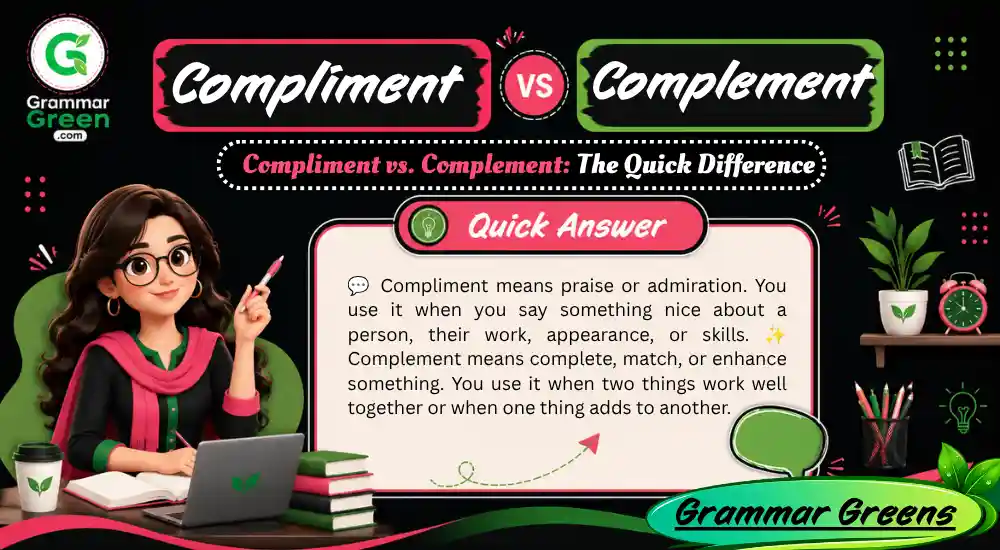
💬 Compliment means praise or admiration. You use it when you say something nice about a person, their work, appearance, or skills.
✨ Complement means complete, match, or enhance something. You use it when two things work well together or when one thing adds to another.
Example:
- 💬 “She gave me a compliment on my dress.”
- ✨ “Her shoes complement her dress.”
The easiest way to remember the difference is complIment = I like it and complEment = complete.
TL;DR
- 💬 Compliment = praise, admiration, or a kind remark.
- ✨ Complement = something that completes, matches, or enhances another thing.
- 🗣️ Compliment can work as a noun and a verb.
- 🧩 Complement can also work as a noun and a verb.
- 🎁 Complimentary can mean free or expressing praise.
- 🔗 Complementary means completing, matching, or enhancing.
- 🧠 Remember: I = compliment → “I like it.”
- 🧠 Remember: E = complement → “complete.”
- 👂 Both words sound alike, so context and spelling help you choose the right one.
You Might Also Like That: TS Meaning in Text
Compliment vs. Complement: The Quick Difference
Compliment and complement have different meanings, even though they sound the same. A compliment means praise or a kind remark about someone or something. A complement means something that completes, improves, or matches another thing. Both words can work as a noun or a verb, so context helps you choose the right one.
| Word | Meaning | Example |
| 💬 Compliment | Praise or admiration | She gave me a compliment. |
| ✨ Complement | Complete, match, or enhance | The shoes complement her dress. |
A simple trick can help: complIment relates to I like it, while complEment connects with complete. Keep this difference in mind whenever you are unsure which spelling to use.
What Does “Compliment” Mean?
A compliment is something you say to show praise, approval, admiration, or appreciation. You can compliment someone’s appearance, skills, work, personality, or behavior. For example, saying, “You did a great job,” is a compliment because you are praising someone’s work.
The word compliment can also describe a kind or flattering remark. You may give someone a compliment, pay someone a compliment, or compliment someone on something. The main idea stays the same: you are saying something positive about a person or their qualities.
You Might Also Like That: IYKYK Meaning
Compliment as a Noun
As a noun, compliment means a positive or kind remark. For example, “She gave me a nice compliment about my presentation.” Other common phrases include give a compliment, pay a compliment, and receive a compliment. In each case, the word refers to the praise itself.
Compliment as a Verb
As a verb, compliment means to praise someone or something. For example, “The manager complimented Sarah on her excellent work.” You can also say, “He complimented her on her new hairstyle.” Remember that the verb focuses on the action of giving praise.
What Does “Complement” Mean?
A complement is something that completes, matches, or enhances another thing. It can make something feel more balanced, useful, attractive, or complete. For example, “The blue curtains complement the gray walls.” The curtains do not praise the walls; they simply work well with them.
The word complement can also describe something that adds what is needed to make a whole. You may see it used with food, clothing, colors, skills, people, or ideas. When you mean complete or enhance, choose complement with an e.
Complement as a Noun
As a noun, complement means something that completes or improves another thing. For example, “The salad was a perfect complement to the main dish.” Here, the salad adds to the meal and makes it feel more complete.
Complement as a Verb
As a verb, complement means to match, improve, or enhance something. For example, “Her black shoes complement her formal dress.” The shoes work well with the dress, so complement is the correct word.
Compliment vs. Complement Examples
Seeing these words in real sentences makes the difference much easier to understand. A compliment usually involves praise, while a complement usually involves matching, completing, or enhancing something.
- 💬 “Your presentation was excellent.” → Compliment
- 💬 “She complimented me on my presentation.” → Compliment
- ✨ “The colors complement each other.” → Complement
- ✨ “This sauce complements the dish.” → Complement
- 💬 “He gave her a compliment.” → Compliment
- ✨ “The table is a perfect complement to the room.” → Complement
Everyday Examples
You can use compliment when talking about people, skills, appearance, or achievements. Use complement when describing things that work well together.
Compliment: “Everyone complimented David on his speech.”
Complement: “The new chairs complement the office design.”
Compliment: “She complimented my cooking.”
Complement: “The herbs complement the flavor of the soup.”
You Might Also Like That: Effect vs Affect
Compliment vs. Complement: Common Sentence Patterns
Learning common sentence patterns can make the choice much easier. With compliment, you will often see structures such as compliment someone, compliment someone on something, give someone a compliment, or pay someone a compliment. These patterns usually involve praise.
With complement, common structures include complement something, a complement to something, and complement each other. These patterns usually describe things that match, improve, or complete one another. Learning these simple patterns can help you use the correct word naturally instead of relying only on spelling.
How to Know Which Word to Use
When you need to choose between compliment vs. complement, ask yourself one simple question: Am I praising something, or am I describing something that works well with another thing?
- 💬 Praising someone? → Compliment
- ✨ Completing or enhancing something? → Complement
- 💬 “She complimented his new jacket.” → Praise
- ✨ “The jacket complements his shoes.” → Matches
This quick test works in most everyday situations. If the sentence expresses admiration or approval, choose compliment. If it shows completion, matching, or enhancement, choose complement.
How to Remember Compliment vs. Complement
A simple memory trick can help you remember the spelling. Think of the I in complIment as “I like it.” A compliment expresses something positive about a person or thing. For example, “I like your new haircut” is a compliment.
For complement, remember the E in complEment and connect it with complete. Something that complements another thing helps complete or enhance it. This trick works because the key spelling difference matches the basic meaning of each word.
💡 ComplIment → I like it → Praise
✨ ComplEment → Complete → Enhance or match
Complimentary vs. Complementary
Complimentary and complementary create another common spelling problem. Complimentary can mean expressing praise, but it can also mean something provided free of charge. For example, “The hotel offers complimentary breakfast.”
Complementary relates to things that complete, match, or enhance each other. For example, “The two colors are complementary.” A simple way to remember them is to connect complimentary with compliment and complementary with complement.
Examples of Complimentary and Complementary
- 💬 Complimentary: “She made a complimentary comment about his work.”
- 🎁 Complimentary: “Guests receive complimentary drinks.”
- ✨ Complementary: “The colors are complementary.”
- ✨ Complementary: “Their skills are complementary.”
The meaning depends on the spelling and the context.
You Might Also Like That: What Does WYF Mean
Common Phrases With Compliment and Complement
Several useful expressions contain these words. Knowing them can help you understand their meaning in everyday English.
Common Phrases With “Compliment”
- 💬 Give someone a compliment
- 💬 Pay someone a compliment
- 💬 Receive a compliment
- 💬 Fishing for compliments
- 💬 Backhanded compliment
- 💬 Compliments of the house
Common Phrases With “Complement”
- ✨ A perfect complement
- ✨ Complement each other
- ✨ A complement to something
- ✨ A full complement of
For example, “The dessert was a perfect complement to the meal.” In contrast, “She received a lovely compliment on her dress.”
Common Mistakes to Avoid
The most common mistake happens when writers use compliment when they mean complement, or vice versa. Because the two words sound alike, spelling alone can cause confusion.
Watch for these common errors:
- ❌ “The shoes compliment the dress.”
- ✅ “The shoes complement the dress.”
- ❌ “She gave me a complement.”
- ✅ “She gave me a compliment.”
Also remember the difference between complimentary and complementary. Checking the meaning before choosing the spelling can prevent most mistakes.
Can “Compliment” and “Complement” Ever Mean the Same Thing?
In modern everyday English, compliment and complement have different meanings. A compliment expresses praise, while a complement adds to, completes, or enhances something. You should not normally use one in place of the other.
You Might Also Like That: What Does SMH Mean in Text
Their similar spelling and pronunciation can make them easy to confuse, but context gives you the answer. If you are talking about admiration, use compliment. If you are talking about completion or compatibility, use complement. Keeping these two ideas separate will help you avoid common word-choice mistakes.
Frequently Asked Questions
Is it compliment or complement?
It depends on the meaning. Use compliment when you mean praise or admiration. Use complement when you mean complete, match, or enhance something.
What is the difference between compliment and complement?
A compliment is a positive remark or expression of praise. A complement is something that completes, matches, or improves another thing.
How do you remember the difference?
Remember complIment → I like it for praise. Remember complEment → complete for something that completes or enhances another thing.
Are compliment and complement homophones?
Yes. Compliment and complement are commonly treated as homophones because they have the same pronunciation in standard English but different spellings and meanings.
Is compliment a noun or a verb?
It can be both. As a noun, it means praise: “She gave me a compliment.” As a verb, it means to praise: “She complimented me.”
Is complement a noun or a verb?
It can also be both. As a noun, it means something that completes or enhances another thing. As a verb, it means to match, complete, or enhance it.
What is the difference between complimentary and complementary?
Complimentary means praising or provided free of charge. Complementary means completing, matching, or enhancing something else.
Final Takeaway
The difference between compliment and complement becomes simple when you focus on meaning. 💬 Compliment means praise, admiration, or a kind remark. ✨ Complement means complete, match, or enhance something.
If you want an easy memory trick, remember “I” in compliment for “I like it,” and “E” in complement for “complete.” When you understand this basic distinction and practice the words in real sentences, you can confidently choose the correct spelling in everyday writing and communication.