

Elicit vs. illicit can be confusing because the two words look and sound very similar, but they have completely different meanings. Elicit is a verb that means to draw out or obtain a response, reaction, answer, or information. Illicit is an adjective that describes something illegal, forbidden, prohibited, or not permitted.
Knowing the difference between elicit and illicit helps you choose the right word in everyday writing and conversation. In this guide, you’ll learn their meanings, grammatical roles, correct usage, examples, pronunciation, common mistakes, and a simple way to remember which word to use.
Quick Answer
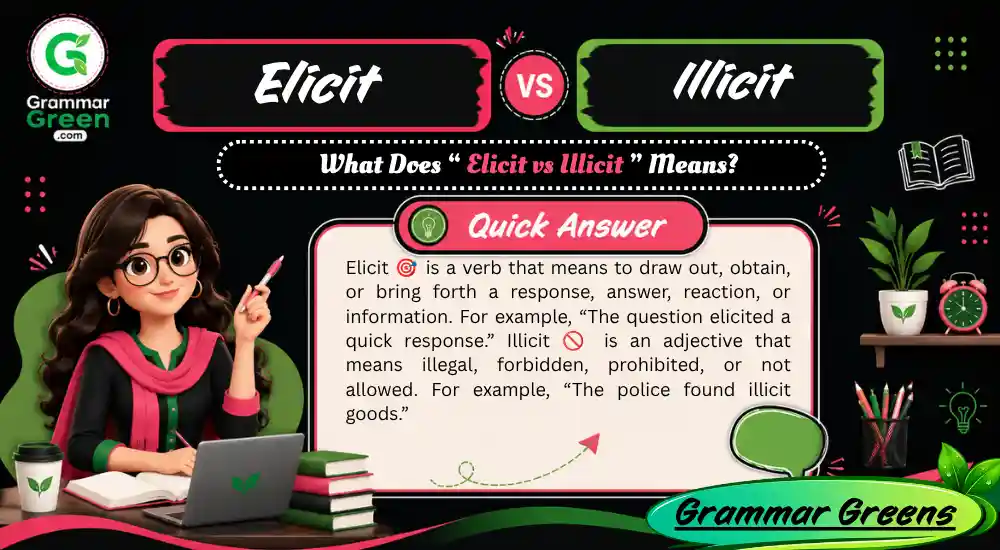
Elicit 🎯 is a verb that means to draw out, obtain, or bring forth a response, answer, reaction, or information. For example, “The question elicited a quick response.” Illicit 🚫 is an adjective that means illegal, forbidden, prohibited, or not allowed. For example, “The police found illicit goods.”
The easiest way to remember the difference is: Elicit = draw out 🎯, while Illicit = forbidden 🚫. Although these words sound very similar, their meanings, spellings, and grammatical roles are different.
TL;DR
- Elicit 🎯 = to draw out a response, reaction, answer, or information.
- Illicit 🚫 = forbidden, illegal, or not permitted.
- Elicit is a verb.
- Illicit is an adjective.
- Elicit a response = get or bring out a response.
- Illicit activities = activities that are forbidden or unlawful.
- Ellicit ❌ is a common misspelling of elicit.
- Ilicit ❌ is a common misspelling of illicit.
- Easy memory trick: Elicit → Evoke 🎯; Illicit → Illegal 🚫.
You Might Also Like That: What Does WYF Mean
Elicit vs Illicit: What’s the Difference?
Elicit and illicit sound very similar, but you cannot use them interchangeably. Elicit is a verb that means to draw out or obtain something, such as a response, reaction, answer, or information. Illicit is an adjective that describes something illegal, forbidden, prohibited, or not permitted.
| Word | Part of Speech | Meaning | Example |
| Elicit 🎯 | Verb | Draw out or obtain | The question elicited a quick answer. |
| Illicit 🚫 | Adjective | Forbidden or illegal | Police found illicit goods. |
A simple rule can help: Elicit = get something out, while illicit = not allowed. Once you connect each word with its meaning and grammar, the difference becomes much easier to remember.
What Does Elicit Mean?
Elicit is a verb that means to draw out, obtain, or bring forth a response, reaction, answer, or information. Someone usually elicits something from another person through a question, action, conversation, or situation. For example, a teacher may elicit an answer from a student, or a funny story may elicit laughter from an audience. Common synonyms include draw out, extract, prompt, evoke, and provoke.
The word often appears with nouns such as response, reaction, information, emotion, answer, and confession. Remember that elicit describes an action, so it normally functions as a verb in a sentence.
Examples of Elicit
- The teacher elicited an answer from the class.
- Her story elicited laughter.
- The interviewer’s question elicited useful information.
- The speech elicited a strong reaction.
- The police officer tried to elicit a confession.
What Does Illicit Mean?
Illicit is an adjective that describes something that people do not legally, officially, or socially permit. It can mean illegal, forbidden, prohibited, unauthorized, or socially unacceptable, depending on the context. For example, illicit activities can refer to actions that break the law, while an illicit relationship can describe a relationship that people consider forbidden or improper.
Unlike elicit, illicit does not describe an action of obtaining something. Instead, it describes a person, thing, activity, or behavior. Common phrases include illicit drugs, illicit goods, illicit trade, illicit activities, and illicit behavior.
Examples of Illicit
- Police discovered illicit goods in the warehouse.
- The company was involved in illicit activities.
- The report described an illicit trade.
- Officials investigated the sale of illicit substances.
- The group was accused of using illicit funds.
Elicit vs Illicit Examples
Seeing the two words side by side makes the difference much clearer. Elicit describes an action where someone draws out or obtains something. Illicit, on the other hand, describes something forbidden or not permitted. This basic difference explains why you cannot replace one word with the other.
| Correct Word | Example | Why? |
| Elicit 🎯 | The question elicited a response. | It means “drew out.” |
| Illicit 🚫 | They discovered illicit goods. | It means “forbidden.” |
| Elicit 🎯 | Her joke elicited laughter. | It produced a reaction. |
| Illicit 🚫 | Police stopped an illicit operation. | The operation was not permitted. |
Quick Usage Examples
- Elicit: The teacher tried to elicit an answer.
- Illicit: The police stopped an illicit operation.
- Elicit: His question elicited useful information.
- Illicit: They investigated illicit trade.
How to Choose Between Elicit and Illicit
Choosing the correct word becomes easy when you focus on meaning and part of speech. First, ask whether you mean “draw out,” “obtain,” or “bring out.” If yes, choose elicit. If you mean “illegal,” “forbidden,” “prohibited,” or “not permitted,” choose illicit.
You Might Also Like That: What Does SMH Mean in Text
You can also use a simple grammar test. Elicit usually describes an action, so it works as a verb. Illicit describes a noun, so it works as an adjective. This quick test can prevent many common word-choice mistakes.
Use This Simple Rule 🎯
Elicit = draw something out
Illicit = forbidden or illegal
The question elicited a response.
The police found illicit goods.
If you can replace the word with “draw out,” use elicit. If you can replace it with “forbidden” or “not allowed,” use illicit.
Are Elicit and Illicit Homophones?
Elicit and illicit are commonly confused because they have very similar sounds and pronunciation. They also look almost identical when written. Their meanings and spellings, however, are different. Grammarly presents them as homophones with the same pronunciation, while other explanations note that speakers may produce a small difference in the opening sound.
The safest way to tell them apart is to focus on context rather than sound. When you hear one in conversation, ask what the speaker means. When you write one, remember the meaning: elicit relates to drawing something out, while illicit relates to something forbidden.
Common Mistakes With Elicit and Illicit
Writers often confuse these words because of their similar spelling and sound. One common mistake involves using illicit when the sentence needs a verb. Another mistake involves using elicit when the writer means something illegal or forbidden.
❌ The teacher tried to illicit a response.
✅ The teacher tried to elicit a response.
❌ They were involved in elicit activities.
✅ They were involved in illicit activities.
Remember that elicit is a verb and illicit is an adjective. Keeping that difference in mind will help you avoid the most common errors.
You Might Also Like That: OMP Meaning
Elicit vs Illicit Spelling: Ellicit or Ilicit?
The correct spellings are elicit and illicit. Writers sometimes add or remove an l because the two words look and sound so similar. Ellicit is a common misspelling of elicit, while ilicit is a common misspelling of illicit.
Use this simple spelling reminder:
- ✅ Elicit — one l
- ❌ Ellicit — incorrect
- ✅ Illicit — double l
- ❌ Ilicit — incorrect
The spelling difference may seem small, but it changes the word completely. Always check the meaning before choosing the spelling.
How to Remember Elicit vs Illicit
A simple memory trick can make these commonly confused words much easier to remember. Connect Elicit with Evoke. Both words relate to bringing out a response, feeling, or reaction. Then connect Illicit with Illegal. Both begin with I, which can remind you that illicit describes something forbidden or not allowed. QuillBot also recommends similar connections when explaining these words.
Easy Memory Trick 💡
Elicit → Evoke → bring out a response 🎯
Illicit → Illegal → not allowed 🚫
So, if you want to get a reaction, think elicit. If you describe something forbidden, think illicit.
You Might Also Like That: EYP Meaning in Text
Frequently Asked Questions About Elicit vs Illicit
What is the difference between elicit and illicit?
Elicit is a verb meaning to draw out or obtain a response, reaction, answer, or information. Illicit is an adjective meaning illegal, forbidden, prohibited, or not permitted.
Is elicit a verb or adjective?
Elicit is a verb. You can elicit a response, reaction, answer, or piece of information.
Is illicit a verb or adjective?
Illicit is an adjective. It describes something that people consider illegal, forbidden, unauthorized, or socially improper.
Are elicit and illicit homophones?
They are commonly pronounced alike or very similarly, which makes them easy to confuse. Their meanings and spellings remain different.
Is illicit the same as illegal?
Not always. Illicit can mean illegal, but it can also describe something forbidden or socially unacceptable without necessarily referring to a specific law.
What does elicit mean?
Elicit means to draw out, obtain, or bring forth a response, reaction, answer, or information.
What does illicit mean?
Illicit means illegal, forbidden, prohibited, or not permitted, depending on the context.
What is a synonym for elicit?
Common synonyms include draw out, extract, prompt, evoke, and provoke.
Final Thoughts
Understanding elicit vs illicit becomes simple when you focus on what each word means. Use elicit 🎯 when someone draws out or brings forth a response, reaction, answer, or information. Use illicit 🚫 when describing something forbidden, illegal, prohibited, or not allowed.
When you are unsure, remember this quick rule: Elicit = bring something out and Illicit = something not allowed. This small memory trick can help you choose the correct word in writing and everyday English. With regular practice, these two commonly confused words will become much easier to use correctly.