
Effect vs. affect can be confusing because these two words sound similar and often appear in similar sentences. The main difference is simple: affect is usually a verb that means to influence or change something, while effect is usually a noun that means a result or consequence. For example, “The weather affected our plans” describes an influence, while “The weather had an effect on our plans” describes the result.
Once you understand this basic rule, choosing between affect or effect becomes much easier. However, English has a few exceptions, including effect as a verb and affect as a noun. This guide explains the difference between affect and effect, along with affected vs. effected, clear examples, common mistakes, and simple ways to remember which word to use.
Quick Answer
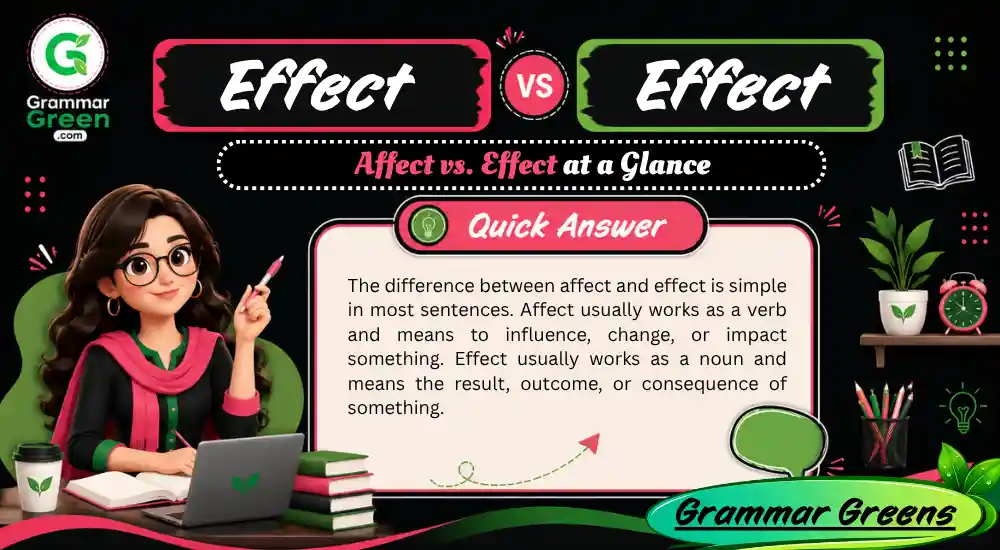
The difference between affect and effect is simple in most sentences. Affect usually works as a verb and means to influence, change, or impact something. Effect usually works as a noun and means the result, outcome, or consequence of something.
For example, “Lack of sleep can affect your mood” means sleep influences your mood. “Lack of sleep can have an effect on your mood” means it produces a result. 🔑 When choosing affect or effect, ask yourself: Is it an influence or a result?
TL;DR
- 🔵 Affect = usually a verb meaning influence or change.
- 🟢 Effect = usually a noun meaning result or outcome.
- ✍️ Affected = influenced or changed.
- ⚡ Effected = brought about or caused.
- 🔄 Affecting = influencing or changing.
- 🎯 Effecting = bringing about or causing.
- 🧠 Easy memory trick: Affect = Action; Effect = End result.
- ⚠️ Effect can also be a verb meaning “bring about.”
- 🧠 Affect can also be a noun in psychology.
You Might Also Like That: IYKYK Meaning
Affect vs. Effect at a Glance
The easiest way to understand affect vs. effect is to look at their usual roles in a sentence. Affect usually works as a verb and means to influence, change, or impact something. Effect usually works as a noun and means the result or outcome of something. This simple rule will help you solve most affect or effect questions in everyday writing.
| Word | Usual Role | Basic Meaning | Example |
| 🔵 Affect | Verb | Influence or change | Stress can affect sleep. |
| 🟢 Effect | Noun | Result or outcome | Stress can have an effect on sleep. |
Remember that this is a rule of thumb, not an absolute rule. English also uses effect as a verb and affect as a noun in special situations. Understanding these exceptions will help you avoid mistakes when you write.
What Does Affect Mean?
Affect usually works as a verb. It means to influence, change, or have an impact on someone or something. When something affects another thing, it causes a change in it. For example, “Lack of sleep can affect your mood” means that poor sleep can change or influence your mood. Common synonyms include influence, change, alter, modify, and impact.
You can often test affect by replacing it with a similar action word. If influence, change, or alter fits the sentence, affect may be the correct choice. For example: “The new rule affected employees” means “The new rule influenced employees.” This substitution test makes affect meaning easier to understand.
What Does Effect Mean?
Effect usually works as a noun. It means the result, outcome, or consequence produced by an action or event. For example, “The medicine had a positive effect” means the medicine produced a positive result. Common synonyms for effect include result, outcome, consequence, aftermath, and repercussion.
You will also see effect in common phrases such as “take effect”, meaning to begin producing a result, and “in effect”, meaning currently operating or true. If you can replace effect with result or outcome, you probably need the noun effect. This simple test works well for many effect vs. affect questions.
Affect vs. Effect Examples in Sentences
Seeing the words in real sentences can make the difference between affect and effect much clearer. In most cases, affect describes an action or influence, while effect describes the result of that action.
You Might Also Like That: What Does SMH Mean in Text
Here are some easy examples:
- 🧠 Stress can affect your concentration.
- 📚 The new lesson plan affected student performance.
- 🌧️ Heavy rain affected traffic.
- 💼 The decision had a major effect on the company.
- 😴 Lack of sleep can have a negative effect on health.
- 🌱 Regular exercise has many positive effects.
When both words appear together, the pattern becomes especially clear: “The storm affected the town and had a serious effect on local businesses.”
How to Choose Between Affect and Effect
When you are unsure about affect or effect, first ask what the word is doing in the sentence. If it describes influence or change, choose affect in most situations. If it names the result or consequence, choose effect.
Ask: Is It an Action or Influence?
If the word describes something changing or influencing another thing, use affect. For example, “Noise can affect your ability to focus.” You can replace affect with “influence,” and the meaning stays almost the same.
Ask: Is It a Result?
If the word names the result or outcome, use effect. For example, “The noise had a negative effect on my concentration.” Here, “result” can replace effect without changing the basic meaning.
Try a Replacement Word
💡 Try “influence” or “change” for affect. Try “result” or “outcome” for effect. If the replacement sounds natural, you have a strong clue about which word you need. This quick method works especially well when the basic verb-noun rule feels confusing.
Affected vs. Effected: What’s the Difference?
Affected vs. effected creates another common grammar problem. Affected is usually the past tense of affect, meaning something was influenced or changed. For example, “The storm affected several roads” means the storm caused changes to the roads.
You Might Also Like That: What Does WYF Mean
Effected is the past tense of the verb effect, which means brought about, caused, or made something happen. For example, “The new manager effected several important changes.” This use is less common in everyday writing. 🔑 A simple rule is: affected = influenced, while effected = brought about.
| Word | Meaning | Example |
| 🔵 Affected | Influenced or changed | The storm affected travel. |
| 🟢 Effected | Brought about or caused | The policy effected major changes. |
Affects vs. Effects
The difference between affects vs. effects follows the same basic pattern. Affects is usually the third-person singular form of the verb affect. For example, “Exercise affects your energy level.” It means exercise influences your energy level.
Effects is usually the plural form of the noun effect. For example, “Exercise has many positive effects.” However, effects can also work as a verb when someone means “brings about” or “causes.” Context matters, so look at the word’s role in the sentence before choosing it.
- 🔵 Affects = influences
- 🟢 Effects = results
- ⚡ Effects can also mean brings about
Affecting vs. Effecting
The words affecting vs. effecting can look almost identical, but they have different meanings. Affecting is the present participle of affect and means influencing or changing something. For example, “The heat is affecting the crops.” It can also describe something emotionally moving, such as an affecting story.
Effecting comes from the verb effect and means bringing about or making something happen. For example, “The organization is effecting major changes.” This form appears less often in everyday English. 🔑 In simple terms, affecting = influencing, while effecting = bringing about.
When Effect Is a Verb
Although effect usually works as a noun, it can also work as a verb. As a verb, effect means to bring about, cause, or accomplish something. You may see it in formal phrases such as “effect change” or “effect reforms.” For example, “The new policy effected major changes in the company.”
Do not confuse effect change with affect change. “Affect change” means to influence change, while “effect change” means to bring the change about. The verb form of effect sounds more formal, so writers often use it in business, academic, or professional settings.
You Might Also Like That: What Does SMH Mean in Text
When Affect Is a Noun
Although affect usually works as a verb, it can also function as a noun, especially in psychology and medical writing. In this use, affect describes a person’s observable emotional expression. For example, a professional might describe someone as having a “flat affect,” meaning the person shows little visible emotion.
This noun use can confuse readers because the pronunciation also differs from the common verb. You usually do not need this meaning in everyday writing. 🔎 If you are writing a normal sentence about influence or change, affect is most likely a verb. The noun form mainly appears in specialized contexts.
Affect Can Also Mean “Pretend” or “Put on an Appearance”
Affect has another less common meaning: to pretend, assume, or put on an appearance. For example, “He affected a serious expression” means he deliberately adopted a serious expression. You may also see phrases such as “affected accent,” where someone intentionally uses a particular accent or manner.
This meaning differs from the usual meaning of affect, which is “influence.” Context usually makes the difference clear. 💡 If someone affects something, they may be deliberately putting on a style, attitude, or appearance rather than influencing something else.
Why “Affect Is a Verb and Effect Is a Noun” Isn’t Always True
The popular rule “affect is a verb, effect is a noun” provides a useful starting point, but it does not cover every situation. Effect can work as a verb meaning “bring about,” while affect can work as a noun in psychology. Affect can also mean “pretend” or “assume an appearance.”
For everyday writing, however, the basic rule remains extremely useful. 🔑 Think of affect = influence or change and effect = result or outcome first. Then check for an exception if the sentence does not make sense. This approach keeps word choice simple without ignoring important grammar rules.
Affect vs. Effect in Different Contexts
You can find affect and effect in almost every type of writing. In everyday English, writers commonly use affect for influence and effect for results. For example, “Weather can affect travel” and “Weather can have an effect on travel.”
You Might Also Like That: What Does WYF Mean
The same pattern appears in academic, business, scientific, and journalistic writing. In psychology, however, affect may appear as a specialized noun. In professional writing, you may also see effect used as a formal verb.
- 🏠 Everyday: The noise affected my sleep.
- 🎓 Academic: The study examined the effects of stress.
- 💼 Business: The decision affected sales.
- 🧪 Scientific: Temperature affects chemical reactions.
- 🧠 Psychology: The patient showed limited affect.
Common Affect and Effect Mistakes
Many mistakes happen because affect and effect sound similar and share related meanings. Writers often use effect when they need the verb affect, or they use affect when they need the noun effect. Another common error involves affected vs. effected, especially when writers want to describe a change.
Use these examples as a quick correction guide:
- ❌ The weather effected our plans.
- ✅ The weather affected our plans.
- ❌ The decision had a positive affect.
- ✅ The decision had a positive effect.
- ❌ The company affected major changes.
- ✅ The company effected major changes.
📌 Always check whether you mean influence or result before choosing the word.
How to Remember Affect vs. Effect
A simple memory trick can help you remember affect vs. effect without checking a dictionary every time. Think of Affect = Action. Both words start with “A,” which can remind you that affect usually describes an action or influence.
For effect, think of End result. Effect usually tells you what happened after an action or event. For example, “Exercise affects your body” describes the influence, while “Exercise has positive effects” describes the results. 🧠 A = Action; E = End result. This mnemonic will help with most everyday examples.
Affect vs. Effect Pronunciation
Pronunciation can add to the confusion because affect and effect sound very similar. In normal everyday use, both words begin with a short vowel sound, but their stress and pronunciation can differ depending on the meaning. The specialized noun affect in psychology also has a different pronunciation from the common verb.
Because of these differences, pronunciation alone does not always help you choose the correct word. 🔊 Focus on the meaning and grammatical role instead. Ask whether you mean influence or change or a result or outcome. That approach remains more reliable when deciding between affect and effect.
Quick Practice: Affect or Effect?
Test your understanding with these sentences. Choose affect, effect, affected, or effected before checking the answers.
- Lack of sleep can ___ your mood.
- The new rule had a major ___ on workers.
- The storm ___ several roads.
- The medicine produced a positive ___.
- The manager ___ important changes.
- Noise can ___ your concentration.
- The policy had unexpected ___.
- The heat is ___ the plants.
Answers:
- affect
- effect
- affected
- effect
- effected
- affect
- effects
- affecting
💡 If you remember affect = influence and effect = result, most of these answers become easy.
Affect vs. Effect: The Simple Rule to Remember
The easiest way to remember the difference between affect and effect is this: affect usually means influence or change, while effect usually means result or outcome. If you can replace the word with influence, try affect. If you can replace it with result, try effect.
You Might Also Like That: TS Meaning in Text
🔑 Keep this final rule in mind: Affect = influence. Effect = result. Remember that English has a few exceptions, such as effect as a verb and affect as a noun. Once you understand the main rule and these exceptions, choosing affect or effect becomes much easier in everyday, academic, and professional writing.
FAQs
What is the difference between affect and effect?
Affect usually means to influence or change something and works as a verb. Effect usually means the result or outcome and works as a noun. For example, “Stress can affect sleep,” while “Stress can have an effect on sleep.”
Is affect a verb or noun?
Affect is usually a verb, but it can also work as a noun in psychology. As a verb, it means to influence or change. As a noun, it refers to observable emotional expression.
Is effect a verb or noun?
Effect is usually a noun meaning result or consequence. It can also work as a verb meaning to bring about or accomplish something.
Should I use affect or effect?
Use affect when you mean influence or change. Use effect when you mean result or outcome. Then check for special meanings if the sentence does not fit the basic rule.
What is the difference between affected and effected?
Affected means influenced or changed. Effected means brought about or caused something to happen. “The storm affected travel,” while “The new policy effected major changes.”
What is the easiest way to remember affect and effect?
🧠 Remember Affect = Action and Effect = End result. This simple memory trick works for most everyday sentences.
What is the difference between affecting and effecting?
Affecting means influencing or changing something. Effecting means bringing about or causing something. The second form is less common and usually appears in formal writing.
What is the difference between affects and effects?
Affects usually means influences and works as a verb. Effects usually means results and works as a plural noun. However, effects can also be a verb meaning brings about.
Final Thought
Learning affect vs. effect does not need to feel complicated. Start with the basic rule: affect usually describes an action or influence, while effect usually describes a result. This rule will help you choose the correct word in most everyday sentences.
When you see an unusual example, do not panic. Simply look at the meaning and grammatical role of the word. Ask whether you mean influence or result. With a little practice, choosing between affect or effect, affected vs. effected, and related forms will become much more natural.





I was pretty pleased to uncover this great site. I wanted to thank you for
your time for this fantastic read!! I definitely savored every bit of it and I have you book-marked to look at new stuff on your web site.
Heya are using WordPress for your blog platform? I’m new to the blog world but I’m trying to get started and
create my own. Do you require any html coding expertise to make your own blog?
Any help would be really appreciated!