
MYF is a short texting abbreviation 📱 that can have different meanings depending on the conversation. In many messages, MYF means “Miss Your Face” 💕, especially when someone talks about missing a friend, partner, or loved one. However, people may also use MYF to mean “My Fault” 🙏 or “My Friend” 🧑🤝🧑. That makes the context important when you see this slang in a text, chat, or social media message.
If you searched for MYF meaning in text, you probably want a quick and clear answer. The meaning can change based on the words around MYF, the relationship between the people, and the tone of the message. This guide explains the common MYF meanings, examples, usage, tone, and how to respond when someone sends you MYF.
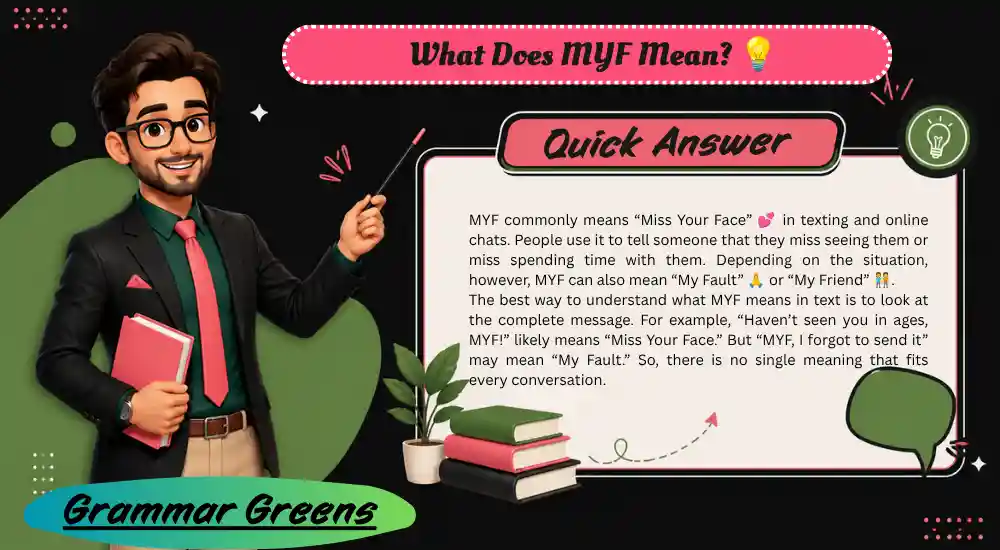
Quick Answer: What Does MYF Mean in Text?
MYF commonly means “Miss Your Face” 💕 in texting and online chats. People use it to tell someone that they miss seeing them or miss spending time with them. Depending on the situation, however, MYF can also mean “My Fault” 🙏 or “My Friend” 🧑🤝🧑.
The best way to understand what MYF means in text is to look at the complete message. For example, “Haven’t seen you in ages, MYF!” likely means “Miss Your Face.” But “MYF, I forgot to send it” may mean “My Fault.” So, there is no single meaning that fits every conversation.
TL;DR: MYF Meaning at a Glance
- 💕 MYF = Miss Your Face — often shows that someone misses another person.
- 🙏 MYF = My Fault — can admit a mistake or accept blame.
- 🧑🤝🧑 MYF = My Friend — may refer to someone in a casual conversation.
- 💬 MYF is informal — people mainly use it in texts, chats, DMs, and social media.
- 🔎 Context matters — surrounding words can reveal the intended meaning.
- 😊 Tone matters too — emojis and punctuation can make the message feel friendly, affectionate, or serious.
You Might Also Like That: FOMO Meaning
What Does MYF Stand For?
MYF can stand for several phrases in casual online communication. The most common meanings discussed in texting contexts include “Miss Your Face,” “My Fault,” and “My Friend.” Because MYF does not have one fixed meaning in every conversation, you should not assume the first definition you find is always correct.
In informal communication, people often shorten phrases to save time or make messages feel more casual. This explains why you may see MYF in text messages, group chats, DMs, or social media comments. The words before and after the abbreviation usually provide the clue you need.
MYF = Miss Your Face
“Miss Your Face” 💕 is one of the most common meanings associated with MYF in texting. Someone may use it when they miss seeing you, spending time with you, or having you around. The phrase can sound friendly, affectionate, or even slightly flirty, depending on who sends it.
For example, a friend might text, “It has been so long, MYF!” Here, MYF expresses that the person misses the other person’s presence. You may also see this meaning in messages between close friends, couples, or family members.
MYF = My Fault
“My Fault” 🙏 is another possible meaning of MYF. People can use it when they admit that they made a mistake or caused a problem. In this context, MYF works like a short version of saying “It was my fault” or “I made the mistake.”
For example, someone might write, “MYF, I forgot to send the file.” The context makes the meaning clear because the sender is accepting responsibility. This use is usually casual and apologetic, so you are more likely to see it in personal texts than formal communication.
MYF = My Friend
“My Friend” 🧑🤝🧑 can also appear as a possible MYF meaning in casual conversations. Someone may use the abbreviation when talking about or addressing a friend. However, this meaning depends heavily on the sentence because MYF has several other common interpretations.
For example, a person might write, “MYF Jake is coming with us,” intending to use MYF as “My Friend.” If the surrounding words clearly discuss a person or friendship, this interpretation becomes more likely. When you are unsure, always read the full message before deciding what MYF means.
How to Tell Which MYF Meaning Someone Means
The easiest way to understand what MYF means is to examine the context 🔎. Look at the words surrounding the abbreviation and ask what the sender is talking about. If the message discusses missing someone, “Miss Your Face” may fit. If the sender admits a mistake, “My Fault” makes more sense.
You should also consider your relationship with the sender. A close friend or partner may use MYF in an affectionate way, while someone discussing a mistake may use it as an apology. Tone, emojis, punctuation, and the full conversation can all help you identify the intended meaning.
MYF Meaning Based on Context and Tone
The tone 🎭 of an MYF message can change its meaning. A message such as “MYF ❤️” may sound warm or affectionate, while “MYF, I forgot!” may sound apologetic. The same three letters can therefore create very different impressions.
Pay attention to the situation before interpreting the abbreviation. A sender who normally uses casual slang may use MYF differently from someone who rarely uses texting abbreviations. If the meaning remains unclear, the safest option is to ask the person directly. This avoids misunderstanding the MYF meaning in a conversation.
MYF Texting Examples
| Text Example | Likely Meaning | Tone |
| “Haven’t seen you in forever, MYF ❤️” | Miss Your Face | 💕 Affectionate |
| “MYF, I forgot to call you.” | My Fault | 🙏 Apologetic |
| “MYF Jake is joining us.” | My Friend | 🧑🤝🧑 Casual |
| “MYF, I really miss hanging out.” | Miss Your Face | 😊 Friendly |
| “Oops, MYF!” | My Fault | 😅 Casual |
These MYF examples show why context matters. The surrounding words usually provide the strongest clue.
Is MYF a Romantic or Flirty Text?
MYF can sound romantic or flirty 💕, but it does not automatically have a romantic meaning. When MYF means “Miss Your Face,” someone may use it to show affection toward a partner, crush, or close friend. The relationship between the sender and receiver helps determine the tone.
For example, “MYF ❤️” from a partner may sound romantic, while the same phrase from a close friend may simply sound warm and friendly. Therefore, do not assume romantic interest based only on the abbreviation. Consider the full message and relationship first.
What Does MYF Mean From a Guy or Girl?
If a guy or girl sends you MYF, the meaning still depends on the context rather than the sender’s gender. If the conversation involves missing each other, MYF may mean “Miss Your Face.” If the person just made a mistake, it may mean “My Fault.”
You should also look at the rest of the conversation and any emojis ❤️😊. A heart or affectionate message may suggest a warmer tone, while an apology points toward “My Fault.” The abbreviation alone cannot reliably tell you what the sender feels.
Where Is MYF Used?
People mainly use MYF in casual communication 📱 rather than formal writing. You may encounter it in text messages, DMs, online chats, and social media conversations. Some people may also use it on platforms such as Snapchat, Instagram, TikTok, WhatsApp, Discord, or Facebook Messenger.
The exact usage can vary between people and online communities. Because MYF is an informal abbreviation, you should not expect everyone to use it in exactly the same way. If you see MYF in a message, read the surrounding conversation before choosing its meaning.
Does MYF Mean the Same Thing on Every Platform?
Not necessarily. MYF meaning can vary across platforms and communities 🌐 because users develop their own slang habits. Someone may use MYF as “Miss Your Face” in a personal text, while another person may use it differently in a group chat.
The platform itself usually does not determine the meaning. Instead, the conversation, community, and context matter more. Whether you see MYF on Snapchat, Instagram, TikTok, WhatsApp, or Discord, examine the complete message before deciding what the abbreviation means.
How to Respond When Someone Texts “MYF”
Your response should match the meaning and tone 💬 of the original message. If MYF means “Miss Your Face,” you could respond warmly with something like, “Miss you too! ❤️” If it means “My Fault,” you can simply say, “No worries!” If the sender means “My Friend,” continue the conversation naturally.
If you cannot tell which meaning the sender intended, ask a simple question such as, “What do you mean by MYF?” Asking directly is better than making an incorrect assumption, especially when the message could have more than one meaning.
Is MYF Formal or Informal?
MYF is informal slang 📱, so people generally use it in casual texts, chats, and social media conversations. It does not usually belong in formal emails, business letters, academic writing, or professional documents.
When writing professionally, use the complete phrase instead. For example, write “My fault” instead of MYF if you need to accept responsibility. Clear language works better in formal settings because not every reader will understand online abbreviations. Save MYF for situations where the other person understands casual texting slang.
Can You Use MYF at Work or in Professional Messages?
It is usually better to avoid MYF at work 💼 unless you know the person well and your workplace encourages casual messaging. Informal abbreviations can create confusion, especially when MYF has multiple possible meanings.
For professional communication, write the complete phrase you intend. Instead of using MYF, say “My fault,” “My friend,” or the full phrase you actually mean. This keeps your message clear and avoids unnecessary confusion. In a workplace, school, customer-service setting, or formal email, clear wording is usually the safer choice.
MYF vs Similar Texting Abbreviations
MYF belongs to the larger group of texting abbreviations 💬 that shorten common phrases. However, its multiple meanings make it different from clearer abbreviations such as LOL, IDK, or BRB.
If you mean “Miss Your Face,” you could simply write “I miss you” when you want maximum clarity. If you mean “My Fault,” phrases such as “my bad” may sound more natural in some conversations. Choosing the full phrase can prevent confusion when the reader may not know which MYF meaning you intended.
Common Mistakes When Interpreting MYF
One common mistake is assuming that MYF always means “Miss Your Face.” While that interpretation appears frequently in texting contexts, other meanings exist. Another mistake involves ignoring the rest of the conversation and trying to define the abbreviation on its own.
You should also avoid assuming that MYF has a romantic 💕 meaning simply because someone uses it. The sender may use it casually or as an apology. Always check the context, tone, relationship, emojis, and surrounding words before deciding what MYF means.
FAQs About MYF Meaning
What is the most common MYF meaning in text?
“Miss Your Face” 💕 is a common interpretation of MYF in texting. However, “My Fault” and “My Friend” can also appear depending on the context.
What does MYF mean in texting slang?
MYF is an informal texting abbreviation that can represent different phrases. The intended meaning depends on the message and situation.
Does MYF mean “My Fault”?
Yes. In some conversations, MYF means “My Fault” 🙏, especially when someone admits a mistake or takes responsibility.
Can MYF mean “My Friend”?
Yes. Some people use MYF to mean “My Friend” 🧑🤝🧑, although the context must support that interpretation.
Is MYF rude?
MYF is not automatically rude. Its tone depends on what the sender means and how they use it. A message can sound affectionate, friendly, apologetic, or blunt depending on the context.
How do I respond to MYF?
First, identify what the sender means. If MYF means “Miss Your Face,” you can respond warmly. If it means “My Fault,” you can accept the apology. If you are unsure, simply ask what they mean.
Final Thoughts
MYF meaning in text depends on more than the three letters themselves. The abbreviation can commonly mean “Miss Your Face” 💕, while some conversations use it for “My Fault” 🙏 or “My Friend” 🧑🤝🧑. That is why the surrounding words, tone, relationship, and situation matter when you interpret MYF.
If you see MYF in a text, chat, or social media message, do not automatically choose one definition. Read the complete message first and look for clues. When the meaning remains unclear, asking the sender is the easiest way to avoid a misunderstanding.