If you have seen “IMO” in a text, chat, comment, or social media post, it usually means “in my opinion.” People use it to show that what follows is their personal view, preference, judgment, or recommendation rather than a statement of objective fact. Merriam-Webster and Dictionary.com both list “in my opinion” as the primary digital-communication meaning of IMO.
Example:
“IMO, the first option is better.”
That simply means:
“In my opinion, the first option is better.”
Quick Answer
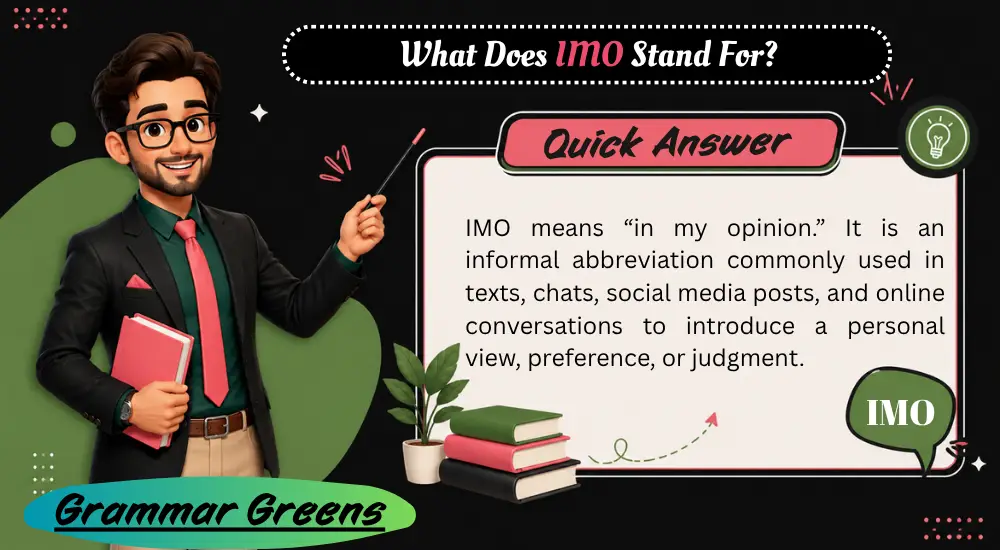
IMO means “in my opinion.” It is an informal abbreviation commonly used in texts, chats, social media posts, and online conversations to introduce a personal view, preference, or judgment.
Example:
“IMO, this is the best option.”
This means:
“In my opinion, this is the best option.”
TL;DR
- IMO = In My Opinion
- 💬 Common in texting, chats, and social media
- 🧠 Used to introduce a personal opinion or viewpoint
- ✍️ Can appear at the beginning or end of a sentence
- 📱 “imo” and “IMO” generally mean the same thing
- 🎯 Usually informal rather than formal
- 🔄 IMHO is similar, while TBH means “to be honest”
- ⚓ In some contexts, IMO can also mean International Maritime Organization
You Might Also Like That: Gyatt Meaning
What Does IMO Stand For?
IMO stands for “in my opinion.” It is a common abbreviation used in informal digital communication, especially texting, chats, comments, and online discussions. Dictionary.com also lists the related form IMHO, meaning “in my (honest/humble) opinion.”
The important part is not just the full form. IMO tells the reader that the writer is sharing a personal viewpoint. For example, saying “IMO, this movie is better” makes it clear that the statement is a personal judgment.
📌 Quick answer:
- IMO: In My Opinion
- Meaning: A personal view or judgment
- Common use: Texts, chats, comments, and social media
- Style: Informal and conversational
What Does IMO Mean in Texting?
In texting, IMO means “in my opinion.” Someone may use it before giving a preference, recommendation, evaluation, or disagreement. QuillBot likewise describes IMO as a texting and internet-slang abbreviation used to introduce a personal opinion.
For example:
“IMO, we should leave early.”
The person is not necessarily saying they are unsure. They are simply making it clear that leaving early is their recommendation or personal view.
You may see IMO in one-to-one texts, group chats, direct messages, social media comments, and other casual online conversations.
How Do You Use IMO?
You can use IMO when you want to introduce or frame something as your own opinion. It can work with preferences, recommendations, judgments, and disagreements.
IMO at the Beginning of a Sentence
This is a common and clear placement:
“IMO, this is the best choice.”
The abbreviation signals that the statement that follows is the writer’s personal opinion.
IMO at the End of a Sentence
IMO can also appear at the end:
“This is the best choice, IMO.”
The meaning is essentially the same. The difference is mainly in sentence style and emphasis.
📌 Common uses of IMO:
- Sharing a preference
- Giving a recommendation
- Expressing a personal judgment
- Offering a different viewpoint
- Framing a statement as subjective
You Might Also Like That: Delulu Meaning
IMO Examples in Real Conversations
Seeing IMO in a conversation can make its meaning easier to understand.
💡 Example 1 — Preference
Person A: Which movie should we watch?
Person B: IMO, the second one is better.
Here, IMO introduces a personal preference.
💡 Example 2 — Recommendation
Person A: Should we leave now?
Person B: IMO, yes. Traffic may get worse later.
Here, IMO introduces a recommendation.
💡 Example 3 — Disagreement
Person A: I think the new design looks better.
Person B: IMO, the old design was cleaner.
Here, IMO helps frame the second person’s response as their own viewpoint. It does not automatically make the disagreement rude.
Is IMO Formal or Informal?
IMO is generally informal. It fits naturally in texts, group chats, social media comments, and casual online conversations. QuillBot also recommends using more formal alternatives in workplace situations rather than relying on texting abbreviations.
For academic assignments, formal reports, official documents, or other situations where a more formal tone is expected, it is usually clearer to write “in my opinion,” “in my view,” or “from my perspective.”
That does not mean IMO can never appear in a professional message. Communication norms vary by workplace and context. The key point is that the abbreviation has a distinctly casual feel.
Is IMO Rude or Passive-Aggressive?
No. IMO is not inherently rude or passive-aggressive.
The abbreviation simply tells the reader that the statement represents a personal opinion. In some situations, this can make a disagreement feel less absolute because the writer is presenting it as their own view.
However, IMO cannot make harsh wording automatically polite.
Compare:
“IMO, we could try another approach.”
with:
“IMO, that is a terrible idea.”
The first may sound neutral and constructive. The second can still sound harsh because of the wording around IMO.
💡 The tone of IMO depends on the whole message, not the abbreviation alone.
IMO vs. IMHO vs. TBH
These abbreviations can appear in similar online conversations, but they do not serve exactly the same purpose.
| Abbreviation | Meaning | Main purpose | Typical feel |
| IMO | In My Opinion | Share a personal opinion | Casual and direct |
| IMHO | In My Humble Opinion | Share a personal opinion | Often more modest |
| TBH | To Be Honest | Signal candor or frankness | Direct or candid |
| IIRC | If I Recall Correctly | Qualify remembered information | Less certain |
| IME | In My Experience | Share personal experience | Experience-based |
IMO and IMHO are the closest matches. Both introduce a personal opinion. The extra “H” in IMHO can give the phrase a more modest tone, although the exact impression depends on context.
TBH is different because it emphasizes honesty or candidness, rather than simply marking something as an opinion.
Does IMO Have Other Meanings?
Yes. Although “in my opinion” is the meaning most relevant to texting and online conversations, IMO can mean different things in other contexts.
For example, Merriam-Webster lists International Maritime Organization as another meaning of IMO. Dictionary.com also distinguishes Imo, the name of a state in southeastern Nigeria, as a separate entry.
Context usually makes the intended meaning clear.
📌 In a text:
“IMO, that restaurant is better.”
Here, IMO means “in my opinion.”
📌 In a maritime discussion:
“The IMO issued new guidance.”
Here, IMO may refer to the International Maritime Organization.
You Might Also Like That: Elicit vs Illicit
IMO Capitalization: Is “imo” the Same as “IMO”?
Usually, yes. “IMO” and “imo” generally have the same meaning when used as texting or internet shorthand.
You may see:
“IMO, this one is better.”
or:
“imo, this one is better.”
The difference is mainly stylistic. QuillBot recommends capitalization for texting abbreviations, while real-world casual messages may use either uppercase or lowercase forms.
So if someone writes “imo” in a message, you normally do not need to interpret it as a different abbreviation.
Common Questions About IMO
What does IMO mean in a text?
IMO usually means “in my opinion.” It tells you that the writer is expressing a personal view, preference, judgment, or recommendation.
What does IMO mean in chat?
In chat, IMO generally means “in my opinion.” It is used to introduce or frame a personal viewpoint.
What does IMO stand for?
IMO stands for “in my opinion.” It is commonly used as an informal abbreviation in digital communication.
Is IMO slang?
IMO is commonly used as informal internet or texting shorthand. It is especially common in casual digital communication such as texts, chats, and social media comments.
Is IMO formal?
Generally, no. IMO has an informal, conversational feel. In formal or academic writing, spelling out “in my opinion” is usually a better choice.
Is IMO rude?
Not by itself. IMO is simply a way to mark a statement as a personal opinion. The surrounding words and context determine whether the complete message sounds friendly, neutral, sarcastic, or rude.
Can IMO be used at the end of a sentence?
Yes. For example:
“That was the better option, IMO.”
The meaning is the same as using IMO at the beginning.
Is “imo” the same as “IMO”?
Yes. Lowercase “imo” normally has the same meaning as uppercase “IMO.” The capitalization is usually a matter of style.
What is the difference between IMO and IMHO?
Both introduce a personal opinion. IMO means “in my opinion,” while IMHO means “in my humble opinion.” IMHO can sometimes sound more modest, but the exact tone depends on the context.
What does IMO mean besides “in my opinion”?
In other contexts, IMO can mean International Maritime Organization. The surrounding topic usually tells you which meaning is intended.
Final Takeaway
IMO means “in my opinion.” When you see it in a text, chat, comment, or social media post, it usually signals that the writer is sharing a personal viewpoint rather than stating an objective fact.
It is most natural in casual online communication. You can place it at the beginning or end of a sentence, and “imo” normally means the same thing as “IMO.” If you need a more formal tone, simply write “in my opinion” instead.
The key is to read IMO in context: the abbreviation identifies a statement as personal, but the wording around it determines the message’s actual tone.