If you’ve seen “lowkey” in a chat, text, or social media post, you may wonder what it actually means. Lowkey is a popular slang term that usually means somewhat, subtly, quietly, or without making a big deal about something. For example, “I lowkey like this song” can mean that you like the song but want to express that feeling casually or without too much emphasis.
The lowkey meaning in chat can change slightly depending on the context. Sometimes it means “kind of” or “a little,” while other times it suggests that someone wants to keep a feeling or opinion understated. In this guide, you’ll learn the lowkey meaning, slang usage, texting examples, common interpretations, and the difference between lowkey, secretly, and highkey.
Quick Answer
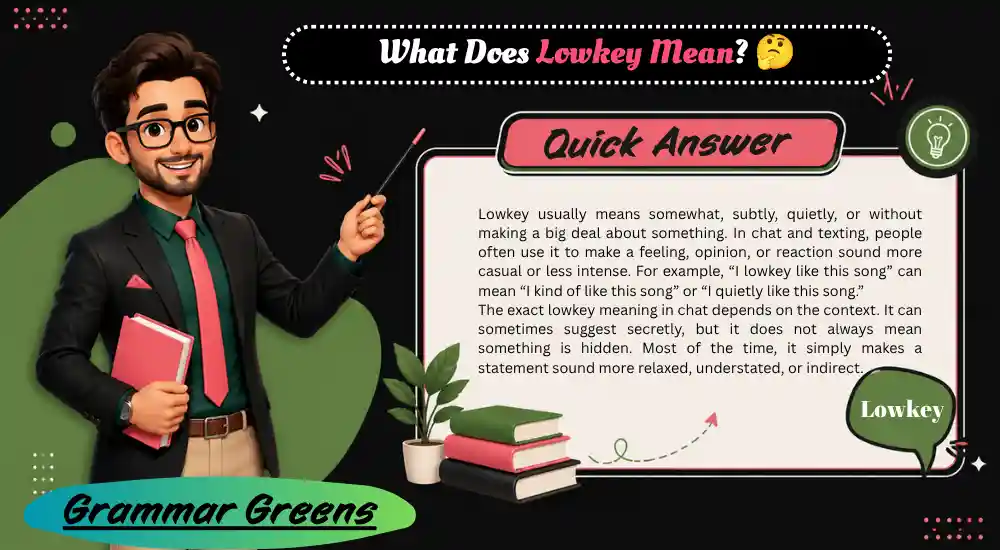
Lowkey usually means somewhat, subtly, quietly, or without making a big deal about something. In chat and texting, people often use it to make a feeling, opinion, or reaction sound more casual or less intense. For example, “I lowkey like this song” can mean “I kind of like this song” or “I quietly like this song.”
The exact lowkey meaning in chat depends on the context. It can sometimes suggest secretly, but it does not always mean something is hidden. Most of the time, it simply makes a statement sound more relaxed, understated, or indirect.
TL;DR: Lowkey Meaning
- 💬 Lowkey usually means somewhat, subtly, or quietly.
- 📱 In chat and texting, it makes statements sound more casual.
- ❤️ “I lowkey like you” can mean I kind of like you or I quietly like you.
- 🤫 Lowkey does not always mean secretly.
- 🎯 It can describe positive, negative, or neutral feelings.
- 🔤 You may see it written as lowkey, low-key, or low key.
- 📢 Highkey is often used as the opposite in modern slang.
- ✍️ Lowkey is best for casual conversations, texts, comments, and social media.
- 📝 For formal writing, use clearer words such as somewhat, slightly, subtly, or quietly.
You Might Also Like That: Delulu Meaning
What Does Lowkey Mean?
Lowkey usually describes something that happens or feels quiet, subtle, somewhat, or without much attention. In modern slang, people often use it to make a statement sound more casual or less strong. For example, “I lowkey love this movie” can mean “I really like this movie, but I’m saying it in a relaxed way.”
The meaning can change with the sentence. In some cases, lowkey means “kind of” or “slightly.” In others, it can suggest that someone does not want to openly show a feeling. So, you should always look at the context before choosing one exact meaning.
What Does Lowkey Mean in Chat and Texting?
In chat and texting, people use lowkey to soften what they say. It can make a strong thought, feeling, or opinion sound more relaxed. For example, “I lowkey want to go” may mean “I kind of want to go,” while “I lowkey miss you” can show a feeling without making it sound too serious.
You may see lowkey in chat, DMs, comments, and group messages. It works well in casual conversations because it gives a sentence a natural, informal tone. However, the exact meaning depends on the words around it and the person’s intention.
What Does Lowkey Mean in Slang?
As a slang expression, lowkey often means somewhat, quietly, subtly, or without making something too obvious. People commonly use it before verbs, adjectives, and feelings. For example, “I lowkey agree” means “I actually agree, but I’m saying it casually.”
Modern lowkey slang does not have just one fixed definition. Someone may use it to reduce the strength of a statement or to make a private feeling sound less direct. This flexible use explains why you may see different definitions such as “kind of,” “a little,” “secretly,” or “subtly.”
Does Lowkey Mean Secretly?
Lowkey does not always mean secretly. Sometimes it can suggest that a person wants to keep a feeling quiet or does not want to make it obvious. For example, “I lowkey like her” may suggest a hidden crush, especially when the speaker does not openly talk about it.
However, secretly focuses on hiding something, while lowkey often focuses on understating or softening something. “I secretly like her” clearly says that the feeling stays hidden. “I lowkey like her” sounds more casual and can leave room for interpretation.
How Does Lowkey Change the Tone of a Sentence?
The word lowkey often changes the tone rather than completely changing the basic meaning. It can make a sentence sound less dramatic, more casual, or slightly indirect. Compare “This movie is amazing” with “This movie is lowkey amazing.” The second sentence sounds more relaxed and understated.
People also use lowkey when they feel unsure about how strongly they want to express something. It can make an opinion feel softer without removing the main idea. This makes lowkey useful in casual conversations, where people often want to share feelings without sounding too serious or intense.
What Does Lowkey Mean Before a Verb?
When lowkey comes before a verb, it usually changes the way the speaker presents the action, feeling, or opinion. For example, “I lowkey want to leave” can mean “I kind of want to leave,” while “I lowkey think you’re right” means the speaker agrees but expresses that thought casually.
You Might Also Like That: Rizz Meaning
You may notice this pattern often in texting and online slang. Examples include:
- 💬 “I lowkey wanna go.”
- 💬 “I lowkey like this.”
- 💬 “You lowkey sound like him.”
- 💬 “I lowkey think you’re right.”
The meaning depends on the full sentence and context.
Lowkey Meaning in Different Contexts
The lowkey meaning can shift based on the situation. People use it when talking about feelings, opinions, plans, reactions, and everyday activities. Understanding the context helps you choose the right interpretation.
| Context | Example | Possible meaning |
| ❤️ Feeling | “I lowkey miss you.” | I quietly or somewhat miss you. |
| 👍 Opinion | “I lowkey agree.” | I actually agree, but casually. |
| 🍕 Desire | “I lowkey want pizza.” | I kind of want pizza. |
| 😂 Reaction | “That’s lowkey funny.” | That is actually somewhat funny. |
| 🎉 Plans | “Let’s keep it lowkey.” | Keep it simple or relaxed. |
Lowkey Examples in Chat and Texting
Seeing lowkey in real sentences makes the meaning much easier to understand. The word often works as a casual modifier that softens a feeling or opinion.
Here are some common examples:
- ❤️ “I lowkey like this.” — I kind of or really like this.
- 😴 “I’m lowkey tired.” — I’m somewhat tired.
- 😂 “That was lowkey funny.” — That was actually pretty funny.
- 🍕 “I lowkey want pizza.” — I kind of want pizza.
- 💭 “I lowkey miss you.” — I miss you, but I’m saying it softly.
- 👍 “I lowkey agree.” — I agree, but I’m keeping the tone casual.
What Does “I Lowkey Like You” Mean?
“I lowkey like you” usually means the person has some level of romantic or personal interest but does not want to express it too strongly. The phrase can sound playful, shy, or slightly indirect. It may also suggest that the person has not openly admitted the feeling before.
You Might Also Like That: OMP Meaning
The exact meaning depends on the conversation. ❤️ If someone says it while flirting, it may mean “I secretly or quietly like you.” If they say it jokingly, they may simply mean “I kind of like you.” The phrase leaves some uncertainty, which can make it feel more casual and less intense.
Is Lowkey Positive, Negative, or Neutral?
Lowkey can work with positive, negative, or neutral statements. The word itself does not create the emotion. Instead, the word that follows it usually gives the sentence its positive or negative feeling.
For example:
- 😍 “That’s lowkey amazing.” → Positive
- 😒 “That’s lowkey annoying.” → Negative
- 😴 “I’m lowkey tired.” → Neutral or slightly negative
- ❤️ “I lowkey love this.” → Positive
- 😬 “I lowkey hate this.” → Negative
So, lowkey meaning depends on the statement around it, not on whether the word itself sounds positive or negative.
Lowkey vs. Secretly vs. Kind of
These words can sometimes appear similar, but they do not always mean the same thing. Lowkey often adds a casual or understated tone, while secretly clearly suggests that someone hides something. Kind of mainly shows that something is true to some degree.
| Word | Main idea | Example |
| 🔹 Lowkey | Casual, subtle, understated | “I lowkey like it.” |
| 🔹 Secretly | Kept hidden | “I secretly like it.” |
| 🔹 Kind of | Somewhat | “I kind of like it.” |
Choosing the right word depends on what the speaker wants to communicate.
Lowkey vs. Highkey
Lowkey and highkey often work as informal opposites. Lowkey makes a statement feel subtle, casual, or understated, while highkey makes it sound open, strong, or obvious.
For example:
- 🤫 “I lowkey love this song.” → I like it, but I’m saying it casually.
- 📢 “I highkey love this song.” → I strongly and openly love it.
People mainly use both terms in casual speech, texting, chats, and social media. Neither word fits every formal situation, but both appear often in modern online communication.
You Might Also Like That:
Lowkey vs. Low-Key vs. Low Key: What’s the Difference?
You may see the expression written as lowkey, low-key, or low key. The form can depend on how the word works in a sentence and the style of the source. Dictionaries recognize different forms and uses, so seeing more than one spelling is normal.
In modern slang, lowkey often appears as one word, especially online. The traditional adjective commonly appears as low-key, as in “a low-key party.” The important point is to understand the meaning and context, rather than assuming that one spelling always carries a different meaning.
Is Lowkey a Word or Slang?
Lowkey is both connected to standard dictionary English and widely used as slang. The traditional expression low-key works as an adjective to describe something quiet, restrained, or not attention-grabbing. Modern speakers also use lowkey as an informal adverb in casual communication.
This difference explains why dictionary entries may show several meanings. You can use lowkey slang naturally in texts, chats, comments, and casual conversations. However, formal English usually calls for clearer alternatives. Knowing the audience and setting helps you decide whether the informal form fits.
Is Lowkey Appropriate in Formal Writing?
In most formal writing, it is better to avoid slang such as lowkey unless you are discussing the word itself. Academic assignments, professional reports, business documents, and formal emails usually need clearer and more direct language.
Instead, you can use words such as somewhat, slightly, subtly, quietly, moderately, or privately, depending on the meaning. For example, instead of “I lowkey disagree,” a formal sentence could say, “I somewhat disagree.” This keeps the meaning clear and makes the writing sound more professional.
How to Use Lowkey Correctly in a Sentence
You can usually place lowkey before a verb, adjective, or phrase that expresses a feeling, opinion, or reaction. The word should support the sentence rather than make it confusing.
Examples include:
- 💬 “I lowkey want to leave.”
- 😍 “I lowkey love this.”
- 😂 “That was lowkey funny.”
- 💭 “I lowkey think you’re right.”
- 😴 “I’m lowkey tired.”
Use lowkey mainly in casual English, especially when speaking with friends or writing online. Avoid forcing it into every sentence because natural usage depends on context.
What Is the Opposite of Lowkey?
The opposite of lowkey depends on which meaning you have in mind. In modern slang, highkey often works as the closest opposite because it suggests that someone expresses a feeling or opinion openly and strongly.
You Might Also Like That: Discreet vs Discrete
Other possible opposites include openly, obviously, openly stated, strongly, or overtly. For example, “I lowkey like it” sounds understated, while “I highkey love it” sounds much more direct. Remember that no single opposite works in every situation because lowkey can describe degree, tone, privacy, or attention.
Where Did the Word Lowkey Come From?
The expression low-key has been part of English for much longer than its modern internet slang use. Traditional uses describe something quiet, restrained, simple, or not designed to attract attention. Over time, speakers began using the expression in a more flexible adverbial way.
Today, lowkey appears frequently in texting, social media, online conversations, and casual speech. Modern users can place it before verbs and adjectives to make statements sound less intense or more understated. This newer use connects naturally with the older idea of keeping something quiet or low in intensity.
Frequently Asked Questions About Lowkey
What does lowkey mean in chat?
In chat, lowkey usually means somewhat, subtly, quietly, or without making a big deal about something. The exact meaning depends on the sentence.
Does lowkey mean secretly?
Not always. Lowkey can suggest a hidden feeling, but it more often makes a statement sound casual or understated.
What does “I lowkey like you” mean?
It can mean “I kind of like you” or “I quietly/secretly like you.” The surrounding conversation determines the intended meaning.
Is lowkey slang?
Yes. Lowkey has a common informal slang use, especially in texting, chats, and social media.
What is the opposite of lowkey?
In modern slang, highkey often acts as the opposite. Depending on the context, openly or strongly can also work.
Is lowkey one word?
In modern informal use, lowkey often appears as one word. You may also see low-key or low key, depending on the grammatical use and writing style.
Final Thought
The easiest way to understand lowkey is to think of it as a word that can make a statement feel less intense, more casual, or more understated. Its meaning can shift between “kind of,” “somewhat,” “quietly,” and, in some situations, “secretly.” That is why the surrounding sentence matters.
If you see lowkey in a text, chat, or social media post, focus on what the person is saying around it. Whether they say “I lowkey love it,” “I lowkey want to go,” or “I lowkey miss you,” the word usually adds a soft, casual tone rather than completely changing the main meaning.