The word “ate” can have more than one meaning, depending on the context. In standard English, ate is the past tense of “eat,” as in “She ate breakfast.” But in modern slang and social media, “ate” has a completely different meaning. When someone says “You ate!”, they usually mean that you did something extremely well, confidently, or impressively.
You may see “ate” in TikTok comments, Instagram posts, text messages, chats, and other online conversations. This guide explains the ate meaning, its slang use, common phrases such as “ate and left no crumbs,” and the difference between its slang and grammatical meanings.
Quick Answer ⚡
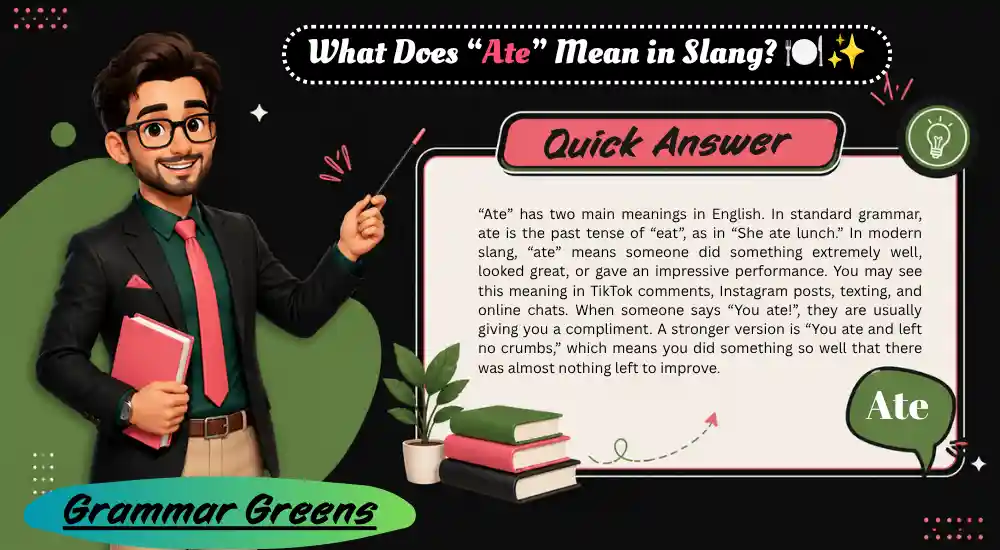
“Ate” has two main meanings in English. In standard grammar, ate is the past tense of “eat”, as in “She ate lunch.” In modern slang, “ate” means someone did something extremely well, looked great, or gave an impressive performance. You may see this meaning in TikTok comments, Instagram posts, texting, and online chats.
When someone says “You ate!”, they are usually giving you a compliment. A stronger version is “You ate and left no crumbs,” which means you did something so well that there was almost nothing left to improve.
TL;DR 📝
If you only need the short answer, remember these points:
- 🍽️ Ate = past tense of “eat.”
- 🔥 Ate in slang = did something very well.
- 👏 “You ate!” = You did an amazing job.
- ✨ “Ate that up” = Did something extremely well.
- 🏆 “Ate and left no crumbs” = Did something almost perfectly.
- 📱 You may see ate slang on TikTok, Instagram, Snapchat, and in text messages.
- 💬 It is usually a positive compliment.
- 📚 Eat → ate → eaten is the basic verb form.
- 🗣️ The slang and grammar meanings use the same pronunciation.
- 🇵🇭 In Tagalog, ate can mean an older sister or elder female.
- 🏛️ Ate also refers to a figure in Greek mythology.
You Might Also Like That: WYS Meaning
What Does “Ate” Mean in Slang? 🍽️✨
In modern slang, “ate” means that someone did something extremely well. It works as a strong compliment for a great performance, stylish outfit, smart answer, dance, song, or creative idea. When someone comments “Ate!”, they are saying that the person impressed them.
The phrase does not usually relate to food in this context. For example, if someone posts a great outfit and you say “You ate!”, you mean they looked amazing. You can also say “She ate that performance” when someone performs very well. This informal expression appears often in social media, texting, TikTok, and Instagram.
Why Is “Ate” a Compliment? 👏
People use “ate” to show strong approval. It suggests that someone performed so well that they left little or nothing to criticize. You might hear it after a person gives a great speech, wins an argument, creates impressive art, or wears an eye-catching outfit. In simple terms, ate slang means “did an amazing job.”
What Does “You Ate” Mean? 🔥
“You ate” means “You did that really well.” People often use it after someone finishes a performance, creates something impressive, or handles a situation with confidence. The phrase sounds casual and friendly, so you will mostly see it in conversations, comments, captions, and online posts.
For example, someone might share a new makeup look and receive the comment “You ate!” Another person might give a strong comeback during an argument, and a friend could say “You ate that!” In both cases, the speaker gives praise rather than talking about eating food.
She Ate, He Ate, They Ate 👑
The meaning stays almost the same when the subject changes. “She ate” means she did something very well, while “He ate” praises his performance. “They ate” praises a group. You can also add words for emphasis, such as “You really ate” or “They absolutely ate.” These forms work naturally in casual online conversations.
What Does “Ate” Mean on TikTok, Instagram, and in Text? 📱
On TikTok and Instagram, people often use “ate” as a short reaction to impressive content. You may see comments such as “You ate,” “She ate,” or simply “ATE!” under videos, photos, dances, outfits, makeup looks, and performances. The meaning remains positive even when the comment contains only one word.
You Might Also Like That:
In texting and chat, friends can use “ate” in the same way. Someone might send you a photo of their outfit, and you could reply, “You ate!” If a friend gives a clever response in a group chat, another person might write “You ate that up.” The expression works best in relaxed, informal conversations.
Ate Meaning in Social Media 💬
The ate meaning on social media usually connects with praise, confidence, and strong performance. The exact meaning can change slightly with context, but the basic idea stays the same: someone did something impressively well. This makes “ate” a popular reaction in comments and short messages.
What Does “Ate and Left No Crumbs” Mean? 🍽️🏆
“Ate and left no crumbs” is a stronger version of “ate.” It means someone did something so well that there was nothing left to criticize. The phrase uses food as a playful comparison. If someone “ate” and left no crumbs, they supposedly finished everything perfectly.
You may see this phrase after a great performance, outfit, speech, joke, or comeback. For example, if someone gives an excellent presentation, a friend might say, “You ate and left no crumbs!” The expression is especially common in internet slang and social media.
“Ate That Up” and “Ate Down” 🔥
People also use related phrases such as “ate that up” and “ate down.” Both can praise someone for doing something extremely well. “Ate that up” often describes a person handling a task or performance with confidence, while “ate down” works as another strong form of praise. These phrases usually appear in casual online conversations.
When Do People Say “Ate”? ⭐
People use “ate” when they want to praise a noticeable achievement or performance. The expression can describe many different situations, so it does not belong to just one type of activity. If someone does something that stands out in a positive way, “ate” can work as a quick compliment.
You Might Also Like That:
Common examples include:
- 👗 Fashion: “She ate that outfit.”
- 🎤 Music: “He ate that performance.”
- 💃 Dance: “They ate that choreography.”
- 💄 Makeup: “You ate this look.”
- 🎨 Creative work: “You ate with this design.”
- 💬 Comeback: “You ate with that reply.”
- 🎓 Presentation: “She ate that presentation.”
Ate in Everyday Online Conversations 💬
The expression works best when the conversation feels casual and friendly. You would normally use it with friends, online followers, or people who understand current internet slang. You would not usually use “you ate” in a formal business email or academic paper because the slang version sounds informal.
How Do You Use “Ate” in a Sentence? ✍️
Using ate as slang is simple once you understand the context. You can use it by itself or add an object that explains what impressed you. For example, “You ate!” works as a short compliment, while “You ate that outfit!” tells someone exactly what you liked.
Here are some natural examples:
- “You ate that performance!”
- “She ate with that makeup look.”
- “He really ate that presentation.”
- “They ate and left no crumbs.”
- “You absolutely ate that comeback.”
- “She ate that dance routine.”
Ate as a Slang Example vs. Literal Example 🍴
The context tells you which meaning applies. “She ate dinner” uses the standard English meaning because it describes eating food in the past. “She ate that performance” uses slang because it praises her performance. The same word can therefore have two very different meanings.
Is “Ate” Always a Compliment? 🤔
Most of the time, “ate” is a compliment when people use it as internet slang. It normally shows that someone impressed the speaker. However, online conversations can include jokes, exaggeration, or sarcasm. Because of this, you should look at the full message and the situation before deciding what someone means.
You Might Also Like That:
For example, “You ate!” after a great performance almost certainly means praise. But someone could also use the phrase jokingly when a friend makes a small mistake. The tone, emojis, punctuation, and relationship between the people can help you understand the intended meaning.
When Can “Ate” Sound Sarcastic? 😏
People sometimes use slang ironically to make a joke. A friend might say “You ate” after a very poor attempt at something because they want to tease you. In that case, the words alone do not tell the whole story. Look at the surrounding conversation and the person’s usual style before taking the comment seriously.
How Do You Respond When Someone Says “You Ate”? 💬✨
If someone says “You ate!”, you can respond just like you would respond to any friendly compliment. A simple “Thank you!” works perfectly. If the conversation feels playful, you can match their energy with a fun response. You do not need a special reply because the phrase simply shows appreciation.
Here are some casual replies:
- 😊 “Thank you!”
- 🫶 “Aww, thanks!”
- 😎 “I had to!”
- 😂 “You already know!”
- 🔥 “I tried!”
- ✨ “Glad you liked it!”
What If You Don’t Know the Slang? 🤷
If someone says “You ate” and you do not understand it, you can simply ask what they mean. In most online contexts, they are probably complimenting you. Once you understand that ate slang means doing something very well, the expression becomes easy to recognize.
Ate vs. Similar Slang Words 🔥
Several English slang expressions have a meaning close to “ate.” People use “slayed,” “killed it,” “nailed it,” and “crushed it” to praise someone for doing something very well. However, “ate” has become especially common in social-media conversations and often sounds more playful.
You Might Also Like That:
| Expression | Simple meaning |
| Ate 🍽️ | Did something extremely well |
| Slayed 👑 | Performed impressively |
| Killed it 🔥 | Did an excellent job |
| Nailed it 🎯 | Got something exactly right |
| Crushed it 💪 | Performed very successfully |
| Served ✨ | Looked or performed impressively |
Ate vs. Slayed 👑
“Ate” and “slayed” often work in similar situations. You can use either one to praise a performance, outfit, or creative result. The main difference comes from style and context rather than a strict definition. Both remain informal expressions, so they fit casual conversations much better than formal writing.
Where Did the Slang “Ate” Come From? 🌎
The modern slang use of “ate” has a cultural history that goes beyond today’s social-media platforms. Current dictionary research connects the expression “ate and left no crumbs” with New York City’s Ballroom scene, including Black and Latino LGBTQ+ communities. The phrase later spread more widely through internet culture and social media.
The expression became easier for a wider audience to recognize as online communities adopted and repeated it. Today, people use “ate” across platforms such as TikTok and Instagram, often without knowing its earlier cultural history. Understanding that history helps explain why the expression became such a strong form of praise.
When Did “Ate” Become Internet Slang? 📱
The slang meaning gained wider online visibility during the mid-2010s and afterward. Social media helped the phrase move between different online communities and reach a much larger audience. TikTok later helped popularize many forms of the expression, but TikTok did not create the slang meaning.
You Might Also Like That:
Is “Ate” the Past Tense of “Eat”? 🍴
Yes. In standard English grammar, “ate” is the simple past tense of “eat.” The basic verb forms are eat → ate → eaten. For example, you can say, “I eat breakfast every morning,” “I ate breakfast yesterday,” and “I have eaten breakfast already.”
This grammatical meaning has nothing to do with internet slang. If someone says “I ate lunch,” they describe an actual meal. If someone says “You ate that performance,” they use slang to praise the performance. The surrounding context tells you which meaning applies.
| Verb form | Word | Example |
| Present | eat | I eat breakfast. |
| Simple past | ate | I ate breakfast. |
| Past participle | eaten | I have eaten breakfast. |
Why Is “Eat” an Irregular Verb? 📚
Eat is an irregular verb because it does not form its past tense by simply adding -ed. Instead, its form changes from eat to ate, and its past participle becomes eaten. This pattern makes “eat, ate, eaten” an important example in English grammar.
How Do You Pronounce “Ate”? 🔊
The pronunciation of “ate” stays the same whether you use the word in standard English or slang. The slang meaning changes the context, not the basic pronunciation. You can hear the word in ordinary sentences such as “I ate lunch” and slang expressions such as “You ate!” without changing how you say it.
If you are learning English, remember that the word has one common pronunciation even though it can carry different meanings. Cambridge and Collins also provide pronunciation information for the word, which makes pronunciation a useful supporting part of the ate definition.
Is Slang “Ate” Pronounced Differently? 🗣️
No. The slang expression “ate” uses the same spoken word as the standard English verb. Only the meaning changes. Your tone can show excitement when you use it as slang, especially in a phrase such as “You ate!”
Other Meanings of “Ate” 📖
Besides the slang meaning and the past tense of eat, the word Ate can refer to other things. Collins, Merriam-Webster, and other dictionary sources list separate meanings that depend on language or context. These meanings should not be confused with modern internet slang.
For example, ate can refer to an elder sister in Tagalog/Filipino, while Ate also appears as a figure in Greek mythology. The spelling may look identical, but the meaning comes from a completely different language or subject. This shows why context matters when someone searches for the meaning of ate.
You Might Also Like That:
Ate in Tagalog 🇵🇭
In Tagalog, ate is a respectful word for an older sister or elder female. It does not carry the same meaning as the English slang expression “ate.” If you see the word in a Filipino conversation, use the surrounding language and context to understand what the speaker means.
Ate in Greek Mythology 🏛️
In Greek mythology, Ate is the name of a mythological figure associated with folly, delusion, and reckless actions. This proper noun has no connection to the modern slang expression. Writers usually capitalize it as Ate when referring to the mythological figure.
The “-ate” Suffix 🔤
The spelling -ate can also appear as a suffix in English words. It can help form nouns, adjectives, or verbs, depending on the word. This is a separate linguistic topic from both the verb ate and the slang expression. For a simple ate meaning article, this distinction only needs a brief explanation.
Common Questions About “Ate” ❓
What does ate mean?
Ate has two common meanings. In standard English, it is the past tense of “eat.” In modern slang, it means someone did something extremely well or impressively.
What does ate mean in slang?
In slang, ate means performed very well, looked amazing, or succeeded at something. People commonly use it as a compliment online.
What does “you ate” mean?
“You ate” means “You did an excellent job.” Friends often use it after a great performance, outfit, comeback, or creative result.
What does “ate and left no crumbs” mean?
It means someone did something so well that nothing could be criticized. It acts as a stronger version of “you ate.”
Is “ate” a compliment?
Yes, when people use ate as slang, it is usually a positive compliment. However, people can sometimes use it jokingly or sarcastically.
What does ate mean on TikTok?
On TikTok, “ate” usually means someone performed impressively or looked excellent. You may see it in comments, captions, and reactions.
What does ate mean in texting?
In texting, “ate” usually works as casual praise. “You ate” can mean “You did that really well.”
Is ate the past tense of eat?
Yes. Ate is the simple past tense of eat. The basic forms are eat → ate → eaten.
How do you use ate in a sentence?
For slang, you can say “You ate that!” or “She ate that performance.” For the literal meaning, you can say “I ate lunch.”
How do you respond to “You ate”?
A simple “Thank you!” works well. You can also respond casually with “I had to!”, “Haha, thanks!”, or “Glad you liked it!”
Final Thought 💭✨
The meaning of “ate” depends on the context. If you see it in a sentence about food, it probably means the person ate something in the past. If you see “You ate!” in a TikTok comment, Instagram post, or text message, it usually means “You did an amazing job.”
Once you understand this difference, the word becomes easy to recognize. Whether someone says “you ate,” “she ate,” or “ate and left no crumbs,” the slang usually expresses strong praise and excitement. Just remember: context decides the meaning. 🍽️🔥