

If you saw “ion” in a text, comment, or social media post, it usually means “I don’t.” It is an informal slang spelling used in casual online conversations. For example, “ion know” means “I don’t know,” while “ion care” means “I don’t care.”
However, “ion” can mean different things depending on context. In informal internet language, it can mean “I don’t,” while ION can also mean “In Other News.” In science, an ion is an electrically charged atom or group of atoms.
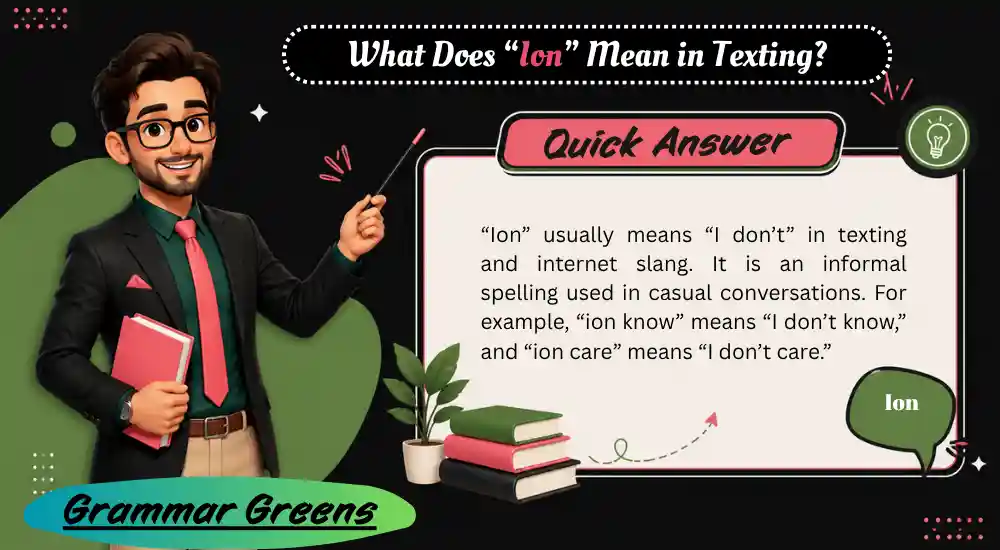
Quick Answer
“Ion” usually means “I don’t” in texting and internet slang. It is an informal spelling used in casual conversations. For example, “ion know” means “I don’t know,” and “ion care” means “I don’t care.”
The meaning can change with context. ION may also mean “In Other News,” while in chemistry and physics, an ion is an electrically charged atom or group of atoms.
TL;DR
- Ion in texting usually means “I don’t.”
- “Ion know” = “I don’t know.”
- “Ion care” = “I don’t care.”
- It is informal slang, so use “I don’t” in formal writing.
- ION can also mean “In Other News.”
- In science, an ion is an electrically charged atom or group of atoms.
You Might Also Like That: Further vs Farther
What Does “Ion” Mean in Texting?
In texting and internet slang, “ion” usually means “I don’t.” It is an informal spelling that represents how the phrase can sound in casual speech. Dictionary.com describes this slang use as a rendering of “I don’t,” particularly associated with Black English.
You will often see ion followed by a verb or another phrase:
| Texting phrase | Standard English |
| ion know | I don’t know |
| ion care | I don’t care |
| ion wanna go | I don’t want to go |
| ion think so | I don’t think so |
| ion remember | I don’t remember |
So, if someone writes “ion know what happened,” they are generally saying “I don’t know what happened.”
This usage is informal. It fits casual conversations, messages, comments, and other settings where people use relaxed internet language. It is not the standard spelling used in formal English.
What Does “Ion” Mean in Slang?
As slang, “ion” is generally a casual way of writing “I don’t.” It should be understood from the words around it rather than treated as a standalone formal abbreviation.
For example, the meaning becomes clear when you look at the complete phrase:
- ion know → I don’t know
- ion like it → I don’t like it
- ion want that → I don’t want that
- ion think you’re right → I don’t think you’re right
One useful distinction is that “ion” does not automatically mean “I don’t know.” The word know supplies the “know” part.
ion = I don’t
ion know = I don’t know
This distinction can help if you are seeing the slang for the first time.
Common Examples of “Ion” in Text Messages
The easiest way to understand this slang is to see it in natural sentences.
You Might Also Like That: WYD Meaning
💡 Examples:
- “ion know what you mean.” → “I don’t know what you mean.”
- “ion care anymore.” → “I don’t care anymore.”
- “ion wanna leave yet.” → “I don’t want to leave yet.”
- “ion think that’s a good idea.” → “I don’t think that’s a good idea.”
- “ion remember his name.” → “I don’t remember his name.”
- “ion like this song.” → “I don’t like this song.”
The exact translation can depend on the rest of the sentence. The important part is that ion usually represents “I don’t” in this type of informal writing.
This is also why searching for “what does ion know mean?” or “what does ion care mean?” can produce a slightly different-looking answer. The meaning of ion stays the same, while the following words complete the thought.
Why Do People Say “Ion” Instead of “I Don’t”?
People use forms like “ion” because informal writing often reflects the way people speak. In quick conversation, words and phrases may blend together or sound different from their careful dictionary pronunciation.
Dictionary.com describes the slang spelling as being based on the colloquial pronunciation of “I don’t,” and notes its connection with Black English. It also records internet use of the slang form from the 2000s.
That does not mean every person who uses ion has the same linguistic background. Internet slang can spread across communities and platforms, and its use can change over time.
The important point for a reader is simple: “ion” in this context is an informal representation of speech, not the scientific word being used accidentally.
Is “Ion” Rude or Disrespectful?
“Ion” is not inherently rude. Its tone depends on the complete sentence and the situation.
For example:
“ion know tbh”
may sound casual or uncertain.
But:
“ion care.”
can sound dismissive because the underlying statement, “I don’t care,” can itself sound blunt.
Other factors also affect tone, including punctuation, the relationship between the people talking, and what was said before the message.
So if someone texts “ion”, you should not assume they are being disrespectful simply because they use slang. Look at the entire message before judging the tone.
Is “Ion” Formal English?
No. “Ion” in the “I don’t” sense is informal slang, so it is generally better to use “I don’t” in formal or professional writing.
You Might Also Like That: FR Meaning in Chat
| Situation | Recommended choice |
| Texting a close friend | Ion can be fine |
| Casual social media conversation | Ion can be appropriate |
| Personal chat | Depends on the conversation |
| School assignment | Use I don’t |
| Professional email | Use I don’t |
| Formal report | Use I don’t |
Using standard English does not make your writing less natural. In formal settings, “I don’t” is simply clearer and more appropriate.
What Does ION Mean Besides “I Don’t”?
ION can have another informal meaning: “In Other News.” This use is different from the slang spelling of “I don’t.” Dictionary.com notes that ION can work as a transition that signals a change of topic.
ION = “In Other News”
For example:
“ION, did you hear about the new movie?”
Here, ION is being used to introduce a different subject. It is similar to saying “On another note” or “In other news.”
Context usually makes the difference:
- “ion know” → likely “I don’t know”
- “ion care” → likely “I don’t care”
- “ION, did you hear…” → possibly “In Other News”
This is why the surrounding words matter when interpreting ion in online conversations.
What Does “Ion” Mean in Science?
In science, an ion is an atom or group of atoms with an electric charge. That charge occurs when the atom or group gains or loses electrons.
A neutral atom has the same number of positively charged protons and negatively charged electrons. If it loses or gains electrons, that balance changes and the particle becomes charged.
- Loses electrons → becomes positively charged
- Gains electrons → becomes negatively charged
You Might Also Like That: ASL Meaning
This scientific meaning has nothing to do with the texting slang “ion” = “I don’t.” The two meanings simply happen to use the same spelling.
The scientific term has a much older history. Dictionary.com notes that the term ion was introduced by Michael Faraday in 1834 and traces the word to Greek.
What Are Cations and Anions?
The two main types of ions are cations and anions.
| Type | Charge | What happens to electrons? |
| Cation | Positive | Electrons are lost |
| Anion | Negative | Electrons are gained |
For example, when an atom loses one or more electrons, it has more positive charge than negative charge and becomes a cation. When an atom gains electrons, it becomes an anion.
You will mainly encounter these terms in chemistry and physics. Dictionary.com identifies positive ions as cations and negative ions as anions.
So if you see “positive ion,” “negative ion,” “cation,” or “anion,” the scientific meaning is almost certainly intended.
How to Tell Which Meaning of “Ion” Someone Means
When you see ion, check the surrounding words and context.
1. Look at what follows “ion”
If you see:
“ion know”
the intended meaning is probably “I don’t know.”
If you see:
“ion care”
it probably means “I don’t care.”
2. Look for a topic change
If someone writes:
“ION, what are you doing this weekend?”
they may be using ION to mean “In Other News.”
3. Check whether the conversation is scientific
If a sentence mentions:
- electrons
- electric charge
- chemistry
- cations
- anions
- atoms
- molecules
then ion almost certainly has its scientific meaning.
4. Consider the writing style
Lowercase ion inside a casual sentence such as “ion know” is a strong clue that the slang meaning is intended.
The surrounding context is usually enough to tell the difference.
“Ion” vs. Similar Texting Terms
Some texting expressions can look similar because they communicate related ideas, but they do not have exactly the same function.
| Term | Meaning |
| ion | I don’t |
| ion know | I don’t know |
| IDK | I don’t know |
| IDC | I don’t care |
| IMO | In my opinion |
| TBH | To be honest |
The biggest difference is that ion can function as the beginning of a longer statement, while IDK is already a complete shorthand expression for “I don’t know.”
You Might Also Like That: EYP Meaning
For example:
“ion think so” → “I don’t think so.”
You would not normally replace ion with IDK in that sentence without changing its meaning.
Frequently Asked Questions About “Ion”
Is “ion” short for “I don’t”?
Yes. In informal texting and internet slang, “ion” commonly represents “I don’t.” It is an informal spelling associated with the colloquial pronunciation of the phrase.
What does “ion know” mean?
“Ion know” means “I don’t know.” The word ion supplies “I don’t,” while know completes the phrase.
What does “ion care” mean?
“Ion care” means “I don’t care.” Depending on the conversation, it can sound casual, indifferent, or dismissive.
Is “ion” a typo?
Not necessarily. If it appears in a phrase such as “ion know” or “ion wanna,” it is usually intentional slang rather than a spelling mistake.
Is “ion” appropriate in formal writing?
Generally, no. In school, business, professional, or formal writing, use “I don’t” instead.
Is “ion” rude?
Not by itself. The tone depends on the full sentence and context. Some phrases containing ion, such as “ion care,” may sound blunt or dismissive, but the slang itself is not automatically rude.
What does ION mean in “In Other News”?
ION can mean “In Other News” when it is used as an informal transition to introduce a different topic. This meaning is distinct from ion = “I don’t.”
What does ion mean in science?
In chemistry and physics, an ion is an electrically charged atom or group of atoms formed when electrons are gained or lost.
Key Takeaway ⭐
The meaning of “ion” depends on context.
If you see it in a casual text such as “ion know,” it usually means “I don’t,” making the whole phrase “I don’t know.” If ION appears as a transition before a new subject, it may mean “In Other News.” In chemistry or physics, an ion is an electrically charged atom or group of atoms.
For everyday texting, the quickest rule is:
ion + verb → usually “I don’t”
So “ion know,” “ion care,” and “ion think” can usually be read as “I don’t know,” “I don’t care,” and “I don’t think.”





Pingback: Complement vs Compliment: What’s the Difference?
Pingback: Principle vs Principal: The Simple Trick to Never Mix Them Up Again
Pingback: Flex Meaning: What Does Flex Mean in Text, Slang and Social Media?
Pingback: Lose vs Loose: What’s the Difference and Is It Losing or Loosing