Further and farther are two of the most commonly confused words in English. Although both can relate to distance, they often serve different purposes. Farther usually refers to physical or measurable distance, while further often means additional, more, or a greater degree. However, the difference is not always absolute, and both words can appear in discussions of distance. Understanding this small but important distinction can help you choose the right word with confidence.
In this guide, we’ll explain further vs. farther in simple terms, show how each word works in real sentences, and cover common expressions such as “further from the truth,” “further information,” and “farther away.” You’ll also learn when the words can be interchangeable and how usage can vary between American and British English.
Further vs. Farther: The Quick Answer
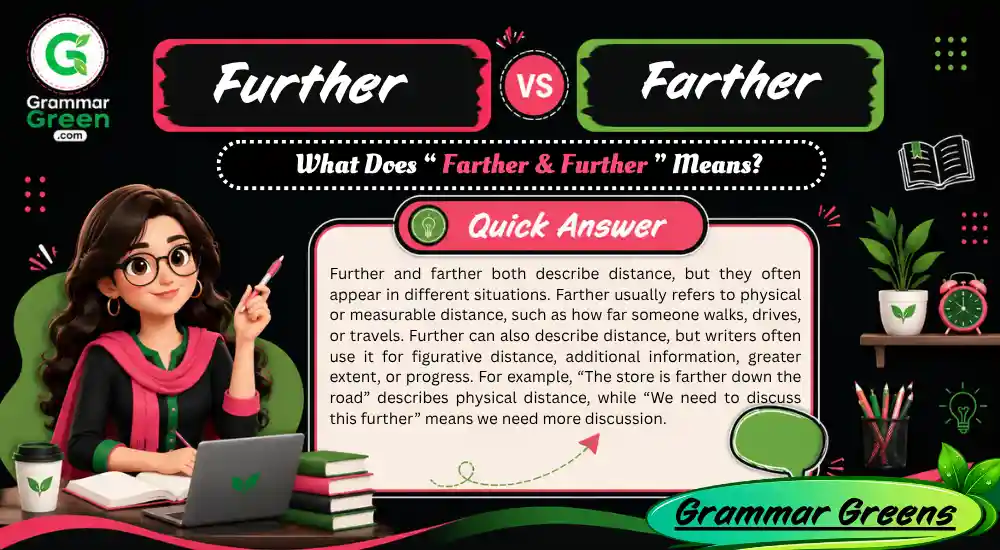
Further and farther both describe distance, but they often appear in different situations. Farther usually refers to physical or measurable distance, such as how far someone walks, drives, or travels. Further can also describe distance, but writers often use it for figurative distance, additional information, greater extent, or progress. For example, “The store is farther down the road” describes physical distance, while “We need to discuss this further” means we need more discussion.
| Word | Common use | Example |
| 📍 Farther | Physical distance | We walked farther than yesterday. |
| ➕ Further | More or additional | We need further information. |
| 💭 Further | Figurative distance | Nothing could be further from the truth. |
| 🚀 Further | Advance or promote | This training will further her career. |
The traditional rule says farther = physical distance and further = figurative distance, but real English usage has more flexibility. Both words can describe distance in many contexts. When you mean “additional,” “more,” or “to advance,” however, further is the clear choice. Learning this basic difference will help you choose the right word without relying on a strict rule that does not cover every situation.
Further vs. Farther: TL;DR
- 📍 Farther → Usually describes physical distance.
- ➕ Further → Often means more or additional.
- 💭 Further → Common for figurative distance.
- 🚀 Further → Can mean advance or promote.
- 🛣️ Farther away → Common for physical distance.
- 📚 Further education → Means additional education.
- 🔎 Further information → Means more information.
- 🧠 Further from the truth → Refers to figurative distance.
- 🔄 Both can describe distance → English usage allows some overlap.
- ⭐ Simple tip: Use farther for clear physical distance and further for additional or abstract meanings.
You Might Also Like That: Rizz Meaning
What Does “Farther” Mean?
Farther is commonly used when you talk about physical distance. It works well when you can imagine or measure the space between two places, people, or objects. For example, “The mountain is farther away than I thought” clearly describes physical distance. You can also use farther when talking about moving a greater distance, such as walking, running, driving, or traveling. In simple terms, think of farther when you are talking about how much more space separates one point from another.
Farther for Physical Distance
📍 Farther often appears with words such as away, than, down, back, and along. For example, “The station is farther away,” “We drove farther than expected,” and “The house is farther down the road” all describe physical distance. Farther is also the comparative form of far in traditional usage. Its superlative form is farthest, as in “That is the farthest point we can reach.” These examples make the physical-distance use easy to recognize in everyday English.
What Does “Further” Mean?
Further has a wider range of meanings than farther. You can use it for figurative distance, but it can also mean more, additional, or to a greater extent. For example, “We need further details” means we need more details. You can also say, “Let’s investigate the matter further,” when you want to continue an activity. Because of these extra meanings, further appears frequently in formal writing, education, business communication, and everyday speech.
Further as a Verb
🚀 Further can work as a verb when it means to advance, promote, or help something develop. For example, “The program will further her career” means the program will help her career progress. You can also say, “The research could further our understanding of the problem.” You cannot normally replace further with farther in these sentences. This verb use creates one of the clearest differences between the two words and explains why further has a much broader meaning than simply describing distance.
Is “Further” or “Farther” Correct for Distance?
When you describe physical distance, farther often works as the traditional choice. For example, “We walked farther than before” clearly focuses on measurable distance. However, further can also describe distance, and many speakers use it naturally in such sentences. English usage does not always follow the simple rule that farther must describe physical distance and further must describe figurative distance. Both forms can be correct, depending on the sentence, region, and style.
The safest approach is to use farther when you want to clearly emphasize physical distance, especially in traditional American English. Use further when the meaning involves additional distance, greater extent, progress, or something abstract. For example, “We need to look further into the issue” does not describe physical space. It means we need to investigate more. This flexible approach reflects actual English usage better than treating the traditional rule as an absolute grammar law.
Further vs. Farther for Figurative, Temporal, and Physical Distance
For figurative distance, writers often prefer further. You might say, “Her argument takes the discussion further,” or “The new evidence moved us further toward an answer.” These sentences describe an idea, process, or level rather than physical space. Further also works naturally with time and progress. For example, “Let’s look further back in history” can refer to an earlier point in time rather than a physical location.
For clear physical distance, farther remains a useful choice: “The second shop is farther away.” Still, you may see further in similar sentences, especially in British English and modern general usage. The important point is context. 🧭 If you mean more, additional, progress, or abstract distance, choose further. If you want to emphasize measurable physical distance, farther is usually the clearer choice.
Can “Further” and “Farther” Be Used Interchangeably?
Sometimes, further and farther can be interchangeable, especially when both words describe distance. For example, “We walked farther down the road” and “We walked further down the road” can both sound natural to many English speakers. The preferred choice can depend on regional habits and writing style. Because of this overlap, calling one form completely wrong can give learners an inaccurate picture of modern English.
You Might Also Like That: Delulu Meaning
However, you cannot replace further with farther in every situation. Consider “We need further information.” Here, further means additional, not physical distance. Likewise, “She wants to further her education” uses further as a verb. In these cases, farther does not fit. So, ask what the word means in the sentence before choosing between them.
Further vs. Farther in American and British English
🇺🇸 American English often follows the traditional preference of using farther for physical distance and further for figurative or additional meanings. However, American speakers also use further for physical distance, particularly in common expressions. This means the traditional rule can guide your choice, but you should not assume that every alternative sounds incorrect. Good writing should focus on meaning and natural usage.
🇬🇧 British English often gives further a wider role when talking about distance. Cambridge notes that farther and further can both refer to distance, with further often appearing more frequently. If you write for an international audience, both forms may appear in reliable English. When you need a simple distinction, use farther for clear physical distance and further for additional or abstract meanings.
Further vs. Farther in Formal and Informal Writing
In formal writing, further appears very often because it can mean additional or more. Common phrases include further information, further details, further research, further discussion, and further consideration. These expressions are standard and natural. For example, “Please contact us for further information” sounds normal in business writing. You should not replace further with farther in these expressions because the meaning has nothing to do with physical distance.
In informal writing, people may use further and farther more flexibly when they describe distance. Your choice should depend on what you want to express. If the sentence focuses on a measurable journey, farther may sound clearer. If it focuses on continuing, adding, or developing an idea, further usually works better. Always choose the word that matches the intended meaning rather than choosing it only because of a memorized rule.
Further From the Truth or Farther From the Truth?
The expression “further from the truth” is very common. You will often see the complete phrase “Nothing could be further from the truth.” Here, further describes figurative distance. The speaker does not mean a physical location. Instead, the statement means that something is completely untrue or very different from reality. This makes further the natural choice in the common expression.
You may occasionally encounter “farther from the truth,” especially because English speakers do not always follow a strict physical-versus-figurative rule. However, further from the truth remains the established and widely preferred expression. If you want to sound natural and avoid confusion, use further in this phrase. 💡 Remember: the sentence compares an idea with the truth, not two physical locations.
You Might Also Like That: OMP Meaning
Further Along or Farther Along?
Both further along and farther along can appear in English, but they can carry slightly different ideas. Farther along can describe a position that is physically more distant, such as “The next town is farther along the road.” In contrast, further along often describes progress or development, such as “We are further along in the project than expected.” The meaning of the sentence helps you choose the natural form.
When you talk about progress, development, or a stage in a process, further along is usually the better choice. When you clearly describe movement along a physical route, farther along can work well. Because both expressions occur in real English, context matters more than a strict rule. Always check whether the sentence describes space or progress.
Common Expressions With Further and Farther
Some expressions strongly favor further because they involve additional information, progress, or an abstract idea. Common examples include further information, further details, further education, further notice, further discussion, further research, further action, further assistance, and further consideration. You may also see further to in formal British business writing, as in “Further to our conversation.”
Common expressions with farther often describe physical location or movement. Examples include farther away, farther down, farther back, farther out, farther west, farther north, and farther than expected. These phrases can help you notice the difference naturally. 📌 Instead of memorizing dozens of grammar rules, learn a few common expressions and pay attention to how native speakers use them.
You Might Also Like That: EYP Meaning in Text
Farthest vs. Furthest: What’s the Difference?
Farthest and furthest are the superlative forms connected with far. Traditionally, writers often use farthest for physical distance and furthest for figurative or additional meanings. For example, “That was the farthest we traveled” focuses on physical distance, while “This is the furthest we can go with the plan” focuses on progress or limits. However, just like farther and further, the two forms can overlap.
| Meaning | Common choice | Example |
| 📍 Physical distance | Farthest | This is the farthest village. |
| 💭 Abstract extent | Furthest | She went the furthest in the discussion. |
| ➕ Additional extent | Furthest | This is the furthest we can go. |
Regional usage can also affect the preferred form, so context remains important.
Further vs. Farther Examples
The easiest way to understand further vs. farther is to see the words in complete sentences.
- 📍 We walked farther than we planned.
- 🚗 The next gas station is farther down the road.
- ➕ Please provide further information.
- 💭 We need to discuss this further.
- 🚀 The experience helped further her career.
- 📚 He decided to pursue further education.
- 🧠 Nothing could be further from the truth.
- 🛣️ The village is farther away than I expected.
- 📈 The team has moved further along in the project.
- 🔎 The police decided to investigate further.
These examples show why meaning matters more than simply counting physical or figurative words.
Common Myths About Further and Farther
You Might Also Like That: Discreet vs Discrete
❌ Myth 1: Farther can only describe physical distance.
In real English, speakers sometimes use farther in figurative contexts.
❌ Myth 2: Further can never describe physical distance.
That rule is too strict. Further can describe distance in many contexts.
❌ Myth 3: One word is always correct.
Context, region, and style can affect the preferred choice.
❌ Myth 4: Further only means distance.
Further can also mean more, additional, or to advance.
❌ Myth 5: Farthest and furthest always have completely separate meanings.
They overlap in many forms of modern English.
How to Choose Between Further and Farther
Use this simple test whenever you feel unsure:
- 📍 Are you clearly talking about physical distance?
Farther is often the clearest choice. - ➕ Do you mean “more” or “additional”?
Use further. - 🚀 Do you mean advance, promote, or develop?
Use further. - 💭 Are you talking about an abstract idea or figurative distance?
Further usually works best. - 🧭 Can either word describe distance naturally?
Check the context and your preferred variety of English.
This approach gives you a practical rule without pretending that English usage always follows one fixed pattern.
Frequently Asked Questions About Further vs. Farther
Is it farther or further?
Both can be correct. Use farther when you want to emphasize physical distance, and use further for additional meaning, progress, or figurative distance.
Is farther only used for physical distance?
No. Although farther commonly refers to physical distance, real English sometimes uses it in figurative contexts too.
Can further be used for physical distance?
Yes. Further can describe physical distance, especially in British English and modern general usage. The traditional distinction does not always apply.
Which is correct: further or farther away?
Both can appear, but farther away often clearly emphasizes physical distance. Further away is also common and accepted.
Is it further or farther from the truth?
Use further from the truth in the common expression “Nothing could be further from the truth.”
Can further and farther be interchangeable?
They can overlap when describing distance, but further has additional meanings that farther cannot normally replace.
Is further a verb?
Yes. Further can mean to advance, promote, or develop, as in “The program will further his career.”
What is the difference between farthest and furthest?
Both can express the superlative form of far. Farthest often emphasizes physical distance, while furthest commonly appears with figurative or additional meanings.
Is further or farther more common?
The answer depends on context and variety of English. Further has a wider range of meanings and appears very frequently because it can mean additional, more, or advance, as well as distance.
Which should I use in formal writing?
Use farther when you clearly mean physical distance. Use further for additional information, discussion, research, progress, or abstract meanings. When both can describe distance, choose the form that sounds natural for your variety of English.
Final Thought
The difference between further and farther becomes easier when you focus on the meaning of the sentence rather than trying to memorize a strict grammar rule. Farther is a useful choice for clear physical distance, while further works for additional things, progress, figurative distance, and many common expressions.
Remember that real English gives both words some flexibility. When you are unsure, ask yourself whether you mean “more” or “advance”—if you do, further is usually the right choice. With a little practice, choosing between these commonly confused words will feel much more natural.