Discreet and discrete are two commonly confused English words. They sound the same, but they have different meanings and uses. Discreet usually means careful, private, tactful, or not attracting attention, while discrete means separate, distinct, or individual. Because their spelling differs by only one letter, it can be easy to use the wrong word when writing.
Understanding the difference between discreet vs discrete can help you choose the correct word with confidence. Whether you are writing about private information, careful behavior, separate groups, or individual units, this guide will show you how to use each word correctly with clear definitions and simple examples.
Discreet vs Discrete: Quick Answer
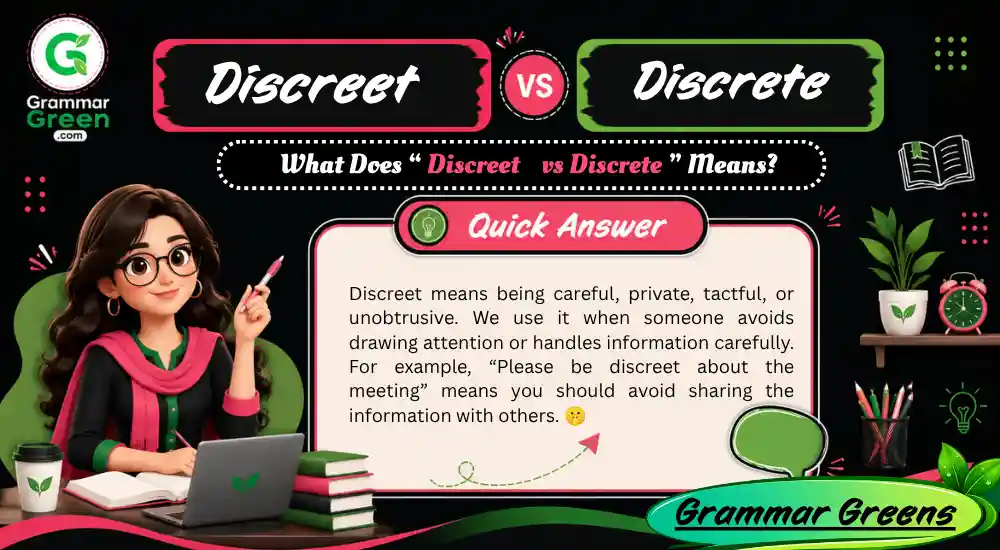
Discreet means being careful, private, tactful, or unobtrusive. We use it when someone avoids drawing attention or handles information carefully. For example, “Please be discreet about the meeting” means you should avoid sharing the information with others. 🤫
Discrete, on the other hand, means separate, distinct, or individual. We use it when things exist as separate units or groups. For example, “The survey divided participants into three discrete groups.” 🧩 The easiest way to remember the difference is simple: discreet = private, while discrete = separate.
| Word | Meaning | Example |
| Discreet 🤫 | Private, careful, tactful | Be discreet about the news. |
| Discrete 🧩 | Separate, distinct, individual | The data has five discrete values. |
TL;DR
- 🤫 Discreet means private, careful, tactful, or unobtrusive.
- 🧩 Discrete means separate, distinct, or individual.
- 👂 Discreet and discrete are homophones because they sound the same but have different meanings.
- ✍️ Use discreet for privacy or careful behavior.
- 📊 Use discrete for separate things, groups, parts, or values.
- 🧠 Easy memory trick: Discreet = private; Discrete = separate.
You Might Also Like That: Elicit vs Illicit
What Does Discreet Mean?
Discreet is an adjective that describes someone or something that shows care, caution, and good judgment. It can describe a person who keeps private information to themselves or an action that does not attract unwanted attention. For example, “She made a discreet inquiry about the job.” Here, she asked carefully without making the situation obvious. 🕵️
The word can also describe something subtle or unobtrusive. You might hear phrases such as discreet behavior, discreet communication, discreet location, or discreet service. Related words include discreetly, discretion, and indiscreet. So, when the idea involves privacy, tact, caution, or avoiding attention, choose discreet. 🤫
Examples of Discreet
- Please be discreet 🤫 about the announcement.
- He asked a discreet question about the salary.
- She gave me a discreet signal to leave.
- The hotel offers a discreet service for guests.
- Try to handle the matter in a discreet manner.
What Does Discrete Mean?
Discrete is an adjective that means separate, distinct, or individual. We use it when we talk about things that remain clearly separated from one another. For example, “The machine has several discrete components.” Each component is treated as a separate part. 🧩
You will often see discrete in academic, scientific, mathematical, and technical writing. Terms such as discrete data, discrete variables, and discrete values describe separate or countable units. The related forms include discretely and discreteness. When the main idea is separation or individuality, rather than privacy or caution, discrete is the correct choice.
Examples of Discrete
- The report contains four discrete sections.
- The students were placed into discrete groups.
- The machine uses several discrete parts.
- The chart shows five discrete values.
- Each stage is a discrete step in the process.
Discreet vs Discrete: Key Differences
The main difference between discreet and discrete comes down to meaning. Discreet focuses on being careful, private, tactful, or unnoticed. Discrete focuses on things being separate, distinct, or individual. Although the words sound the same, you cannot normally use them interchangeably. 🔤
You Might Also Like That: OMP Meaning
A quick comparison can make the difference easier to remember:
| Feature | Discreet 🤫 | Discrete 🧩 |
| Basic meaning | Careful or private | Separate or distinct |
| Common idea | Privacy or tact | Separation |
| Common use | Behavior, information, actions | Groups, parts, units, data |
| Technical use | Rare | Common |
| Memory clue | Private | Separate |
Discreet vs Discrete Examples in Sentences
Seeing the words in real sentences can make the distinction much clearer. Discreet works when the sentence involves privacy, caution, or avoiding attention, while discrete works when something has separate parts or units. Reading contrasting examples also helps you recognize the correct word when you encounter it in everyday writing. ✍️
Compare these examples carefully:
- Discreet: The assistant was discreet about the client’s personal information.
- Discrete: The research divided the results into discrete categories.
- Discreet: He made a discreet phone call.
- Discrete: The program has five discrete functions.
The first examples involve privacy or careful behavior. The second examples involve separate things.
When Should You Use Discreet or Discrete?
Use discreet when you want to describe someone who acts carefully or keeps something private. Think about situations involving confidential information, tact, modest behavior, or avoiding attention. 🤫 For example, “The manager was discreet when discussing the employee’s problem.”
Use discrete when you mean separate, distinct, or individual. Think about objects, groups, categories, stages, or values that you can identify separately. 🧩 For example, “The project has three discrete stages.” A simple question can help: Am I talking about privacy or separation? Privacy points to discreet; separation points to discrete.
Discreet vs Discrete: Common Mistakes to Avoid
Because discreet and discrete are homophones, writers often choose the wrong spelling. One common mistake is using discrete when talking about private information. For example, “Please be discrete about this matter” is incorrect when the intended meaning is “keep this private.” The correct sentence is, “Please be discreet about this matter.” 🤫
You Might Also Like That: EYP Meaning in Text
Another mistake happens when writers use discreet to mean separate. For example, “The experiment used three discreet groups” should be “The experiment used three discrete groups.” 🧩 Remember that discreet = careful/private and discrete = separate/distinct. Spellcheck may not catch these mistakes because both words are correctly spelled.
Discrete vs Continuous: What Does Discrete Mean in Math?
In math and statistics, discrete has a special meaning. Discrete data consists of separate, countable values. For example, the number of students in a classroom is discrete because you can count students as whole units. You cannot normally have 25.5 students. 🔢
Continuous data, in contrast, can take many values within a range. Height, weight, and temperature are common examples. This creates an important comparison:
| Discrete 🧩 | Continuous 📈 |
| Separate values | Values along a continuous range |
| Often countable | Often measured |
| Number of books | Book weight |
| Number of students | Student height |
So, discrete vs continuous is an important technical distinction.
Discreetly vs Discretely
Discreetly means acting in a careful, private, or unobtrusive way. For example, “She discreetly left the room.” The action does not attract much attention. 🤫
Discretely means in a separate or distinct way. It often appears in technical or formal contexts. For example, “The system stores the values discretely.” 🧩 These adverbs follow the same basic distinction as the adjectives. Discreetly connects with privacy and caution, while discretely connects with separation. Do not let the similar spelling make you treat them as interchangeable.
Discretion vs Discreteness
Discretion is the noun related to discreet. It refers to the ability to make careful decisions, especially when handling sensitive information. For example, “The employee handled the matter with discretion.” 🤫
Discreteness relates to discrete and describes the quality of being separate or distinct. For example, a researcher may discuss the discreteness of individual values in a dataset. 🧩 Although these nouns look similar, they represent different ideas. Discretion connects with careful judgment and privacy, while discreteness connects with separation and individuality.
Are Discreet and Discrete Homophones?
Yes, discreet and discrete are homophones. This means they have the same or nearly the same pronunciation but different spellings and meanings. 👂 Their similar sound explains why many writers confuse them, especially when they learn English through listening.
The spelling gives you an important clue. Discreet has the ending “-eet,” while discrete contains a t between the two “e” sounds in its spelling. Even though the pronunciation does not help much, the meaning does. When you see a sentence, look at the context. Ask whether it describes privacy and caution or separation and distinct units.
Why Are Discreet and Discrete So Easy to Confuse?
These words are easy to confuse because they have similar spellings, the same pronunciation, and related historical roots. Both developed from the same Latin source, which helps explain why their forms still look closely related today. 🔤
The problem becomes even greater because both words can function as adjectives. A writer may know the correct meaning but still choose the wrong spelling. The best solution does not involve memorizing a long definition. Instead, connect each word with one simple idea: discreet means private or careful, while discrete means separate or distinct. This makes correct usage much easier.
How to Remember the Difference Between Discreet and Discrete
A simple memory trick can help you remember discreet vs discrete. Think of discreet as something you want to keep private. 🤫 You can connect it with a secret because both ideas involve keeping information from attracting attention.
For discrete, think separate. 🧩 A useful spelling trick is to notice the T in “discrete.” You can imagine that the T helps separate the two E’s. Another easy rule is:
- 🤫 Discreet = keep it private
- 🧩 Discrete = keep it separate
If you remember those two short ideas, you can usually choose the correct word quickly.
You Might Also Like That: What Does WYF Mean
Discreet vs Discrete Word Origins
The words discreet and discrete share a historical connection. Both trace back to the Latin word discretus, which carried ideas related to distinguishing or separating. Over time, English developed different spellings and meanings for the two words. 📚
Today, discreet focuses mainly on careful judgment, privacy, and avoiding attention, while discrete focuses on separate or distinct things. You do not need to study their full etymology to use them correctly. However, knowing that they share an origin explains why they look and sound so similar and why English learners often confuse them.
Discreet vs Discrete: Synonyms and Related Words
Knowing a few synonyms can make the difference between these words easier to understand. For discreet, useful related words include cautious, tactful, prudent, subtle, unobtrusive, private, and inconspicuous. 🤫 These words often describe careful behavior or actions that avoid unwanted attention.
For discrete, useful synonyms include separate, distinct, individual, detached, divided, and unconnected. 🧩 These words focus on things that exist apart from one another. Remember that synonyms do not always work in every sentence. The exact meaning and context should guide your choice.
| Word | Useful Related Words |
| Discreet 🤫 | careful, private, tactful, prudent, unobtrusive |
| Discrete 🧩 | separate, distinct, individual, detached, divided |
Frequently Asked Questions About Discreet vs Discrete
What is the difference between discreet and discrete?
Discreet means careful, private, tactful, or unobtrusive. Discrete means separate, distinct, or individual. They sound alike but have different meanings.
Is it discreet or discrete?
It depends on the meaning. Use discreet for privacy or careful behavior. Use discrete for separate or distinct things.
Are discreet and discrete homophones?
Yes. Discreet and discrete are homophones because they share the same pronunciation but have different spellings and meanings.
Is discrete the opposite of continuous?
In many mathematical and statistical contexts, yes. Discrete describes separate or countable values, while continuous describes values that can vary across a range.
Can discreet mean separate?
Usually, no. If you mean separate or distinct, choose discrete. Use discreet when you mean careful, private, or unobtrusive.
Can discrete mean private?
Usually, no. If you mean private or careful, choose discreet. Context determines the correct word.
Final Takeaway
The difference between discreet and discrete becomes simple when you focus on their meanings. Discreet 🤫 describes something private, careful, tactful, or unobtrusive. Discrete 🧩 describes something separate, distinct, or individual.
When you are unsure, ask yourself one question: Am I talking about privacy or separation? If the idea involves privacy, caution, or avoiding attention, choose discreet. If it involves separate groups, parts, categories, or values, choose discrete. Keep the simple rule in mind: discreet = private; discrete = separate.