Then and than are two commonly confused words in English. They sound similar, but they serve different purposes in a sentence. If you are unsure whether to write “better than” or “better then,” or you often pause over “then or than,” you are not alone. The difference becomes much easier once you connect each word with its main use.
In simple terms, use then when you talk about time, sequence, order, or a result, and use than when you make a comparison. This guide explains the difference between then and than, shows you how to use each word correctly, and provides clear examples to help you avoid common mistakes.
Then vs. Than: Quick Answer
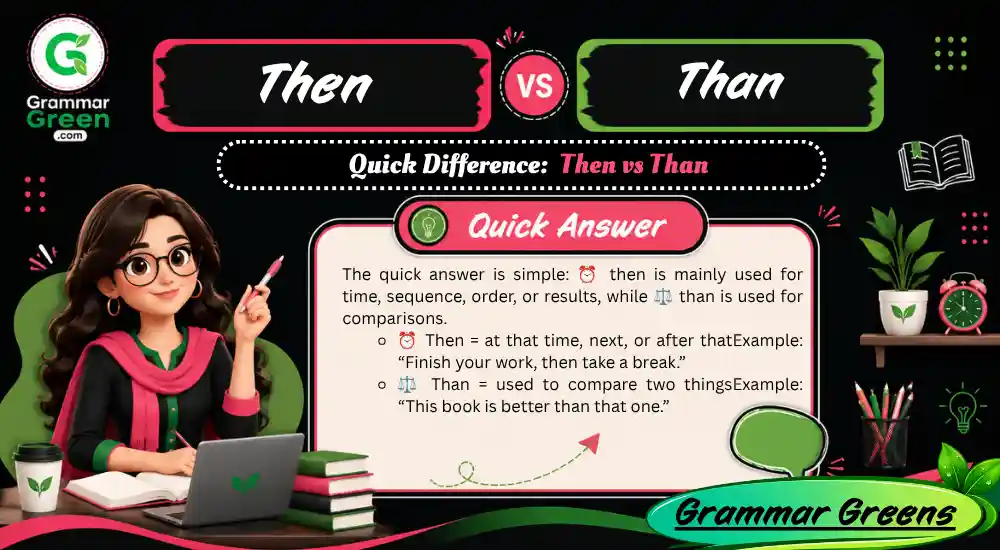
The quick answer is simple: ⏰ then is mainly used for time, sequence, order, or results, while ⚖️ than is used for comparisons.
- ⏰ Then = at that time, next, or after that
- Example: “Finish your work, then take a break.”
- ⚖️ Than = used to compare two things
- Example: “This book is better than that one.”
If you are asking “then or than?”, check the meaning first. If the sentence talks about when something happens, choose then. If it compares people, things, amounts, or qualities, choose than.
Then vs. Than: TL;DR
- ⏰ Then → Use it for time or a sequence of events.
- ➡️ Then → It can mean next or after that.
- 🔗 Then → It can show a result in an if–then statement.
- ⚖️ Than → Use it when making a comparison.
- 📊 Than → Commonly follows words like more, less, better, faster, taller, and older.
- ✍️ Better than ✅ — not “better then” when making a comparison.
- ✍️ More than ✅ — not “more then” when comparing an amount.
- 🧠 Easy trick: Then = Time, Than = Comparison.
You Might Also Like That: TS Meaning in Text
Then vs. Than: Quick Difference
The easiest way to understand then vs. than is to remember one simple rule: then usually relates to time or sequence, while than shows a comparison. For example, “We ate dinner and then watched a movie” shows order. On the other hand, “My car is faster than yours” compares two things.
| Word | Main Use | Example |
| ⏰ Then | Time or sequence | Finish your work, then relax. |
| ⚖️ Than | Comparison | Ali is taller than Ahmed. |
So, when you ask “then or than?”, first ask yourself whether you are talking about when something happens or how two things compare.
What Does “Then” Mean?
Then has several uses, but most of them connect to time, order, or results. You can use it to talk about something that happened at a particular time, something that happens next, or what should happen after a condition. For example, “I lived there then” refers to a past time, while “First read the question, then answer it” shows sequence.
Then for Time
Use then when you mean “at that time.” For example, “I was much younger then.” You can also use it in phrases such as back then, since then, and until then. These expressions connect an action or situation to a particular point in time.
Then for Sequence or Order
Use then when you explain what happens next or after something else. For example, “Wash your hands, then prepare the food.” Here, then clearly shows the order of two actions. A useful test is to replace then with “next” or “after that.” If the sentence still makes sense, then is probably the correct choice.
Then for Consequence
You can also use then to show a result or consequence. For example, “If you are tired, then take a break.” In this structure, the second part follows from the first part. This use often appears with if–then sentences, but you can also use then by itself when the result is clear from the context.
Then for a Previous Time or Status
Then can refer to a person, place, or situation as it existed at an earlier time. For example, “The then manager approved the plan.” Here, then means the person held that position at that time. You may also see phrases such as “I was happier then,” where the word points back to an earlier period.
You Might Also Like That: Effect vs Affect
What Does “Than” Mean?
Than mainly appears when you compare two people, things, actions, amounts, or situations. It often follows words such as more, less, better, worse, taller, faster, older, and easier. For example, “This phone is cheaper than that one.” If you can identify a comparison in the sentence, than is usually the word you need.
Than for Comparisons
Use than when you compare one thing with another. For example, “Sara is taller than Mia” compares height, while “This book is better than that one” compares quality. The comparison can involve almost anything, including price, size, speed, age, quality, distance, or ability. This is the most important rule to remember when learning when to use than.
Than After Comparative Words
Than often follows comparative adjectives and adverbs. Common examples include better than, bigger than, faster than, older than, more than, less than, and earlier than. For example, “This route is shorter than the other one.” When a comparative word tells you that two things differ, than normally connects the two sides of that comparison.
Than as a Conjunction or Preposition
In grammar, than can work as a conjunction or a preposition, depending on how you use it. You do not need to memorize these labels to use the word correctly. Focus on its job: than connects a comparison. For example, “She runs faster than I do” and “She runs faster than me” both use than to introduce a comparison.
Then vs. Than Examples
Seeing then and than examples side by side can make the difference much clearer. Look at how the meaning changes depending on the word:
| Correct Word | Example | Why? |
| ⏰ Then | We ate, then we left. | Shows sequence |
| ⏰ Then | I was younger then. | Refers to time |
| ⏰ Then | If it rains, then stay home. | Shows a result |
| ⚖️ Than | She is taller than me. | Shows comparison |
| ⚖️ Than | This costs more than that. | Compares price |
| ⚖️ Than | I’d rather walk than drive. | Shows preference |
A simple question can help: Is the sentence about time or order? Choose then. Is it comparing something? Choose than.
When to Use “Then” in a Sentence
Use then when your sentence talks about time, sequence, order, or consequence. For example, “We finished the meeting and then went home” shows what happened next. “I lived in New York back then” refers to a past time. You can also use then in conditional sentences: “If you finish early, then call me.” These uses explain the main meaning of then in a sentence.
When you are unsure, try replacing then with “after that” or “at that time.” If the sentence keeps its meaning, you likely need then. This quick test makes when to use then much easier, especially when you are proofreading your writing.
When to Use “Than” in a Sentence
Use than when your sentence makes a comparison. You may compare people, objects, amounts, actions, or qualities. For example, “This bag is lighter than mine,” “John works faster than I do,” and “The new version costs less than the old one.” In each example, the word connects two sides of a comparison.
You will often see than after comparative words such as more, less, better, worse, taller, smaller, faster, and easier. If you can replace the word with something like “in comparison with,” the sentence probably needs than.
You Might Also Like That: IYKYK Meaning
Common Then vs. Than Mistakes
Many writing mistakes happen because then and than sound very similar. Writers often type “better then,” “more then,” or “rather then” when they actually need than. Remember that these expressions normally involve a comparison or relationship, so than is correct.
| ❌ Incorrect | ✅ Correct |
| better then | better than |
| more then | more than |
| rather then | rather than |
| other then | other than |
| no later then | no later than |
| longer then | longer than |
More Than vs. More Then
Use more than when you compare an amount, number, or degree. For example, “She has more than ten books.” However, more then can appear when then refers to a past time, although this use is much less common. For example, “I worked more then than I do now.” Here, then means at that earlier time, while the second than creates the comparison.
Rather Than vs. Then
The standard expression is rather than, which means you prefer one option over another. For example, “I’d rather walk than take the bus.” Do not automatically choose then simply because the words sound similar. Look at the meaning. If the sentence presents a choice or preference, than is usually correct.
Other Than vs. Then
Use other than when you mean “except” or “besides.” For example, “No one other than Maria knew the answer.” The phrase creates a relationship between Maria and the rest of the group. Other then does not work with this meaning. Remember other than as a fixed expression that often means something is excluded from a group.
You Might Also Like That: There vs Their vs They’re
No Later Than vs. Then
The correct expression is no later than. For example, “Please arrive no later than 8 p.m.” Here, than compares the required arrival time with the stated deadline. Even though the sentence talks about time, it still uses than because the expression makes a comparison between times.
When Can “Then” Appear in a Comparison?
This point can confuse even careful writers. Then can appear near a comparison when it refers to time, while than performs the actual comparison. For example, “I was happier then” means I was happier at that earlier time. In “I was happier then than I am now,” then refers to time, while than connects the comparison.
So, do not decide between the words simply because a sentence contains a comparative adjective. Look at what each word does. If then means “at that time,” keep it. If you need to compare two things, use than.
Then vs. Than in Formal and Informal Writing
The basic difference between then and than stays the same in both formal and informal English. You should use then for time or sequence and than for comparison whether you write an email, school assignment, report, text message, or social post.
You Might Also Like That:
Formal writing simply requires more careful proofreading. In academic and professional writing, mistakes such as “better then” can distract readers from your message. Informal writing may contain shorter sentences or relaxed expressions, but the correct word still depends on its meaning. Always check whether you are showing time or making a comparison.
Then vs. Than Pronunciation: Do They Sound the Same?
Many people confuse then and than because the words sound very similar in everyday speech. Their pronunciation can be close enough that listeners may not notice the difference quickly. This makes spelling especially important when you write.
Instead of trying to choose the correct word by sound, focus on meaning. Ask whether the sentence talks about time, order, or a result or whether it compares two things. This approach works better when proofreading because the meaning tells you which word belongs in the sentence.
How to Remember Then vs. Than
A simple memory trick can help you remember the then vs. than difference:
- ⏰ Then = Time
- ⚖️ Than = Comparison
You can also use a replacement test. If you can replace the word with “at that time” or “after that,” choose then. If you can replace it with “in comparison with,” choose than. For example, “We ate, then left” works with “after that,” while “She is taller than me” clearly makes a comparison.
Then or Than: A 5-Second Decision Test
When you ask “then or than?”, follow these three quick steps:
- ⏰ Is it about time, order, or what happens next? → Use then.
- ⚖️ Are you comparing two things? → Use than.
- 🔎 Still unsure? Try the replacement test.
For example, “Finish your work, ___ take a break.” The word means “after that,” so choose then. In “This test is easier ___ the last one,” the sentence compares two tests, so choose than. This simple method can help you choose the correct word without memorizing complicated grammar rules.
Than I vs. Than Me: Which Is Correct?
Both than I and than me can appear in English, but the choice depends on sentence structure and style. For example, “She is taller than I am” follows a more formal structure, while “She is taller than me” sounds natural in everyday English. In formal or academic writing, many writers prefer a complete structure such as “than I am.”
You Might Also Like That: There vs Their vs They’re
The important point is that this issue has nothing to do with then. Both than I and than me use than because they introduce a comparison. When in doubt, writing the full phrase—such as “than I am”—can make the sentence clearer.
Then vs. Than in Common Expressions
Some expressions can help you recognize the correct word quickly. Common expressions with then include back then, since then, until then, just then, now and then, and even then. These phrases generally relate to time or a situation.
Common expressions with than include more than, better than, rather than, other than, no sooner than, and no later than. These expressions usually involve comparison, choice, exception, or a relationship between two things. Learning these common phrases can make everyday English writing much easier.
Then vs. Than: Common Questions
Is it better than or better then?
Use better than when you compare two things. For example, “This option is better than the other one.” Use better then only when then refers to a specific earlier time, such as “Things were better then.”
Is it more than or more then?
Use more than for a comparison or amount: “The box weighs more than ten pounds.” More then can be correct when then refers to time, as in “I worked more then than I do now.”
Is it rather than or rather then?
Use rather than when showing a preference or choice: “I’d rather read than watch TV.” Rather then does not express this standard meaning.
Is it other than or other then?
Use other than to mean except or besides: “Everyone other than Tom attended.” The standard expression is not other then.
Is it no later than or no later then?
Use no later than because the phrase compares a deadline with another time: “Please submit the form no later than Friday.”
Is then used for comparison?
Usually, no. Use than for comparison. However, then can appear in a sentence that also contains a comparison when it means “at that time.”
Can than refer to time?
Than can appear in comparisons involving time, such as “no later than 6 p.m.” The word still performs a comparison; it does not mean “at that time.”
Are then and than homophones?
They are often pronounced very similarly, which causes confusion. Their meanings and uses remain different, so always check the context.
How can I remember the difference?
Remember: ⏰ Then = time and ⚖️ Than = comparison. Then use the replacement test to confirm your choice.
Final Takeaway
The difference between than and then becomes simple once you focus on meaning. Use then when you talk about time, sequence, order, or consequence. Use than when you make a comparison.
When you are unsure, pause for a second and ask: “Am I talking about time, or am I comparing something?” If you mean time or what happens next, choose then. If you compare two things, choose than. Keep the rule simple, check the context, and you will avoid most then vs. than mistakes in your writing.