

Affect is a common English word, but its meaning can easily confuse readers because it looks and sounds similar to effect. In most everyday situations, affect works as a verb that means to influence, change, or have an impact on someone or something. For example, you might say that stress can affect your health or that bad weather can affect your travel plans.
If you have searched for “affect meaning,” “what does affect mean,” or “meaning of affect,” this guide will make the word simple to understand. You’ll learn its common definition, see clear examples, understand affect vs. effect, and discover how affect works in grammar and different contexts.
Quick Answer: What Does Affect Mean?
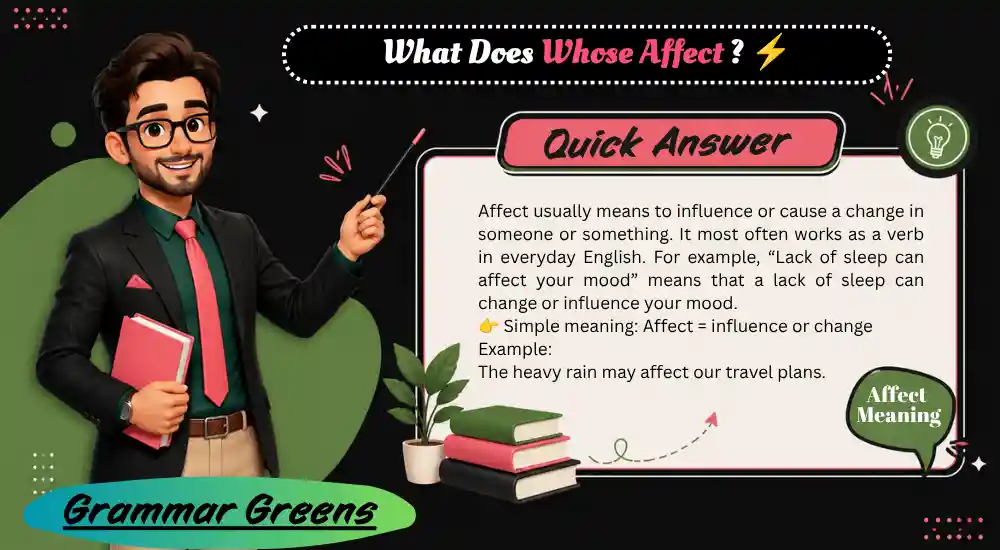
Affect usually means to influence or cause a change in someone or something. It most often works as a verb in everyday English. For example, “Lack of sleep can affect your mood” means that a lack of sleep can change or influence your mood.
👉 Simple meaning: Affect = influence or change
Example:
The heavy rain may affect our travel plans.
In this sentence, the rain can influence the travel plans. Remember that affect usually describes an action or influence, while effect usually describes the result of that action.
TL;DR
- 🎯 Affect usually means influence or change.
- 📝 It most often works as a verb.
- ❤️ Affect can describe an emotional impact.
- 🧠 In psychology, affect can work as a noun.
- 🎭 Affect can also mean pretend in formal usage.
- ⚖️ Affect vs. effect: affect usually means influence, while effect usually means result.
- 🔤 Affected is the common past form of affect.
- 💡 Use the sentence context to choose the correct meaning.
- 📚 Learn the common meaning first before focusing on rare uses.
You Might Also Like That: WYLL Meaning
Affect Meaning and Definition
The most common affect meaning is to influence, change, or have an effect on something. You can use it when one thing changes another thing in some way. People commonly use the word when they talk about health, behavior, emotions, decisions, work, school, weather, and daily life.
For example, “Stress can affect your health” means that stress can influence your health. The change does not always have to be negative. Something can positively affect or negatively affect a person, situation, or result.
Affect as a Verb
Affect mainly works as a verb. It tells us that something influences or changes another person or thing. You normally place the affected person or thing after the verb.
Examples:
- Poor sleep can affect your concentration.
- Noise can affect your ability to study.
- The decision may affect many people.
- Weather can affect travel plans.
A simple way to remember the common use is: affect = influence. When you want to describe an action that changes something, affect will often be the correct word.
Affect and Emotional Impact
Affect can also describe a strong emotional impact. When something deeply affects someone, it causes a strong feeling or emotional response. For example, “The story affected me deeply” means that the story made the speaker feel something strongly.
You can use this meaning with words such as feelings, emotions, mood, and reactions. However, this everyday use differs from the specialized psychology meaning of affect. In ordinary English, it simply tells us that something emotionally influenced a person.
How to Use Affect in a Sentence
You can use affect when you want to explain how one thing influences another. A simple sentence pattern looks like this:
Subject + affect + person or thing
For example, “Stress affects my sleep.” Here, stress performs the action, while my sleep receives the influence. You can use this pattern in many everyday situations.
- Exercise can affect your energy.
- Money problems can affect families.
- Music can affect your mood.
- New rules can affect employees.
Affect Example Sentences
Here are some simple affect examples from everyday English:
- Lack of sleep can affect your memory.
- The news affected her deeply.
- Cold weather can affect your health.
- His decision may affect our plans.
- Social media can affect how people communicate.
- The delay affected the entire team.
Notice that affected works as the past form of affect. These examples show how the word can describe changes in health, emotions, communication, plans, and behavior.
Affect vs. Effect: What’s the Difference?
Affect vs. effect creates one of the most common English word problems. In their most common uses, affect works as a verb, while effect works as a noun.
| Word | Common Role | Simple Meaning | Example |
| Affect 🎯 | Verb | Influence or change | Stress can affect sleep. |
| Effect 📌 | Noun | Result or outcome | Stress can have an effect on sleep. |
A useful basic rule is Affect = influence and Effect = result. However, English has exceptions, so this rule does not cover every possible use.
Easy Way to Remember Affect vs. Effect
Try this simple memory trick: Affect = Action and Effect = End result. The first letters can help you remember their common roles.
For example:
Loud noise can affect your concentration.
Here, the noise influences your concentration. Then:
The effect of loud noise may include poor concentration.
Here, effect describes the result.
🧠 Quick trick: If you mean influence, think affect. If you mean the result, think effect.
Is Affect a Verb or a Noun?
Most people use affect as a verb in everyday English. In this role, it means to influence or change something. For example, “The weather affected our plans” uses affected as a verb.
However, affect can also work as a noun in psychology and related fields. This specialized use describes someone’s visible emotional expression or emotional state. So, saying that affect is always a verb would be too simple.
👉 Everyday use: Affect = usually a verb
👉 Psychology: Affect = can be a noun
The surrounding context tells you which meaning applies.
Affect as a Noun in Psychology
In psychology, affect has a more specialized meaning. It can describe the way a person shows or expresses emotion through facial expressions, voice, body language, and other visible reactions. You may see phrases such as flat affect in professional or clinical writing.
For example, “The patient showed a flat affect” describes limited visible emotional expression. This meaning differs from the everyday verb affect, which means influence or change.
What Does Affect Mean in Psychology?
In simple terms, psychological affect relates to emotional expression. It helps describe what a person’s emotions look like from the outside. A person may show a wide emotional range, while another person may show very little visible emotion.
This specialized meaning often appears in psychology, psychiatry, and mental-health writing. It should not confuse you when you read everyday sentences. In normal conversation, affect usually means influence.
Other Meanings of Affect
Although affect usually means “influence,” dictionaries also record less common meanings. These meanings appear more often in formal, literary, or specialized writing.
One less common use means to pretend, adopt, or deliberately display a particular behavior, manner, or attitude. For example, “He affected an air of confidence” means that he deliberately displayed a confident manner.
Because this meaning appears less often, beginners should focus first on the common meaning: affect = influence or change.
Affect Meaning “To Pretend”
The formal meaning of affect can mean to pretend to have a certain quality, feeling, or manner. For example:
She affected an air of calm.
Here, she deliberately presented herself as calm.
You can also find expressions such as affect an accent, affect ignorance, or affect confidence. This use can look unusual because most people know affect as “influence.”
💡 Tip: Learn this meaning, but do not let it replace the much more common everyday meaning of affect.
Less Common and Historical Uses
Some dictionaries also record older or rare meanings of affect, including uses connected with adopting, assuming, choosing, or taking on something. These meanings can appear in older books, formal writing, or historical texts.
You usually will not need these meanings in everyday conversation. If you are learning English, focus on the most useful meanings first:
- Influence or change 🎯
- Cause an emotional response ❤️
- Pretend or deliberately display 🎭
- Emotional expression in psychology 🧠
This approach keeps the word easier to understand.
Affect Word Forms
Understanding the main word forms of affect can make your writing clearer.
| Word Form | Use | Example |
| Affect | Base verb | Noise can affect sleep. |
| Affects | Present tense | Noise affects sleep. |
| Affected | Past tense | Noise affected my sleep. |
| Affecting | -ing form | Noise is affecting my sleep. |
These forms all connect to the common verb meaning of influence or change. Learning them together can also help you recognize the word quickly when you read it.
Common Mistakes With Affect
The biggest mistake involves confusing affect with effect. Writers also sometimes assume that affect can never work as a noun. In psychology, however, affect can work as a specialized noun.
Another mistake involves using the rare “pretend” meaning without understanding the context. Most everyday sentences use affect to mean influence.
✅ Remember:
- Affect usually means influence.
- Effect usually means result.
- Affected means influenced or emotionally impacted.
- Effected usually means brought about or caused to happen.
Affect Pronunciation
Affect can have different pronunciation patterns depending on its meaning. The common verb, meaning influence, normally receives stress on the second syllable. The specialized psychology noun uses a different stress pattern.
This difference can help you understand the word when someone speaks it aloud. However, you should always consider the context before deciding which meaning a speaker intends.
🔊 When you learn the word, connect its pronunciation with its meaning:
- Common verb → influence or change
- Psychology noun → emotional expression
That small distinction can prevent confusion between the two uses.
Affect Synonyms and Related Words
The best affect synonyms depend on the meaning you want to express. When affect means influence, you can often use words such as impact, change, alter, modify, influence, or sway.
When affect describes an emotional response, words such as move, touch, stir, or upset may work in certain contexts.
For example:
Stress can affect your sleep.
You could say:
Stress can influence your sleep.
However, synonyms do not always carry exactly the same meaning or tone. Choose a replacement that fits the sentence naturally.
Quick Answer
Affect usually means to influence, change, or have an impact on someone or something. It normally works as a verb.
Example:
Lack of sleep can affect your health.
The word also has other meanings. In psychology, affect can work as a noun related to visible emotional expression. In formal writing, affect can also mean to pretend or deliberately display a certain manner.
⭐ Simple rule: Affect = influence. Effect = result.
FAQs
What does affect mean?
Affect usually means to influence or cause a change in someone or something. For example, “Stress can affect your health” means stress can influence your health.
Is affect a verb or noun?
Affect usually works as a verb in everyday English. It can also work as a noun in psychology, where it refers to visible emotional expression.
What is the difference between affect and effect?
Affect usually means influence, while effect usually means a result or outcome. For example, “Stress can affect sleep” and “Stress can have an effect on sleep.”
What does affect mean in psychology?
In psychology, affect refers to a person’s observable emotional expression or emotional state. You may see terms such as flat affect in professional writing.
Can affect mean pretend?
Yes. In formal or literary English, affect can mean to pretend, adopt, or deliberately display a particular manner or quality.
How do I remember affect vs. effect?
Use the simple memory aid Affect = Action and Effect = End result. This works well for their most common uses, although English has exceptions.
Final Thought
Understanding affect meaning becomes much easier when you focus on its most common use first. In everyday English, affect usually means to influence or change something. Once you understand that meaning, you can build your knowledge by learning its emotional use, psychology meaning, formal “pretend” meaning, and word forms.
The biggest point to remember is the difference between affect and effect. 🎯 Think affect = influence and effect = result. With a few simple examples and regular practice, you can use both words more confidently and avoid common grammar mistakes.