Have you ever wondered what “whose” 🔑 means or when to use it in a sentence? Whose is a common English word that we use to ask about possession, ownership, or a connection. For example, “Whose phone is this?” asks who the phone belongs to. You can also use “whose” to connect ideas, as in “The student whose book I borrowed is my friend.” Understanding the meaning of whose can make your everyday English clearer.
Many learners also confuse “whose” and “who’s” ⚠️ because they sound the same when spoken. However, they have different meanings and grammatical roles. Whose shows possession, while who’s usually means “who is” or “who has.” This guide explains the meaning of whose, how to use it correctly, and simple examples that help you avoid common mistakes.
Quick Answer
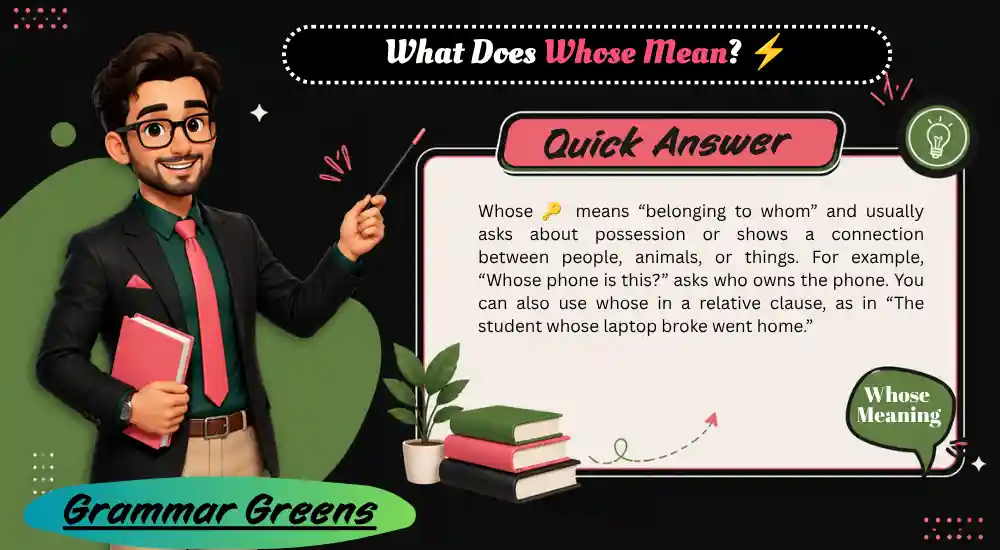
Whose 🔑 means “belonging to whom” and usually asks about possession or shows a connection between people, animals, or things. For example, “Whose phone is this?” asks who owns the phone. You can also use whose in a relative clause, as in “The student whose laptop broke went home.”
Remember the main difference: whose shows possession, while who’s means “who is” or “who has.” If you can replace who’s with “who is” or “who has,” then who’s is usually correct. Otherwise, use whose when you mean possession.
TL;DR
Here is the easiest way to remember the meaning of whose 📌:
- 🔑 Whose shows possession or connection.
- ❓ Use whose to ask who owns something.
- 🧩 Use whose in relative clauses.
- 🐾 Whose can refer to people, animals, and things.
- ⚖️ Whose is different from who’s.
- 👤 Who’s means “who is” or “who has.”
- ❌ Do not write whose’s.
- 📝 Use examples to learn whose usage naturally.
- ✅ Use the replacement test to check whose vs. who’s.
You Might Also Like That: Ion Meaning
What Does “Whose” Mean?
Whose 🔑 means “belonging to whom” or asks who owns or has a connection with something. We mainly use it to ask about possession. For example, “Whose jacket is this?” means “Who does this jacket belong to?” The word can also connect a person or thing with something related to them. In “The girl whose phone rang left the room,” “whose” connects the girl with her phone. This simple whose definition covers its most common use in English.
You can use whose in both questions and statements. It can refer to people, animals, and even things when you want to show a relationship or connection. For example, “Whose keys are these?” asks about ownership, while “I visited a house whose roof was damaged” shows a connection. So, the whose meaning in English goes beyond simple ownership and can help connect ideas clearly.
How Is “Whose” Used in English?
English speakers use whose 📝 mainly to ask about possession or to connect a noun with something that belongs to or relates to it. In a question, you can say, “Whose laptop is on the desk?” In a relative clause, you can say, “I know the teacher whose class you joined.” These examples show how whose usage can work in different sentence structures without changing its basic idea.
The word can also make sentences shorter and smoother. Instead of saying, “I met a man and his car was stolen,” you can say, “I met a man whose car was stolen.” This use of whose as a relative pronoun helps connect two ideas naturally. Once you understand this pattern, you can use whose confidently in everyday English and formal writing.
“Whose” for Possession
We often use whose 🔑 to ask who owns something or who something belongs to. For example, “Whose bag is this?” asks about the owner of the bag. You can also ask, “Whose car did you borrow?” or “Whose shoes are by the door?” In each example, whose shows possession. This makes it easy to remember: when you want to ask about ownership, whose is usually the correct word.
“Whose” in Relative Clauses
You can use whose 🧩 to connect a person or thing with another noun. For example, “She is the woman whose son works here.” The word “whose” connects the woman with her son. You can also say, “I read a book whose ending surprised me.” This structure makes sentences more natural because it joins related information without creating two separate sentences. Here, whose works as a relative pronoun.
“Whose” in Questions
One common use of whose ❓ appears in questions about ownership. You can place whose before a noun to ask who owns something. For example, “Whose phone is ringing?” or “Whose notebook is this?” The answer can identify the owner, such as “It is Sarah’s phone.” This pattern makes whose in questions easy to understand: whose + noun + verb often creates a question about possession.
You can also use whose when the person who owns something is not known. For example, “Whose keys did you find?” asks about the owner of the keys. In everyday conversations, people use these questions often at home, school, and work. Learning a few common whose sentence examples can help you understand the pattern and use it naturally.
Can “Whose” Be Used for Things and Animals?
Yes, whose 🐾 can refer to people, animals, and things. Many learners think we can only use whose for people, but English allows broader use. For example, “The dog whose owner moved away looked sad” refers to an animal. You can also say, “I bought a phone whose screen is very bright.” In both cases, whose connects something with a related person, feature, or quality.
You can also use whose for things in formal and everyday English. For example, “We visited a building whose windows were broken.” Some formal sentences may use “of which,” but whose often sounds more natural and direct. This makes whose useful when you describe objects, animals, companies, places, or other things that have a clear connection to another noun.
Whose vs. Who’s: What’s the Difference?
The difference between whose ⚖️ and who’s is simple once you understand their jobs. Whose shows possession or connection, while who’s is a contraction of “who is” or “who has.” They sound alike, but their meanings differ. Compare “Whose bag is this?” with “Who’s coming to the party?” The first asks about ownership, while the second asks who is coming.
| Word | Meaning | Example |
| Whose 🔑 | Shows possession | Whose jacket is this? |
| Who’s 👤 | Who is / who has | Who’s waiting outside? |
An Easy Trick to Remember Whose vs. Who’s
Try the replacement test ✅ when you are unsure. If you can replace “who’s” with “who is” or “who has,” use “who’s.” For example, “Who’s at the door?” becomes “Who is at the door?” and still makes sense. However, “Whose bag is this?” does not work with “who is.” That tells you that whose is correct because the sentence asks about possession.
Whose vs. Who vs. Whom
The words who, whom, and whose 🔤 can confuse English learners, but each has a different main job. Who usually refers to the person performing an action, while whom refers to the person receiving an action. Whose shows possession. For example, “Who called you?” uses who as the subject. “Whom did you call?” uses whom as the object. “Whose phone did you call from?” asks about possession.
| Word | Main Use | Example |
| Who 👤 | Subject | Who called me? |
| Whom 👤 | Object | Whom did you call? |
| Whose 🔑 | Possession | Whose phone is this? |
Common Mistakes With “Whose”
Many mistakes happen because whose and who’s ⚠️ sound the same. Writers sometimes add an apostrophe to whose or use who’s when they want to show possession. Remember that whose already has a possessive meaning, so it does not need an apostrophe. Reading your sentence aloud can help, but the replacement test works even better when you need to choose between the two words.
Using “Who’s” for Possession
❌ Who’s phone is this?
✅ Whose phone is this?
The first sentence uses who’s, which means “who is” or “who has.” That meaning does not fit the sentence. The second sentence correctly uses whose because the question asks who owns the phone. This is one of the most common whose grammar mistakes.
Using “Whose” Instead of “Who’s”
❌ Whose coming with us?
✅ Who’s coming with us?
Here, the sentence means “Who is coming with us?” Because “who is” works as a replacement, you need who’s, not whose. This simple test can help you avoid one of the most common mistakes with these two words.
Adding an Apostrophe to “Whose”
❌ Whose’s book is this?
✅ Whose book is this?
Never add an apostrophe to whose when you use it to show possession. The word already has a possessive function. Whose’s is not the correct form in standard English. If you see an apostrophe, check whether you actually mean who’s, which can stand for “who is” or “who has.”
“Whose” Examples in Everyday Sentences
The best way to understand whose 📝 is to see it in real sentences. These examples show how the word works in questions, statements, and relative clauses:
- Whose bag is on the chair?
- Whose keys did you find?
- Do you know whose car this is?
- She is the woman whose son won the award.
- I bought a house whose roof needs repair.
- The dog whose owner moved away stayed with us.
These whose examples show that the word can ask about ownership or connect one noun with another. Try creating your own sentences to practice the pattern.
Does “Whose” Have an Apostrophe?
No, whose ❌ does not need an apostrophe. This often confuses learners because who’s contains an apostrophe. However, the apostrophe in who’s shows that it is a contraction of “who is” or “who has.” Whose does not work as a contraction. It already expresses possession or connection.
A useful rule is simple: whose = possession, while who’s = who is/who has. For example, “Whose coat is this?” asks about ownership. “Who’s wearing that coat?” means “Who is wearing that coat?” Once you learn this difference, the apostrophe becomes much easier to remember.
What Part of Speech Is “Whose”?
The word whose 🔤 can serve different grammatical roles depending on how you use it. It can work as a pronoun or as a word that comes before a noun to show possession. For example, “Whose is this?” uses whose without a noun after it, while “Whose book is this?” places whose directly before the noun “book.”
You do not need complex grammar terms to use it correctly. Focus on what whose does in the sentence. It usually asks about or shows possession, ownership, or connection. Understanding this basic function matters more than memorizing difficult grammar labels.
FAQs
What does “whose” mean?
Whose 🔑 means “belonging to whom” and usually asks about ownership or possession. For example, “Whose book is this?” asks who owns the book.
What is the difference between “whose” and “who’s”?
Whose shows possession, while who’s means “who is” or “who has.” For example, “Whose bag is this?” and “Who’s coming with us?” use the words correctly.
Can “whose” be used for things?
Yes. You can use whose 🧩 for people, animals, and things. For example, “I visited a house whose windows were broken.”
Is “whose” a pronoun?
Yes, whose can function as a pronoun. It can also come before a noun to show possession or connection.
Does “whose” have an apostrophe?
No. Whose does not need an apostrophe. The apostrophe belongs to who’s, which means “who is” or “who has.”
How do you use “whose” in a sentence?
Use whose when you want to ask about possession or connect something with a person, animal, or thing. For example, “Whose jacket is this?”
What is the difference between who, whom, and whose?
Who usually acts as the subject, whom acts as the object, and whose shows possession. These words have different roles in a sentence.
Final Thought
Understanding whose 💡 does not require complicated grammar rules. Start with its main idea: whose shows possession or connection. When you ask “Whose bag is this?” you want to know who owns the bag. When you say “the woman whose car was stolen,” you connect the woman with her car.
The biggest mistake to avoid involves whose vs. who’s ⚠️. Remember that whose shows possession, while who’s means “who is” or “who has.” With these simple rules and regular practice, you can use whose naturally and confidently in both everyday conversations and formal writing.