If you often confuse whose vs. who’s, you’re not alone. These two words sound the same, but they have different meanings and uses. Whose shows possession, belonging, or a relationship, while who’s is a contraction of who is or who has. Knowing this simple difference can help you avoid common grammar mistakes in texts, emails, schoolwork, and everyday writing.
The good news is that you can tell whose and who’s apart with a simple trick. In this guide, you’ll learn when to use whose or who’s, see clear sentence examples, understand why whose does not need an apostrophe, and discover an easy way to choose the correct word every time.
Whose vs. Who’s: Quick Answer
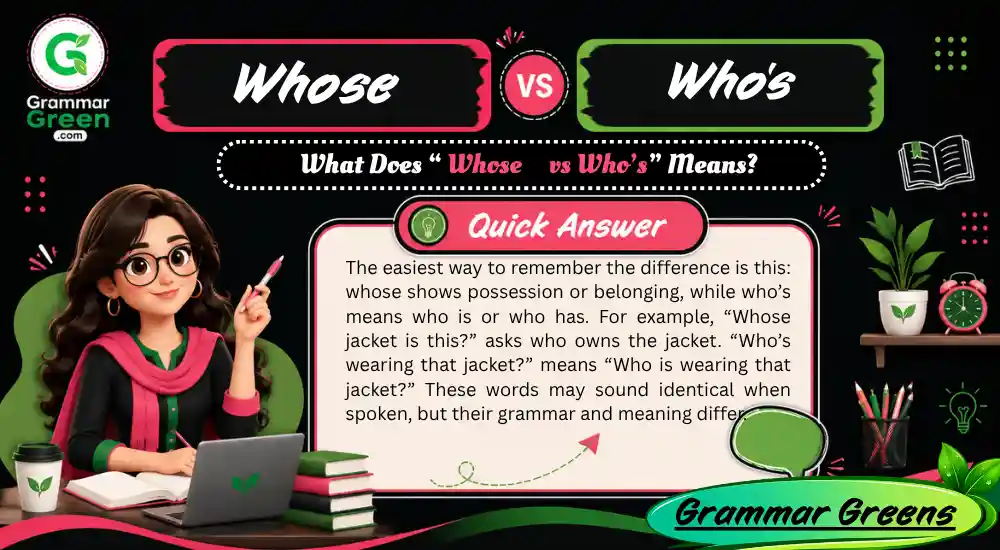
The easiest way to remember the difference is this: whose shows possession or belonging, while who’s means who is or who has. For example, “Whose jacket is this?” asks who owns the jacket. “Who’s wearing that jacket?” means “Who is wearing that jacket?” These words may sound identical when spoken, but their grammar and meaning differ.
| Word | Meaning | Use | Example |
| Whose 🔑 | Possession or belonging | Shows who something belongs to | Whose phone is this? |
| Who’s ✏️ | Who is / who has | Shortened form of two words | Who’s calling me? |
TL;DR: Whose vs. Who’s
- 🔑 Whose = possession, belonging, or association
- ✏️ Who’s = who is
- ⏳ Who’s = who has
- 🧠 Use the replacement test for who’s
- ❌ Don’t use who’s to show possession
- ✅ Use whose for ownership and relationships
- 📝 Whose does not need an apostrophe
- 🔍 Who’s uses an apostrophe because it shortens two words
- 🐶 Whose can describe people, animals, places, and things
You Might Also Like That: MB Meaning
What Does “Whose” Mean?
Whose is the possessive form of who. It asks about or describes who something belongs to. You can use it for people, animals, places, and things when you want to show a connection or relationship. For example, “Whose book is on the desk?” asks who owns the book. You can also use whose in statements, such as “The student whose notebook went missing looked worried.”
How to Use Whose in a Sentence
Use whose when you need to show possession, belonging, or association. It often comes before a noun, such as “whose car,” “whose idea,” or “whose house.” You can also use it in a relative clause: “She met the writer whose novel became popular.” Remember that whose does not need an apostrophe, even though it expresses possession.
What Does “Who’s” Mean?
Who’s is a contraction. It combines who is or who has into one shorter form. The apostrophe shows that letters have been removed. For example, “Who’s at the door?” means “Who is at the door?” Similarly, “Who’s finished the work?” can mean “Who has finished the work?” Understanding both meanings makes it much easier to choose who’s correctly.
Who’s = Who Is
Use who’s when you can replace it with who is without changing the meaning. For example, “Who’s coming to dinner?” means “Who is coming to dinner?” You can use this form in questions, statements, and relative clauses. If replacing who’s with who is still makes sense, you have found the correct word.
Who’s = Who Has
Who’s can also mean who has. For example, “Who’s finished the assignment?” means “Who has finished the assignment?” You may also see it in sentences such as “Who’s been to London?” Here, who’s means “who has.” This use often appears before a past participle, such as finished, been, seen, or done.
When Should You Use Whose?
Use whose when you want to show ownership, possession, belonging, or association. It commonly appears in questions such as “Whose keys are these?” and “Whose idea was that?” However, whose does not only describe physical ownership. It can also show a relationship, as in “The teacher whose class I joined was helpful.” This wider use makes whose an important part of everyday English grammar.
You can use whose with people, animals, places, and things. For example, “The dog whose owner moved away looked sad” and “The company whose products we use opened a new office.” This means whose can describe more than simple ownership. It can show that one person, animal, place, or thing connects to another.
When Should You Use Who’s?
Use who’s when the sentence needs who is or who has. A quick replacement test can help you decide. For example, “Who’s your teacher?” becomes “Who is your teacher?” so who’s works. Likewise, “Who’s completed the project?” becomes “Who has completed the project?” If either expansion makes sense, you should use who’s.
Be careful not to choose who’s simply because you see an apostrophe. The apostrophe does not show possession here. Instead, it replaces missing letters in who is or who has. If you want to show that something belongs to someone, use whose instead. This simple rule can prevent many common whose vs. who’s mistakes.
The Easy “Who Is / Who Has” Test
The replacement test gives you a fast way to choose the correct word. First, replace who’s with “who is.” If the sentence sounds correct, use who’s. If it does not, try “who has.” If neither version works and the sentence asks about possession or belonging, use whose.
For example, “Who’s at the door?” becomes “Who is at the door?” That works. But “Whose bag is this?” cannot become “Who is bag is this?” The sentence asks about ownership, so whose is correct. This simple test works in many everyday situations.
Why Doesn’t “Whose” Have an Apostrophe?
Many learners wonder why whose shows possession but does not contain an apostrophe. The answer comes from its grammar. Whose is already the possessive form of who, so it does not need an apostrophe. By contrast, who’s uses an apostrophe because it combines two words: who is or who has.
Think of the apostrophe as a contraction signal, not a possession signal. Compare “Whose coat is this?” with “Who’s wearing the coat?” The first asks about ownership. The second means “Who is wearing the coat?” Remembering this difference makes the apostrophe rule much easier.
Can “Whose” Refer to Things, Animals, and Places?
Yes, whose can refer to more than people. You can use it with animals, places, objects, and organizations when you want to show a connection or relationship. For example, “The dog whose tail was injured needed care” uses whose with an animal. “The city whose history attracts tourists is beautiful” uses it with a place.
You can also use whose with things: “The book whose cover is torn belongs to me.” This use may seem unusual at first, but it follows the same basic rule. Whose connects one noun to another and shows possession, association, or another close relationship.
Whose vs. Who’s in Relative Clauses
Both words can appear in longer sentences, but they perform different jobs. Whose can introduce a relative clause that shows possession or association: “I met the woman whose brother works here.” Who’s can appear when it means who is or who has, such as “I know someone who’s working there.”
The key is to expand who’s. If you can replace it with who is or who has, keep the apostrophe. If the clause shows possession or connection, use whose. This distinction helps you handle longer sentences without guessing.
Whose vs. Who’s Examples
Seeing the words side by side can make the difference much clearer. Notice how whose connects something to an owner or relationship, while who’s expands into who is or who has.
Examples of Whose
- Whose phone is ringing? 📱
- Whose car is parked outside? 🚗
- I know the student whose book is missing.
- Whose idea was this?
- The dog whose owner moved away needs a home.
Examples of Who’s
- Who’s coming with us? 👥
- Who’s at the door?
- Who’s responsible for this?
- Who’s finished the assignment?
- Who’s been to that restaurant?
Side-by-Side Examples
| Correct Sentence | Meaning |
| Whose phone is this? | Who owns the phone? |
| Who’s calling? | Who is calling? |
| Whose idea was it? | Who had the idea? |
| Who’s responsible? | Who is responsible? |
| Whose turn is it? | Who has the turn? |
| Who’s finished? | Who has finished? |
Common Whose vs. Who’s Mistakes
The most common mistake happens when writers see the apostrophe in who’s and assume it shows possession. It does not. The apostrophe only creates the contraction who is or who has. Use whose when you ask who owns, has, or connects to something.
- ❌ Who’s phone is this?
✅ Whose phone is this? - ❌ Whose coming with us?
✅ Who’s coming with us? - ❌ Whose been working here?
✅ Who’s been working here?
How to Remember Whose vs. Who’s
Use two simple memory rules. 🧠 Whose = possession. Think about something belonging to someone. Who’s = who is or who has. When you see who’s, expand it in your mind. If “who is” or “who has” works, keep the apostrophe.
Another helpful reminder is that the apostrophe in who’s does not mean ownership. It tells you that two words have been shortened. Once you connect whose with possession and who’s with a contraction, you can usually choose the right word quickly.
Whose vs. Who’s in Formal and Informal Writing
Both whose and who’s can appear in everyday writing, but formal writing may avoid contractions. In casual messages, emails, and conversations, who’s sounds natural: “Who’s joining the meeting?” In academic or highly formal writing, some style guides prefer the full form who is or who has.
Whose does not have this issue because it is not a contraction. You can use it normally in formal and informal writing. For example, “The researcher whose study received attention…” works in an academic sentence without any problem.
Whose vs. Who’s Mini Quiz
Test yourself by choosing whose or who’s:
- ___ coming to the party?
- ___ jacket is this?
- ___ finished the report?
- ___ idea was it?
- Do you know ___ car this is?
Answers:
- Who’s
- Whose
- Who’s
- Whose
- Whose
Use the who is / who has test whenever you feel unsure. If the sentence asks about possession, choose whose.
FAQs About Whose vs. Who’s
What is the difference between whose and who’s?
Whose shows possession, belonging, or association, while who’s means who is or who has. For example, “Whose book is this?” asks about ownership, while “Who’s reading the book?” means “Who is reading the book?”
Is who’s possessive?
No. Who’s is not a possessive word. It is a contraction of who is or who has. Use whose when you need to show possession or belonging.
Does who’s mean who is or who has?
It can mean either one. The surrounding sentence tells you which meaning applies. “Who’s coming?” means “Who is coming?” while “Who’s finished?” can mean “Who has finished?”
Why doesn’t whose have an apostrophe?
Whose already functions as a possessive form of who, so it does not need an apostrophe. The apostrophe in who’s marks a contraction instead.
Can whose refer to things?
Yes. Whose can refer to people, animals, places, objects, and organizations when it shows possession, association, or a relationship.
How can I remember whose vs. who’s?
Remember whose = possession and who’s = who is/who has. When you see who’s, try expanding it. If the expanded sentence works, use who’s.
Final Thought
The difference between whose and who’s becomes simple once you focus on what each word does. Use whose when you talk about possession, belonging, or association. Use who’s when you mean who is or who has. When you are unsure, use the replacement test and expand “who’s” into “who is” or “who has.” With a little practice, you can avoid this common grammar mistake and choose the correct word with confidence.