If you see “MB” in a text message, it usually means “my bad.” It is a casual way to admit a mistake, acknowledge that something was your fault, or offer a quick apology. The phrase “my bad” is considered informal and is used to accept responsibility for being wrong or making a mistake.
For example, if someone sends the wrong time and then texts, “MB, I meant 7 PM,” they are saying, “My bad—I made a mistake.”
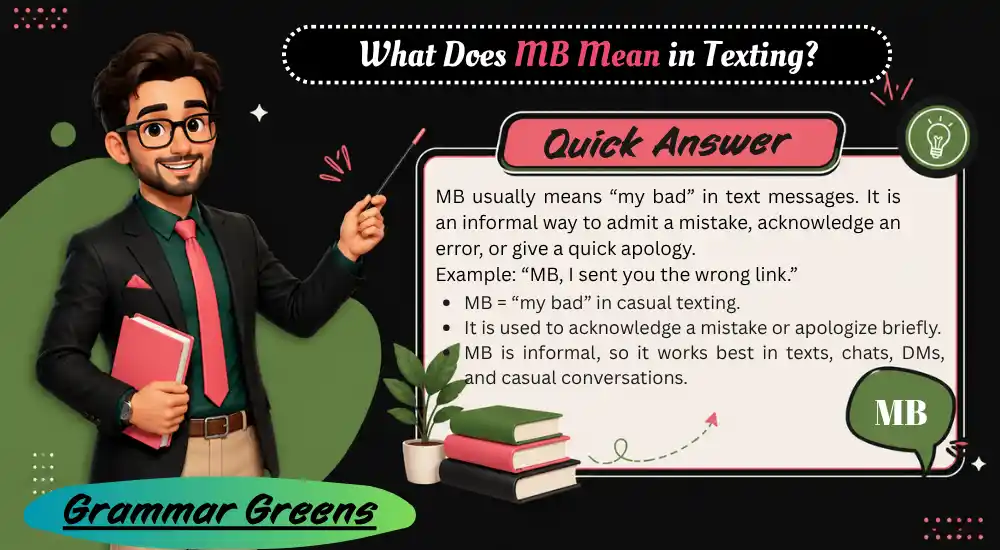
Quick Answer
MB usually means “my bad” in text messages. It is an informal way to admit a mistake, acknowledge an error, or give a quick apology.
Example: “MB, I sent you the wrong link.”
TL;DR
- MB = “my bad” in casual texting.
- It is used to acknowledge a mistake or apologize briefly.
- MB is informal, so it works best in texts, chats, DMs, and casual conversations.
- In serious or professional situations, “I’m sorry” or “My mistake” may be more appropriate.
- MB can also mean “megabyte” when the context involves files, storage, or digital data.
You Might Also Like That: What Does Ion Mean
What Does MB Mean in Texting?
In texting, MB usually stands for “my bad.” People use it when they want to quickly acknowledge a small mistake without writing a longer apology.
The expression can mean something close to “That was my mistake,” “My fault,” or “Sorry about that.” Because “my bad” is informal, MB is most natural in casual conversations with friends, family, classmates, coworkers you know well, or people you chat with online.
MB = “my bad” in most casual texting contexts.
What Does “My Bad” Mean?
“My bad” is an informal expression used when someone admits that they are wrong or that something is their fault. It can work as a brief apology, especially when the mistake is relatively minor.
For example, if you accidentally send someone the wrong link, you might say:
“MB, I sent you the wrong link.”
The message does two things at once: it acknowledges the error and takes responsibility for it.
How Is MB Used in Text Messages?
People commonly use MB when they need to correct themselves or acknowledge something they did wrong. It is especially useful when the mistake does not require a long or formal apology.
Common situations include:
- Sending the wrong information
- Making a typo
- Forgetting something
- Misunderstanding a message
- Giving someone the wrong time or location
- Sending something to the wrong person
- Realizing you made an incorrect assumption
💡 Example:
Alex: You said the meeting was at 5.
Sam: MB, I checked again. It’s actually at 6.
Here, MB quickly signals that Sam recognizes the mistake and is correcting it.
You Might Also Like That: FRFR Meaning
MB Texting Examples
Seeing MB in context makes its meaning much easier to understand.
| Situation | Example |
| Wrong information | “MB, I gave you the wrong address.” |
| Typo | “MB, I meant Tuesday, not Thursday.” |
| Forgetting something | “MB, I completely forgot to call you.” |
| Misunderstanding | “MB, I thought you said tomorrow.” |
| Wrong link | “MB, that’s the old link. Here’s the new one.” |
💡 Example Conversation
Person 1: You sent me the wrong file.
Person 2: MB! I’ll send the correct one now.
In each example, MB means “my bad,” not a completely different phrase. The surrounding words make the intended meaning clear.
What Tone Does MB Have?
MB has a casual and informal tone. It is short, conversational, and usually suitable for everyday digital communication.
Because it is so brief, the tone can also depend on what comes after it. “MB, I forgot” can sound like a simple admission of a small mistake. In a serious situation, however, replying with only “MB” may feel too casual or dismissive because the other person may expect a fuller apology.
⭐ Think of MB as a quick acknowledgment of a mistake, not a formal apology.
When Should You Use MB?
MB works best when the conversation is informal and the mistake is relatively minor.
You can use it naturally in:
- Text messages with friends
- Group chats
- Casual DMs
- Informal online conversations
- Gaming chats
- Social-media messages
- Quick corrections
You Might Also Like That: IMO Meaning
For example:
“MB, I read your message wrong.”
or:
“MB, forgot to send that earlier.”
The phrase is useful when you want to take responsibility without making a small mistake sound overly serious.
When Should You Avoid MB?
MB is not the best choice for every situation.
If you made a serious mistake, caused significant inconvenience, or are communicating in a formal setting, a clearer apology is usually more appropriate.
For example, instead of:
“MB.”
you might write:
“I’m sorry for the mistake. I’ll fix it as soon as possible.”
This is especially relevant in professional communication, customer-service situations, or sensitive conversations. The more serious the situation, the more useful it is to explain what happened and what you will do about it.
How Do You Respond to “MB”?
If someone says “MB” after making a small mistake, your response can be simple.
Common casual replies include:
- “No worries.”
- “All good.”
- “It’s okay.”
- “No problem.”
- “You’re good.”
- “Thanks for clarifying.”
💡 Example:
Person 1: MB, I sent the wrong time.
Person 2: No worries!
For a more serious mistake, you do not have to respond as though everything is automatically fine. Your reply can acknowledge the situation and focus on what needs to happen next.
MB vs. Sorry vs. My Mistake
These expressions can overlap, but they are not identical in tone or use.
| Expression | Meaning | Formality | Typical tone |
| MB | My bad; I made a mistake | Very informal | Casual |
| Sorry | An apology | Casual to neutral | General |
| My mistake | I acknowledge my error | Neutral | Direct |
| My fault | I accept responsibility | Casual to neutral | Direct |
| I apologize | A more explicit apology | Formal | Professional |
MB is the shortest and most casual option. “My mistake” is clearer and more neutral, while “I apologize” is better suited to formal situations.
What Does MB Mean on Social Media?
On social media and messaging platforms, MB generally keeps the same conversational meaning: “my bad.”
You may encounter it in:
- Instagram DMs
- Snapchat messages
- TikTok comments or chats
- WhatsApp conversations
- Discord chats
- Group messages
- Other casual online conversations
The platform itself usually does not change the meaning. The surrounding conversation matters more.
You Might Also Like That: IWK Meaning
For example:
“MB, I didn’t see your message earlier.”
In this context, MB naturally means “my bad.”
Does MB Always Mean “My Bad”?
No. Context matters.
In a casual text about a mistake, MB will usually be understood as “my bad.” But in a conversation about computers, storage, files, or data, MB can mean “megabyte.” NIST, for example, uses MB as an abbreviation for megabyte.
📋 Compare the context:
| Example | Meaning of MB |
| “MB, I forgot to call.” | My bad |
| “MB, I sent the wrong photo.” | My bad |
| “The photo is 4 MB.” | Megabytes |
| “The file is 20 MB.” | Megabytes |
A simple rule is to look at the words around MB. If someone is admitting a mistake, it probably means “my bad.” If they are discussing file size or digital data, it probably means “megabyte.”
What Does MB Mean Besides “My Bad”?
The most important alternate meaning to know is megabyte, a unit used to describe digital information and file sizes. NIST lists MB as an abbreviation for megabyte.
For example:
“The image is 5 MB.”
Here, MB clearly refers to the size of the image, not an apology.
So, when you see MB, check the context before deciding what it means. In casual texting, “my bad” is the relevant interpretation when the message is about a mistake or apology. In technology-related conversations, megabyte is the more likely meaning.
Frequently Asked Questions About MB
What does MB mean in text?
In text messages, MB usually means “my bad.” It is an informal way to acknowledge a mistake, admit fault, or give a quick apology.
What does MB stand for in texting?
MB commonly stands for “my bad” in texting and casual online conversations.
Does MB mean my bad?
Yes. In a casual texting context, MB commonly means “my bad.” The phrase is an informal way to admit that you made a mistake or that something was your fault.
Is MB an apology?
It can be. MB is often used as a brief, informal apology after a mistake. However, it is less formal and less explicit than phrases such as “I’m sorry” or “I apologize.”
Is MB rude?
MB is not inherently rude. It is simply very casual. It can seem dismissive if someone uses it after a serious mistake or in a situation where a more thoughtful apology is expected.
Is MB formal or informal?
MB is informal. It is best suited to casual texting, chats, DMs, and everyday conversations rather than formal documents or professional apologies.
How do you respond to MB?
For a minor mistake, you can respond with “No worries,” “All good,” “It’s okay,” or “No problem.” Your response should depend on the situation.
What does MB mean on social media?
In a conversational social-media context, MB usually means “my bad.” It can be used when someone wants to acknowledge a mistake or apologize quickly.
Does MB always mean my bad?
No. Context determines the meaning. In technology, MB commonly means “megabyte.”
What does MB mean in technology?
In technology, MB commonly means megabyte, a unit used to describe digital information and file sizes.
⭐ Final Takeaway
MB usually means “my bad” in text messages and casual online conversations. It is a short, informal way to acknowledge a mistake, accept responsibility, or apologize.
If you see “MB” after someone makes a mistake, “my bad” is usually the intended meaning. If MB appears next to a file size, such as “10 MB,” it most likely means megabyte instead.
The easiest way to understand MB is to look at the context around it. In casual conversation, think “my bad.” In technology and file-size discussions, think “megabyte.”