Have you ever wondered whether to write your or you’re in a sentence? You’re not alone. These two words sound the same, but they have different meanings and grammatical roles. Your shows possession or association, while you’re is a contraction of “you are.” Learning the difference can help you write clearer emails, school assignments, messages, and everyday English.
This guide explains your vs. you’re in simple language, with clear examples, common mistakes, and an easy memory trick. Whether you are a student, English learner, or writer, you’ll learn how to choose the correct word confidently and avoid confusing these commonly confused words.
Your vs. You’re: The Quick Answer
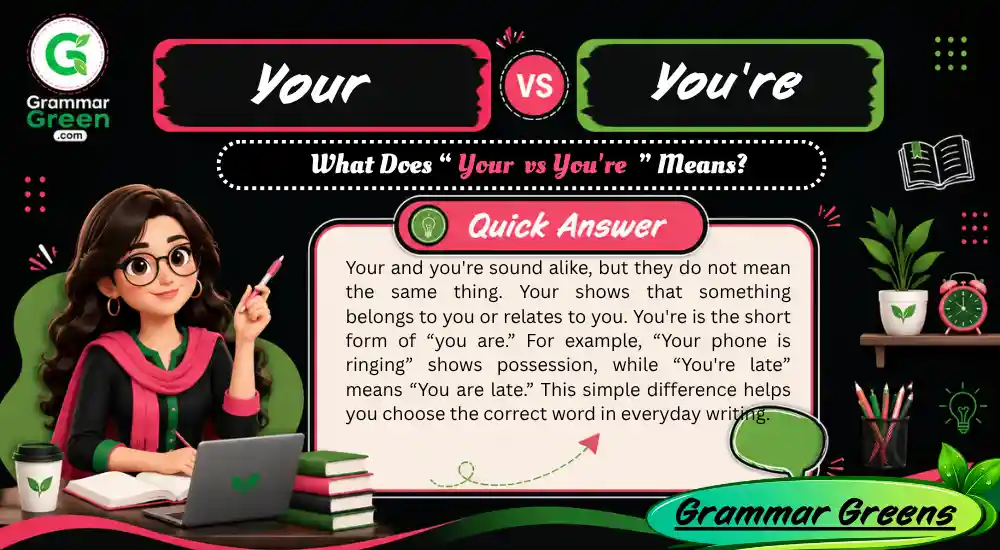
Your and you’re sound alike, but they do not mean the same thing. Your shows that something belongs to you or relates to you. You’re is the short form of “you are.” For example, “Your phone is ringing” shows possession, while “You’re late” means “You are late.” This simple difference helps you choose the correct word in everyday writing.
| Word | Meaning | Example |
| Your | Shows possession | Your book is here. |
| You’re | Means you are | You’re very kind. |
When you understand this rule, you can avoid many common grammar mistakes in emails, schoolwork, and messages.
TL;DR
- ✅ Your shows possession or a connection to someone
- ✅ You’re is the short form of you are
- 🧠 Use the “you are” test to choose the correct word
- ✍️ Example: Your book is here
- 😊 Example: You’re doing a great job
- ⚠️ You’re welcome is correct, not your welcome
- 📚 Practice with simple examples to avoid common grammar mistake
You Might Also Like That: MYF meaning in text
What Does “Your” Mean?
Your is a possessive adjective, also called a possessive determiner. It shows that something belongs to you or connects to you. You can place it before a noun, such as book, name, phone, or idea. For example, “Your bag is on the chair” tells us that the bag belongs to you. “Your opinion matters” shows a connection to you.
Examples of “Your” in a Sentence
- 📚 Your homework looks neat.
- 🏠 Your house has a beautiful garden.
- 📱 Did you bring your phone?
- ✍️ Please check your spelling.
- 🎒 Where is your school bag?
Remember, your usually comes before a noun. It does not mean “you are.”
What Does “You’re” Mean?
You’re is a contraction of you are. A contraction combines two words into a shorter form. The apostrophe replaces letters from “are,” creating “you’re.” Writers often use this form in everyday English because it sounds natural and keeps sentences short.
For example, “You’re ready” means “You are ready.” You can also write “You’re learning English,” which means “You are learning English.” Both forms have the same meaning.
Examples of “You’re” in a Sentence
- 😊 You’re very helpful.
- 📖 You’re learning quickly.
- ⏰ You’re late for class.
- 🌟 You’re doing a great job.
- 🎉 You’re welcome to join us.
Use you’re when you can replace it with you are without changing the sentence’s meaning.
Your vs. You’re: A Simple Comparison Table
The easiest way to understand your vs. you’re is to compare their grammatical roles. Your shows possession, while you’re expresses a statement about you. The words look similar, but they work differently in a sentence.
| Feature | Your | You’re |
| Word type | Possessive adjective | Contraction |
| Full meaning | Belonging to you | You are |
| Main use | Before a noun | Before an adjective, verb, or phrase |
| Example | Your jacket is blue. | You’re wearing a blue jacket. |
| Quick test | Ask, “What belongs to you?” | Replace with “You are.” |
Your vs. You’re Examples
Compare these sentences:
- Your friend is waiting. → The friend is connected to you.
- You’re waiting for your friend. → You are waiting.
- Your answer is correct. → The answer belongs to your work.
- You’re correct. → You are correct.
These examples show why you cannot use the two words interchangeably.
You Might Also Like That: FAFO Meaning
When to Use “Your” in a Sentence
Use your when you want to show possession, ownership, or a connection to someone. It can describe physical things, personal qualities, ideas, and relationships. For example, “Your smile is lovely” connects the smile to you. “Your teacher called” connects the teacher to you.
You do not need to own something physically to use your. The word can also describe a person’s role, opinion, or responsibility.
Common Examples of “Your”
- 🏡 Your home
- 📚 Your books
- 📝 Your assignment
- 💡 Your idea
- 🎓 Your teacher
- ❤️ Your family
- 🎯 Your goal
Quick rule: If the word comes before a noun and shows a connection to you, your is usually correct.
When to Use “You’re” in a Sentence
Use you’re when you mean you are. It can describe a person’s condition, action, feeling, or situation. For example, “You’re happy” means “You are happy.” “You’re working” means “You are working.”
The word can appear before an adjective, a present participle, or another phrase. It does not show ownership.
Common Examples of “You’re”
- You’re happy.
- You’re ready.
- You’re working hard.
- You’re a good friend.
- You’re going to school.
- You’re doing well.
Quick rule: If you can replace you’re with you are, use you’re.
The “You Are” Test: An Easy Way to Choose the Correct Word
The “you are” test is one of the simplest ways to solve your vs. you’re confusion. When you are unsure, replace the word with “you are.” If the sentence still makes sense, use you’re. If the sentence sounds wrong, use your.
For example, “You’re kind” becomes “You are kind,” which makes sense. However, “Your kind” becomes “You are kind,” which changes the meaning. The test helps you check your writing quickly.
Practice the “You Are” Test
| Sentence | Correct word | Test |
| ___ very smart. | You’re | You are very smart. |
| I like ___ idea. | Your | I like you are idea. ✖️ |
| ___ going home. | You’re | You are going home. |
| Where is ___ bag? | Your | Where is you are bag? ✖️ |
Use this test whenever you feel unsure.
You Might Also Like That: TMB Meaning
Your vs. You’re Examples in Everyday English
Many people confuse your and you’re because the words sound the same. The best way to learn the difference is to see how people use them in daily life. You might use your in a message about someone’s belongings, while you’re often appears in a statement about a person’s action or feeling.
Everyday Sentence Examples
- 📱 Your phone is charging.
- 😊 You’re doing great.
- 🎒 Did you pack your lunch?
- 🏃 You’re running fast.
- 📚 I like your writing.
- ✍️ You’re improving your grammar.
These examples show how both words appear naturally in conversation, text messages, and school writing.
Common Mistakes With Your and You’re
Writers often confuse your and you’re because they sound identical in most standard English accents. However, the grammar rule stays simple. Your shows possession, while you’re means you are. The most common mistakes happen when people type quickly or forget to check their sentences.
Incorrect and Correct Examples
| Incorrect | Correct | Why? |
| Your very kind. | You’re very kind. | You are very kind. |
| I like you’re idea. | I like your idea. | The idea connects to you. |
| Your going home. | You’re going home. | You are going home. |
| You’re book is here. | Your book is here. | The book belongs to you. |
A quick proofreading check can help you catch these errors before you send a message or submit an assignment.
Your Welcome or You’re Welcome: Which Is Correct?
“You’re welcome” is the correct phrase when you respond to someone’s thanks. It means “You are welcome.” For example, someone says, “Thank you for helping me,” and you reply, “You’re welcome.” The phrase expresses kindness and shows that you are happy to help.
“Your welcome” is incorrect when you want to respond to thanks because your shows possession. The phrase does not describe something that belongs to you.
More Common Phrase Examples
- You’re welcome — You are welcome.
- You’re right — You are right.
- You’re the best — You are the best.
- Your book — A book connected to you.
- Your idea — An idea connected to you.
Remember the full form before choosing the word.
You Might Also Like That: FAFO Meaning
Your vs. You’re in Emails, School Writing, and Text Messages
Your vs. you’re mistakes can appear in many types of writing. In emails, a small grammar error can make your message look rushed. In school assignments, correct word choice helps you communicate your ideas clearly. In text messages, people often type quickly and forget apostrophes.
Practical Writing Examples
- 📧 Email: “You’re invited to our meeting.”
- 🎓 School: “Your essay explains the topic well.”
- 💬 Text: “You’re coming with us, right?”
- 📝 Work: “Please review your report.”
You do not need formal language in every situation, but correct grammar always improves clarity.
Why Do Your and You’re Sound the Same?
Your and you’re are commonly confused words because they usually share the same pronunciation. English contains many words that sound alike but have different meanings and spellings. These words are called homophones.
Your and you’re have different grammatical roles, even though they sound the same in everyday speech. Your shows possession, while you’re means you are. The spelling helps readers understand the meaning.
Other Common Homophones
- There / their / they’re
- Its / it’s
- Who’s / whose
- Were / we’re
- To / too / two
Learning common homophones can help you avoid mistakes in English writing.
Your vs. You’re vs. Yore: Understanding the Three Words
English has another word that sounds like your and you’re: yore. This word refers to a long time ago. You will often see it in the phrase “days of yore,” which means days from the past.
Your and you’re appear much more often in everyday writing. Yore usually appears in stories, history, or literary writing.
Examples of All Three Words
| Word | Meaning | Example |
| Your | Belonging to you | Your shoes are clean. |
| You’re | You are | You’re very kind. |
| Yore | A long time ago | People told stories of days of yore. |
Understanding these three words can improve your vocabulary and help you recognize similar-sounding words.
Your vs. You’re Practice Quiz
Now test your understanding of your vs. you’re. Choose the correct word for each sentence. Think about whether the sentence shows possession or means “you are.”
Choose the Correct Word
- ___ going to the library.
- I like ___ new shoes.
- ___ very helpful.
- Where is ___ notebook?
- ___ learning English.
- Please bring ___ homework.
- ___ welcome to join us.
- I agree with ___ opinion.
Answers
- You’re — You are going to the library.
- Your — The shoes connect to you.
- You’re — You are very helpful.
- Your — The notebook connects to you.
- You’re — You are learning English.
- Your — The homework connects to you.
- You’re — You are welcome.
- Your — The opinion connects to you.
If you got every answer right, you understand the main difference.
You Might Also Like That: FRFR Meaning
Frequently Asked Questions About Your and You’re
Is “your” a contraction?
No. Your is a possessive adjective or possessive determiner. It shows possession or association with you. For example, “Your car is outside.” The word does not combine “you” and “are.”
Is “you’re” possessive?
No. You’re means “you are.” It does not show ownership. For example, “You’re ready” means “You are ready.”
Can “your” mean “you are”?
No. Your shows possession or association. It cannot replace “you are” in a sentence.
Can “you’re” show possession?
No. You’re means “you are.” Use your when you want to show possession.
How can I remember the difference?
Use the “you are” test. If the sentence works with “you are,” choose you’re. Otherwise, choose your.
Conclusion
The difference between your and you’re is simple once you understand their meanings. Your shows possession or association, while you’re means “you are.” You can use this rule in emails, school assignments, text messages, and everyday conversations.
When you feel unsure, try the “you are” test. If the sentence still makes sense, use you’re. If it does not, use your. With a little practice, you can avoid these common grammar mistakes and write with more confidence.