“Its” and “it’s” look almost identical, but they serve different purposes in English. This small apostrophe often causes confusion, especially when deciding when to use its or it’s in a sentence. The simple rule is that its shows possession or belonging, while it’s is a contraction of “it is” or “it has.” Understanding this difference can help you avoid one of the most common grammar mistakes in English writing.
In this guide, you’ll learn the difference between its and it’s, see clear its vs. it’s examples, and discover an easy way to choose the correct word. We’ll also cover common mistakes, apostrophe rules, its’, and practical examples so you can use its and it’s correctly with confidence.
Quick Answer
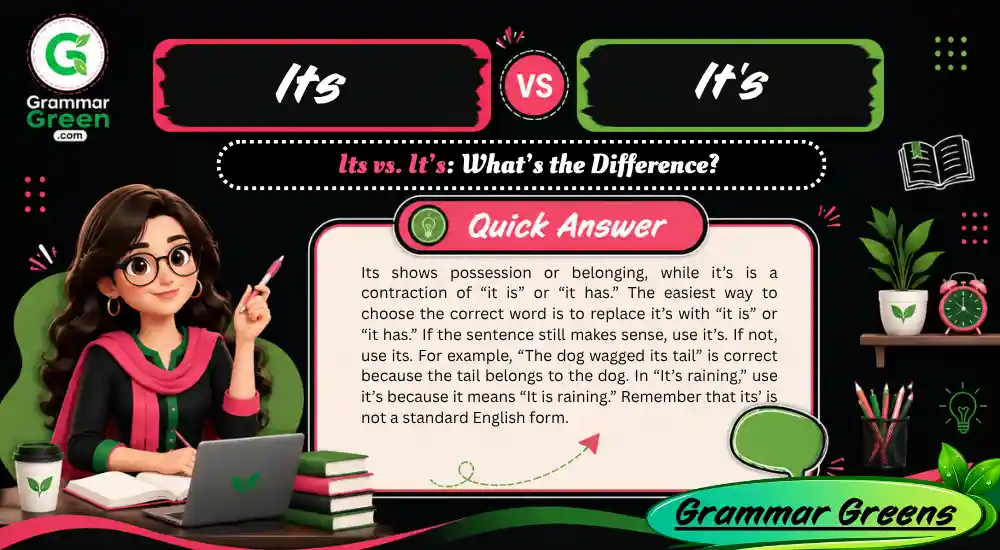
Its shows possession or belonging, while it’s is a contraction of “it is” or “it has.” The easiest way to choose the correct word is to replace it’s with “it is” or “it has.” If the sentence still makes sense, use it’s. If not, use its.
For example, “The dog wagged its tail” is correct because the tail belongs to the dog. In “It’s raining,” use it’s because it means “It is raining.” Remember that its’ is not a standard English form.
TL;DR: Its vs. It’s
- 🐾 Its = shows possession or belonging.
- ✨ It’s = means “it is” or “it has.”
- ❌ Its’ = not correct in standard English.
- 🔍 Use the “it is / it has” test to check whether it’s fits.
- 📝 Its does not use an apostrophe to show possession.
- 💡 Example: “The company changed its logo because it’s growing.”
- 🎯 Knowing this simple difference helps you avoid a common grammar mistake.
You Might Also Like That: Elicit vs Illicit
Its vs. It’s: What’s the Difference?
Its and it’s have the same pronunciation, but they do not have the same meaning. Its shows possession, belonging, or association, while it’s is a contraction of “it is” or “it has.” For example, “The dog wagged its tail” shows possession. In contrast, “It’s a friendly dog” means “It is a friendly dog.” Knowing this basic difference makes its vs. it’s grammar much easier to understand.
| Word | Meaning | Example |
| its | Shows possession | The bird opened its wings. |
| it’s | It is / It has | It’s getting late. |
👉 Quick rule: If you can replace it’s with it is or it has, use it’s. If you are showing that something belongs to “it,” use its.
What Does “Its” Mean?
Its is the possessive form of “it.” We use it when something belongs to, comes from, or connects with an animal, object, organization, or idea. Unlike many possessive nouns, its does not need an apostrophe. For example, “The company changed its logo” tells us that the logo belongs to the company. Similarly, “The tree lost its leaves” shows that the leaves belong to the tree.
You can use its with people-like organizations, animals, machines, and things. Remember that its does not mean “it is” or “it has.” It only works as a possessive form.
Examples of “Its” in a Sentence
You can see its in many everyday sentences. 📝 “The cat cleaned its paws.” “The phone lost its signal.” “The school updated its website.” “The company announced its new policy.” In each example, its shows a connection or belonging. A useful question to ask is: “Whose?” If the answer is “belonging to it,” its is usually the correct choice.
What Does “It’s” Mean?
It’s has two common meanings: “it is” and “it has.” The apostrophe shows that letters have been left out when two words combine. For example, “It’s cold” means “It is cold.” Likewise, “It’s been a busy day” means “It has been a busy day.” This makes it’s a contraction, not a possessive form.
When you see it’s, check whether the sentence makes sense with it is or it has. If one of those expanded forms works, you have found the correct use. This simple check can prevent many common grammar mistakes.
You Might Also Like That: EYP Meaning in Text
“It’s” as “It Is”
Use it’s when you mean “it is.” For example, “It’s a beautiful morning” means “It is a beautiful morning.” You can also write “It’s difficult to explain,” which means “It is difficult to explain.” 🌤️ This form appears often in everyday conversation, emails, messages, and general writing. If replacing it’s with it is keeps the sentence natural and correct, you can safely use it’s.
“It’s” as “It Has”
Use it’s when it means “it has.” For example, “It’s been a long week” means “It has been a long week.” Another example is “It’s already started,” which means “It has already started.” This use often appears before a past participle, such as been, started, or finished. Remember: it’s can mean “it has,” not only “it is.”
When Should You Use “Its” or “It’s”?
Choosing between its and it’s becomes simple when you first identify the meaning. Use its when you want to show possession or belonging. For example, “The business changed its name.” Use it’s when you can expand the word to “it is” or “it has.” For example, “It’s a new business” means “It is a new business.”
🔎 Try asking yourself what the sentence needs. Does it need a word that shows belonging? Choose its. Does it need it is or it has? Choose it’s. This quick check answers many its or it’s questions without needing to memorize complicated grammar rules.
The Easy “It Is / It Has” Test
The “it is / it has” test is one of the easiest ways to remember its vs. it’s. Whenever you are unsure, replace it’s with “it is” or “it has.” If the sentence still makes sense, it’s is correct. If the replacement sounds wrong, you probably need its instead.
For example, “It’s raining” becomes “It is raining.” ✅ The sentence works. But “The dog wagged it’s tail” becomes “The dog wagged it is tail.” ❌ That does not work. The correct sentence is “The dog wagged its tail.” This simple test helps you choose the right word quickly.
Its vs. It’s Examples
Examples make the difference between its and it’s easier to remember. Compare these sentences:
| Its | It’s |
| The dog wagged its tail. | It’s a friendly dog. |
| The company changed its logo. | It’s changing quickly. |
| The phone lost its signal. | It’s been disconnected. |
| The tree dropped its leaves. | It’s getting cold. |
Notice that its connects something to an owner or source, while it’s replaces two words. You can even use both forms in one sentence: “The company changed its policy because it’s growing quickly.” That sentence clearly shows the difference.
Common Its vs. It’s Mistakes
People often confuse these words because the apostrophe looks like a small detail. However, it changes the function of the word. A common mistake is writing “The cat licked it’s paw.” ❌ The correct sentence is “The cat licked its paw.” ✅ Here, the word shows possession.
Another mistake is writing “Its raining today.” ❌ The correct form is “It’s raining today.” ✅ You can also see mistakes such as “its’” when writers try to make its possessive. Remember these simple rules:
You Might Also Like That: EYP Meaning in Text
- 🐾 its = belonging to it
- ✨ it’s = it is
- ⏳ it’s = it has
- ❌ its’ = not the standard possessive form
Is “Its’” Correct?
“Its’” is not the standard possessive form of “it.” Writers sometimes add an apostrophe because many possessive words use one. However, English treats its differently. We write “The dog hurt its leg,” not “The dog hurt its’ leg.” The form its’ should therefore be avoided in standard English writing.
It helps to compare all three forms:
| Form | Correct? | Meaning |
| its | ✅ | Possession |
| it’s | ✅ | It is / It has |
| its’ | ❌ | Not standard English |
Why Doesn’t “Its” Have an Apostrophe?
The missing apostrophe in its can seem strange because many possessive forms use one. For example, we write “Sarah’s book” to show possession. However, possessive forms such as his, hers, yours, ours, theirs, and its do not use an apostrophe. These words already work as possessive forms.
So, do not think that every word showing possession needs an apostrophe. Instead, remember the specific form. 🧠 Its already shows possession, so adding an apostrophe creates the wrong form. This explains why “its tail” is correct while “it’s tail” is not.
Can “It’s” Mean “It Was”?
No. In standard English, it’s does not normally mean “it was.” The contraction it’s represents “it is” or “it has.” If you mean “it was,” write the full phrase it was.
For example, “It’s difficult yesterday” is incorrect because the sentence needs the past form. Write “It was difficult yesterday.” ✅ This distinction can help you avoid another common its vs. it’s mistake. When checking it’s, remember that your two replacement choices are it is and it has, not “it was.”
Its vs. It’s in Formal and Academic Writing
The difference between its and it’s stays the same in formal and academic writing. You should still use its for possession and it’s for “it is” or “it has.” However, some formal writing styles may prefer fewer contractions. In that case, writers may choose “it is” instead of “it’s.”
For example, an academic writer may write “It is important to consider the results” instead of “It’s important to consider the results.” Both forms can be grammatically correct, but the first may sound more formal. Never replace its with it’s simply because you are writing formally.
You Might Also Like That: Discreet vs Discrete
How to Remember Its vs. It’s
You do not need a complicated grammar trick to remember its vs. it’s. Keep this short rule in mind:
🔑 Its = belonging to it
🔑 It’s = it is / it has
You can also use the replacement test whenever you feel unsure. Replace it’s with it is or it has. If the sentence still works, keep it’s. If the sentence needs a possessive word, use its. With regular practice, this rule becomes automatic.
Its vs. It’s in Different Types of Writing
You can find its and it’s in almost every type of English writing. In an email, you might write, “The company updated its schedule.” In a message, you might say, “It’s getting late.” In academic writing, you could write, “The study changed its original focus.” In website content, you might write, “It’s easy to understand.”
📌 The writing situation does not change the basic grammar rule. Whether you write a business email, school assignment, website article, social media post, or casual message, its still shows possession and it’s still means it is or it has.
Its vs. It’s: Quick Practice Quiz
Test yourself before moving on. Choose its or it’s in each sentence:
- The bird spread ___ wings.
- ___ going to rain tonight.
- The company changed ___ name.
- ___ been a difficult year.
- The computer lost ___ connection.
- ___ important to check your work.
- The dog hurt ___ paw.
- The team says ___ ready.
Answers:
- its ✅
- it’s ✅
- its ✅
- it’s ✅
- its ✅
- it’s ✅
- its ✅
- it’s ✅
💡 If you got them all right, you understand the basic its vs. it’s difference.
Frequently Asked Questions About Its vs. It’s
Is “its” possessive?
Yes. Its is a possessive form that shows something belongs to or connects with “it.” For example, “The company changed its website.” The website belongs to the company.
Is “it’s” a contraction?
Yes. It’s is a contraction of “it is” or “it has.” The apostrophe marks the letters removed from the original words.
Can “it’s” mean “it has”?
Yes. For example, “It’s been a busy day” means “It has been a busy day.”
Why doesn’t “its” have an apostrophe?
Its already works as a possessive form, like his, hers, yours, ours, and theirs. It does not need an apostrophe.
Is “its’” correct?
No. In standard English, use its for possession. Do not add an apostrophe after the s.
How can I quickly tell whether to use “its” or “it’s”?
Use the replacement test. If “it is” or “it has” fits, use it’s. If you mean belonging to it, use its.
Can “it’s” mean “it was”?
No. Use it was when you mean “it was.” It’s normally means it is or it has.
Are “its” and “it’s” pronounced the same?
In standard English, its and it’s are generally pronounced the same. Their difference appears in meaning, spelling, and grammatical function, not normally in pronunciation.
Conclusion
The difference between its and it’s becomes easy once you remember one simple rule: its shows possession or belonging, while it’s means “it is” or “it has.” The apostrophe in it’s signals a contraction, not possession. For example, “The company changed its policy” shows possession, while “It’s changing quickly” means “It is changing quickly.”
Whenever you are unsure, use the “it is / it has” test. If either phrase works, choose it’s. If you are showing that something belongs to “it,” choose its. With this quick habit, you can avoid one of the most common English grammar mistakes and use both forms confidently.