

Lay vs. lie confuses many English learners because both words relate to putting something in a position or being in a resting position. The basic rule is simple: lay means to put or place something, while lie means to rest or recline. However, the confusion grows because lay is also the past tense of lie. Once you understand this difference, forms such as laid, lain, laying, and lying become much easier to use correctly.
In this guide, you’ll learn when to use lay and lie, how to choose between lie down or lay down, and why sentences such as “I lay down yesterday” can be correct. We’ll also cover laying vs. lying, the past tense and past participle forms, common mistakes, and simple examples that make the rules easy to remember.
Quick Answer
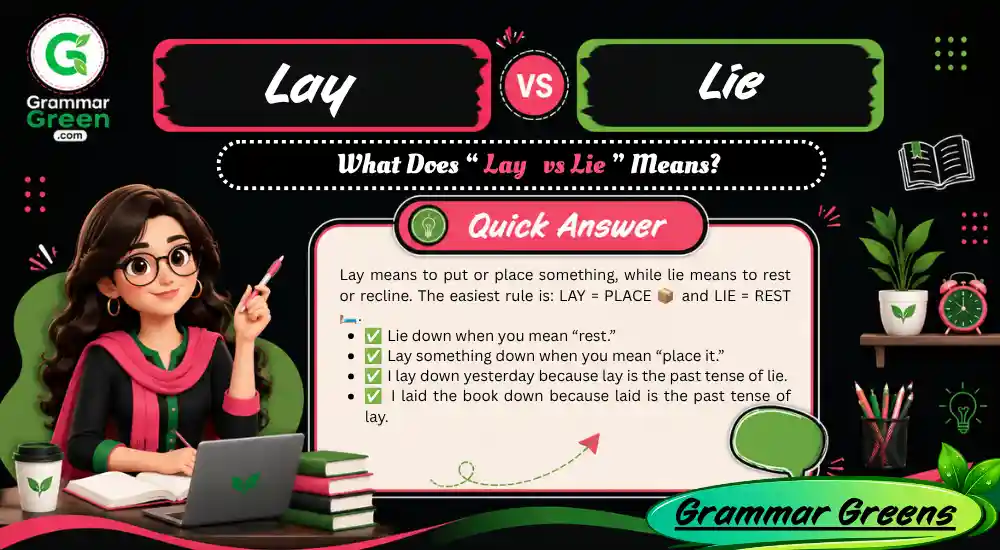
Lay means to put or place something, while lie means to rest or recline. The easiest rule is: LAY = PLACE 📦 and LIE = REST 🛏️.
- ✅ Lie down when you mean “rest.”
- ✅ Lay something down when you mean “place it.”
- ✅ I lay down yesterday because lay is the past tense of lie.
- ✅ I laid the book down because laid is the past tense of lay.
- ✅ Lying means resting; laying means placing something.
- ✅ Lain is the past participle of lie.
- ⚠️ Lieing is incorrect; the correct spelling is lying.
You Might Also Like That: What Does IMO Mean
TL;DR
- 🛏️ Lie = rest or recline.
- 📦 Lay = put or place something.
- ⏰ Lay = past tense of lie.
- 📚 Laid = past tense and past participle of lay.
- 🛋️ Lying = resting or reclining.
- 📍 Laying = placing something.
- 🔄 Lain = past participle of lie.
- 💬 Lie down = standard present-tense phrase for resting.
- 📝 Lay down = correct when placing something or when lay works as the past tense of lie.
Lay vs Lie: What’s the Difference?
The main difference between lay and lie comes down to the action. Lay means to put or place something somewhere, while lie means to rest or recline. For example, you can lay a book on a table, but you lie on a sofa when you want to rest. The easiest way to remember this rule is LAY = PLACE and LIE = REST. 🧠
The tricky part comes when you talk about the past. Lay also works as the past tense of lie. So, “I lie down every night” becomes “I lay down yesterday.” This small change causes many mistakes, but a simple comparison table can make the difference much clearer.
| Word | Basic meaning | Example |
| Lie | Rest or recline | I lie on the sofa. |
| Lay | Put or place | Lay the book on the desk. |
| Lay | Past tense of lie | I lay on the sofa yesterday. |
| Laid | Past tense of lay | She laid the book down. |
| Lain | Past participle of lie | He has lain there for an hour. |
When Should You Use “Lie”?
Use lie when you mean to rest, recline, or be in a resting position. The verb does not need a direct object. You can say, “I lie on the bed,” because you describe what you do yourself. You can also use it with places such as a bed, couch, floor, or beach. 🛏️
Common examples include:
- I lie down when I feel tired.
- She lies on the couch.
- The dog lies on the floor.
- We lie in bed on Sunday mornings.
Remember: lie = rest/recline. If you are not placing something somewhere, lie will often be the correct choice.
When Should You Use “Lay”?
Use lay when you mean to put or place something or someone somewhere. Unlike lie, this verb normally needs an object. Ask yourself the simple question, “Lay what?” If you can give an answer, lay usually fits. For example, “Lay the phone on the table.” 📱
Here are some simple examples:
- Lay the book on the desk.
- She lays the baby in the crib.
- Please lay the clothes on the bed.
- He laid the keys on the table yesterday.
👉 Think of LAY = PUT or PLACE. This quick rule can help you choose the correct word in many everyday sentences.
Lie Down or Lay Down: Which One Is Correct?
In standard English, use lie down when you mean that you will rest or recline yourself. For example, “I am tired, so I need to lie down.” Use lay down when you put something somewhere: “Please lay the blanket down.” 🛋️
The confusion becomes easier when you remember that lay is also the past tense of lie. So, “I lie down every afternoon” becomes “I lay down yesterday.” Both can be correct, but they describe different tenses.
| Meaning | Correct example |
| Present: rest | I lie down. |
| Past: rested | I lay down yesterday. |
| Present: place | I lay the book down. |
| Past: placed | I laid the book down. |
Why “I Lay Down” Is Sometimes Correct
Many people think “I lay down” always contains a grammar mistake. It does not. When lay acts as the past tense of lie, the sentence is completely correct. For example, “I lay down for a nap yesterday” means that you rested yesterday. The present form is “I lie down for a nap.” 💤
The key is to check the time and the meaning. If you talk about the present and mean “rest,” use lie. If you talk about the past and mean “rested,” use lay. This tense difference explains why lay vs. lie feels harder than it first appears.
You Might Also Like That: MYF Meaning in Text
Lay, Lie, Laid, and Lain: The Complete Verb Forms
The best way to understand these verbs is to learn their forms as groups. The reclining verb follows lie → lay → lain, while the placing verb follows lay → laid → laid. A third lie means “to tell an untruth” and follows lie → lied → lied. 📚
| Meaning | Present | Past | Past Participle | -ing Form |
| Rest/recline | lie | lay | lain | lying |
| Put/place | lay | laid | laid | laying |
| Tell an untruth | lie | lied | lied | lying |
Learning these three patterns will help you avoid common mistakes with lay, lie, laid, lain, laying, and lying.
Laying vs Lying: What’s the Difference?
Laying comes from lay, which means putting or placing something. Lying comes from lie, which means resting or reclining. For example, “She is laying the blanket on the bed” means she is placing the blanket there. “She is lying on the bed” means she is resting there. 🛏️
A simple comparison helps:
- Laying the book on the table = placing it 📖
- Lying on the table = resting/reclining
- Laying the baby down = placing the baby
- Lying down = resting yourself
❌ Lieing is not the correct spelling. The correct form is lying.
Lie vs Lay When Talking About Beds, Couches, and Floors
Everyday locations make lie vs. lay much easier to understand. When you rest yourself on a bed, couch, or floor, use lie. When you put an object on one of those surfaces, use lay. For example, “I am lying on the couch” describes your position, while “I am laying the blanket on the couch” describes an action. 🛋️
Compare these examples:
- Lie in bed when you want to rest.
- Lie on the couch after work.
- Lie on the floor if you need to stretch.
- Lay the blanket on the bed.
- Lay the book on the couch.
The object test works well here: if you place something, choose lay.
Laid vs Lain: How Do You Know Which One to Use?
Laid and lain come from different verbs, so you should not treat them as interchangeable. Laid comes from lay and usually refers to putting or placing something. Lain comes from lie and refers to resting or remaining in a position. 🔎
You Might Also Like That: Your vs You’re
Compare:
- She has laid the book on the table.
- He has lain on the sofa all afternoon.
- They had laid the clothes on the bed.
- She had lain there for an hour.
👉 Laid = placed
👉 Lain = rested/reclined
This distinction becomes especially useful when you use has, have, or had.
Why Do People Say “Lay Down” Instead of “Lie Down”?
You may often hear people say “I’m going to lay down” in everyday conversation. This usage is common in informal speech, which can make English learners wonder whether lie down or lay down is correct. In traditional standard English, use lie down when you mean that you will rest yourself. 💬
However, context matters. Lay down is correct when you include an object, such as “Lay the baby down” or “Lay the book down.” Also, “I lay down yesterday” is correct because lay serves as the past tense of lie. So, do not judge the phrase without checking its meaning and tense.
How Does the Meaning Change When You Switch Lay and Lie?
Changing lay to lie can completely change the action in a sentence. Lie describes a person, animal, or thing resting in a position, while lay describes someone placing something or someone in a position. This difference becomes clear when you compare similar sentences. 🔄
- I lie on the bed. → I rest there.
- I lay the book on the bed. → I place the book there.
- She lies on the couch. → She rests there.
- She lays the blanket on the couch. → She places it there.
The word lay needs an object in this meaning, while lie does not.
Lay vs Lie in Questions and Commands
You use lay and lie in questions and commands just as you do in normal sentences. The same basic rule still applies: use lie for resting and lay for placing something. This makes everyday requests much easier to understand. 🗣️
You Might Also Like That: What Does IMO Mean
Examples:
- Should I lie down? ✅
- Can I lie on the couch? ✅
- Lay the book on the table. ✅
- Please lay the baby down. ✅
- Where should I lay it? ✅
When you give a command, ask what action you want someone to perform. If they need to rest, choose lie. If they need to put something somewhere, choose lay.
Lay vs Lie With Pronouns: “Lay Me Down” vs “Lie Down”
Pronouns can make the difference easier to see. In “Lie down,” the person performs the resting action. In “Lay me down,” someone places another person somewhere, so me acts as the object. 👤
Compare:
- Lie down. → Rest yourself.
- Lay me down. → Put me in a resting position.
- Lay it down. → Put it somewhere.
- Lay the baby down. → Put the baby somewhere.
- Lie down beside me. → Rest beside me.
The same rule remains: lay takes an object when it means “put or place,” while lie describes resting without a direct object.
Common Expressions That Use Lay or Lie
Not every use of lay and lie involves beds or physical positions. English also uses both verbs in common expressions. For example, lay the groundwork means to prepare the foundation for something, while lie in wait means to stay hidden and wait for someone or something. 💡
Some useful expressions include:
- lay the groundwork = prepare the basics
- lay the foundation = create a base
- lay an egg = produce an egg
- lie low = stay unnoticed
- lie in wait = wait secretly
- lie ahead = exist in the future
These expressions have their own meanings, so learn them as complete phrases rather than trying to apply only the basic PUT vs. REST rule.
How Lay and Lie Work With Helping Verbs
Helping verbs such as has, have, had, can, should, and will can change which form you need. After has, have, or had, use lain when you mean that someone has rested. Use laid when someone has placed something. 📖
Examples:
- I have lain on the couch all day.
- She has lain in bed for hours.
- He had lain there before lunch.
- I have laid the book on the desk.
- She has laid the clothes on the bed.
- They had laid the papers on the table.
Remember: lain = lie, while laid = lay when you describe the placing action.
You Might Also Like That: FAFO Meaning
A Simple Decision Process for Choosing Lay or Lie
When you are unsure whether to use lay or lie, follow a simple three-step check. First, ask whether you mean rest/recline or put/place. Second, look for an object. Third, check the tense. 🧠
Quick rule
- Rest or recline? → LIE
- Put or place something? → LAY
- Past tense of “lie”? → LAY
- Past tense of “lay”? → LAID
- Past participle of “lie”? → LAIN
A useful memory trick is LAY = PLACE and LIE = REST. If you remember those two words, you can solve many lay vs. lie questions quickly.
Common Lay and Lie Mistakes
English learners often mix these verbs because lay serves two different roles. The most common mistakes involve lie down, lay down, laying, lying, laid, and lain. The best way to avoid them is to check both the meaning and the tense before choosing a form. ⚠️
| Incorrect/Common confusion | Better standard form |
| I am laying on the bed. | I am lying on the bed. |
| I need to lay down. | I need to lie down. |
| I have laid down. | I have lain down. |
| She is laying on the couch. | She is lying on the couch. |
| I laid down yesterday. | I lay down yesterday. |
The last example shows why tense matters: lay can correctly mean the past tense of lie.
Lay vs Lie Examples in Everyday English
Real-life examples can make the lay vs. lie difference much easier to remember. Think about what you are doing in each situation. If you are resting yourself, use lie. If you are putting something somewhere, use lay. 🏠
- I lie in bed every morning.
- I lay in bed yesterday.
- I am lying on the sofa.
- Please lay the phone on the table.
- She laid the clothes on the bed.
- He has lain on the floor for an hour.
- They are laying the books on the desk.
- We decided to lie down for a few minutes.
These examples show how meaning and tense work together.
Lay vs Lie: Quick Reference Chart
When you need a fast answer, use this lay vs. lie cheat sheet. The chart brings the main forms together so you can check them without reviewing every grammar rule. 📌
| What you mean | Correct form | Example |
| Rest now | lie | I lie down. |
| Resting now | lying | I am lying down. |
| Rested in the past | lay | I lay down yesterday. |
| Rested before another past action | had lain | I had lain there for an hour. |
| Put/place now | lay | Lay the book here. |
| Putting/place now | laying | She is laying the book down. |
| Put/place in the past | laid | She laid the book down. |
| Put/place before another action | had laid | She had laid it there. |
The easiest memory trick
🧠 LAY = PUT/PLACE
🧠 LIE = REST/RECLINE
You Might Also Like That: Ion Meaning
Frequently Asked Questions About Lay vs Lie
Is it “lie down” or “lay down”?
Use lie down when you mean rest or recline. For example, “I need to lie down.” Use lay down when you put something somewhere, such as “Lay the book down.” Remember that I lay down yesterday is also correct because lay acts as the past tense of lie.
Is “I lay down” correct?
Yes. “I lay down” is correct when you describe resting in the past. For example, “I lay down after lunch yesterday.” The present-tense version is “I lie down after lunch.” The difference comes from the tense, not from the basic meaning of resting.
Is “I laid down” correct?
It depends on what follows. “I laid the book down” is correct because you placed the book somewhere. But in standard English, use “I lay down” when you mean that you rested yourself in the past.
Is it “laying” or “lying”?
Use lying when someone or something rests. Use laying when someone places something. For example, “She is lying on the bed” means she is resting, while “She is laying the blanket on the bed” means she is placing the blanket there.
What is the past tense of “lie”?
When lie means rest or recline, its past tense is lay. Its past participle is lain. For example: “I lie down today,” “I lay down yesterday,” and “I have lain down before.”
What is the past tense of “lay”?
The past tense of lay is laid. For example, “I lay the book on the table” becomes “I laid the book on the table yesterday.”
What is the difference between “laid” and “lain”?
Laid comes from lay and usually means placed. Lain comes from lie and means rested or reclined. For example, “She has laid the book down” describes placing, while “She has lain on the couch” describes resting.
Why is “lay” the past tense of “lie”?
English uses different verb forms for different tenses. The reclining verb follows lie → lay → lain. That means lay can mean “put/place” in the present tense, but it can also mean “rested” when it serves as the past tense of lie. This overlap creates much of the confusion.
Is “lay down” grammatically correct?
Yes, but the meaning and tense matter. Lay down is correct when you place something somewhere, such as “Lay the phone down.” In standard formal English, use lie down when you mean “rest yourself.” However, I lay down yesterday is correct because lay is the past tense of lie.
Final Thought
The lay vs. lie difference becomes much easier once you focus on the action. If you mean rest, choose lie. If you mean put or place, choose lay. Then check the tense to choose between lay, laid, and lain. 🧠
When you feel unsure, ask yourself one simple question: “Am I resting, or am I placing something?” That quick check can help you choose the right form in everyday English and avoid common mistakes with lie down, lay down, laying, and lying.