
Some hard words to spell can confuse even strong English speakers. You may know what a word means, use it often, and still pause when you need to write it. Words such as necessary, accommodate, definitely, miscellaneous, and questionnaire can cause trouble because English spelling does not always match pronunciation. Silent letters, double consonants, unusual letter combinations, and words borrowed from other languages can make spelling even harder.
This guide brings together a useful list of difficult English words to spell, from common words that people often misspell to advanced spelling-bee words. You will find hard spelling words, their meanings, examples, and practical spelling tips to help you remember them. Whether you want to improve your English spelling, prepare for a spelling test, or simply stop making common spelling mistakes, this guide gives you a clear place to start.
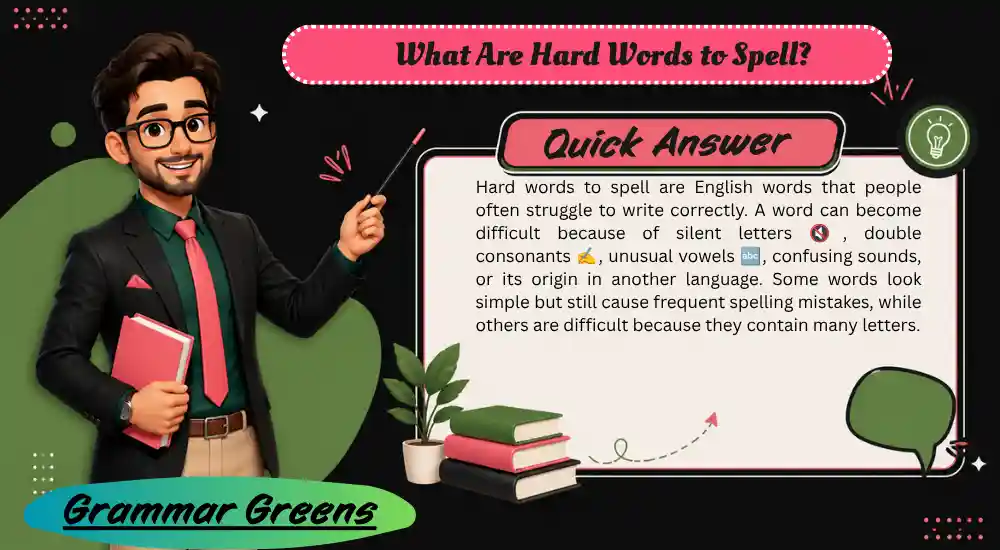
Quick Answer: What Are Hard Words to Spell?
Hard words to spell are English words that people often struggle to write correctly. A word can become difficult because of silent letters 🔇, double consonants ✍️, unusual vowels 🔤, confusing sounds, or its origin in another language. Some words look simple but still cause frequent spelling mistakes, while others are difficult because they contain many letters.
Common examples include necessary, accommodation, definitely, questionnaire, miscellaneous, entrepreneur, and rhythm. Learning these words becomes easier when you understand their spelling patterns instead of trying to memorize every letter. A good spelling guide should also include meanings, examples, pronunciation, and simple memory tips.
TL;DR: Hard Words to Spell at a Glance
- ✍️ Necessary — one “c” and two “s” letters
- 🏨 Accommodation — remember the double “c” and double “m”
- 🔤 Definitely — do not add an extra “a”
- 🧠 Miscellaneous — watch the vowel pattern
- 📝 Questionnaire — remember the “nn” and “aire”
- 🌍 Entrepreneur — a French-origin word with tricky spelling
- 🔇 Rhythm — uses an unusual vowel pattern
- 🧹 Vacuum — remember the two “u” letters
- 🍽️ Restaurant — often misspelled because of its pronunciation
- 📚 Occurrence — needs double “c” and double “r”
The key lesson is simple: hard spelling does not always mean long spelling. Even short, everyday words can cause problems.
You Might Also Like That: Spelling Bee Words
100+ Hard Words to Spell
The following words cover a mix of common hard spelling words, advanced vocabulary, spelling-bee words, and words that people frequently misspell. Some are difficult because of silent letters, while others contain repeated letters or unusual combinations. Learning them in groups can make practice much easier.
| Word | Why It Can Be Hard | Simple Tip |
| Accommodate 🏨 | Double letters | Remember cc + mm |
| Necessary ✍️ | Confusing c and s | One c, two s’s |
| Definitely 🎯 | Often written incorrectly | Think finite inside it |
| Miscellaneous 📚 | Unusual vowel order | Practice it in parts |
| Questionnaire 📝 | Tricky ending | Remember -naire |
| Occurrence 🔄 | Repeated letters | Double c + r |
| Maintenance 🔧 | Pronunciation can mislead | Think maintain |
| Separate ↔️ | Often written with “a” | There is an a in separate |
| Restaurant 🍽️ | Sounds different from spelling | Break it into parts |
| Vacuum 🧹 | Double “u” | Remember uu |
| Guarantee ✅ | Vowel order | Remember guar |
| Embarrass 😳 | Double letters | Double r + s |
| Conscientious 🧠 | Many vowels | Break it into chunks |
| Privilege 🎓 | Often confused with “e” | Ends with -lege |
| Pronunciation 🗣️ | Common spelling mistake | No “ou” after pron |
| Entrepreneur 💼 | Foreign spelling | Learn it as chunks |
| Rhythm 🎵 | Few traditional vowels | Memorize the pattern |
| Silhouette 🖼️ | French spelling | Remember -ette |
| Rendezvous 📍 | Silent letters | Learn the whole pattern |
| Connoisseur 🍷 | Repeated letters | Practice slowly |
These words are only a starting point. The best way to improve is to write difficult words from memory, check your mistakes, and practice them again later.
Hard Words to Spell With Meanings
Understanding a word can make its spelling easier to remember. Instead of studying a list without context, connect each word with a clear meaning. For example, accommodate means “to provide space for someone,” while conscientious describes someone who takes care and works carefully. Miscellaneous refers to a mixed collection of different things. Learning the meaning and spelling together gives your brain more than one way to remember the word. It also helps you use difficult English words naturally in writing and conversation.
Hard Words to Spell With Example Sentences
Example sentences show how difficult words work in real writing. They also help you remember a word after you learn its spelling. For example: “The hotel can accommodate 200 guests.” Another example is, “It is necessary to check the details.” When you practice, write your own sentence instead of copying one every time. This simple step helps turn a spelling word into an active part of your vocabulary. It also improves your understanding of hard words and their meanings.
Common Words That Are Surprisingly Hard to Spell
Not every difficult spelling word looks complicated. In fact, some of the hardest words to spell are common everyday words. People often see these words so often that they assume they know the spelling automatically. That can lead to small mistakes when they write from memory. Words such as separate, restaurant, maintenance, guarantee, vacuum, definitely, and necessary can cause problems for both English learners and native speakers.
These words deserve special attention because you may use them regularly. Instead of only studying rare vocabulary, add familiar words that you often misspell to your personal practice list. 📝
- Separate — often misspelled as “seperate”
- Definitely — often misspelled as “definately”
- Necessary — confusing double letters
- Restaurant — pronunciation can affect spelling
- Maintenance — often confused with “maintainance”
- Guarantee — tricky vowel order
Hard Words to Spell by Difficulty Level
Putting words into difficulty levels makes spelling practice more useful. Beginners can start with words that contain one clear spelling trap, while advanced learners can move toward long or unusual words. This approach also helps students avoid feeling overwhelmed by a huge list. Remember that difficulty can differ from person to person. A word that feels easy to one writer may feel confusing to another. Use the levels below as a general guide, then build your own list from words you frequently misspell.
Easy but Tricky Words
Some words look easy because they are short or common, but their spelling can still cause mistakes. Words such as weird, rhythm, separate, receive, and friend have spelling patterns that may confuse learners. These words are useful for beginners because they teach important English spelling rules without requiring advanced vocabulary. Try writing each word several times, then cover it and spell it from memory. 🔤
Intermediate Words
Intermediate spelling words usually contain more letters or several spelling traps. Examples include necessary, maintenance, occurrence, restaurant, guarantee, and privilege. These words appear regularly in school, work, and everyday writing, so learning them can improve practical English skills. Focus on one difficult part at a time rather than trying to memorize the whole word in one step. ✍️
Advanced Words
Advanced words often combine several difficult patterns. Words such as conscientious, miscellaneous, questionnaire, entrepreneur, and silhouette may require extra practice. Their spelling may also reflect their history or another language. Break each word into smaller parts and learn the difficult section separately. Once you can spell each part, put the complete word together. This method works especially well for students and anyone preparing for advanced spelling practice. 📚
Extremely Difficult Words
Some English words become challenging because they are unusually long, rare, or filled with unexpected letters. Examples include pneumonoultramicroscopicsilicovolcanoconiosis, antidisestablishmentarianism, and other advanced vocabulary terms. You do not need to memorize every extremely long word unless you have a specific reason, such as a spelling competition. Focus first on useful words that appear in real writing. Then move toward rare words when you feel ready for a greater challenge. 🧠
Words With Spelling Patterns That Cause Problems
English spelling becomes easier when you recognize patterns. Many difficult words to spell share the same problems, such as silent letters, repeated consonants, or unusual vowel combinations. Instead of treating every word as a completely new problem, group words by their spelling pattern. This strategy can save time and make practice more organized.
For example, learning accommodate, embarrass, occurrence, and committee together can help you notice how double letters appear in English. 🔤
Words With Silent Letters
Silent letters make many English words difficult because the sound does not clearly show the spelling. Words such as knight, receipt, psychology, knowledge, and rendezvous contain letters that you may not hear when you say them. When you learn these words, pay attention to both the spoken and written forms. You can also group words with similar silent-letter patterns. 🔇
Words With Double Consonants
Double consonants cause frequent spelling mistakes because writers may forget one letter or add one unnecessarily. Examples include accommodate, necessary, embarrass, occurrence, committee, and beginning. A useful strategy involves marking the repeated letters while practicing. Once you recognize the pattern, these words become easier to remember. ✍️
Words With Confusing Vowels
Vowels create many spelling problems because English sounds can match several letter combinations. Words such as receive, weird, beautiful, guarantee, and separate can confuse learners because their pronunciation does not always give a clear spelling clue. Write these words several times and pay special attention to the vowel group that causes trouble. 🔤
Words With Unexpected Letter Combinations
Some words contain letter combinations that look unusual in English. Rhythm, queue, yacht, and conscientious are good examples. These words become easier when you learn them as complete patterns instead of sounding out every letter. You can also divide longer words into smaller chunks. This method reduces the amount of information you need to remember at one time. 🧩
Hard Words to Spell and Pronounce
Some words create a double challenge because their pronunciation and spelling do not match in an obvious way. English includes many words whose written form developed differently from how people pronounce them today. Words such as colonel, entrepreneur, rendezvous, silhouette, and pronunciation can make learners stop and think.
When you practice these words, learn the spoken and written forms together. Say the word, look at its spelling, cover it, and then write it from memory. This approach helps connect the sound with the correct letters. 🗣️
Hard Spelling Bee Words
Spelling bees often include words that test more than basic spelling. Contestants may face unusual words, foreign-origin words, silent letters, double consonants, and difficult endings. Words such as conscientious, questionnaire, entrepreneur, silhouette, and rendezvous can provide useful practice.
If you prepare for a spelling bee, do not only memorize a large list. Study the word’s meaning, pronunciation, origin, and spelling pattern. Ask someone to say the word aloud while you write it. This creates realistic spelling bee practice and helps you prepare for words you have not seen before. 🏆
Regional and District-Level Words
Regional and district spelling bees often require stronger preparation than ordinary classroom spelling tests. Practice words with silent letters, foreign roots, double consonants, and unusual endings. You should also learn how to break unfamiliar words into smaller parts. Knowing common roots and spelling patterns can help you make a better guess when you meet a new word. 📚
Advanced Spelling Bee Words
Advanced spelling bee words may come from many languages and can contain spelling patterns that English learners rarely see. Focus on words such as chiaroscuro, connoisseur, bouillabaisse, and onomatopoeia when you want a serious challenge. Learn each word with its meaning and origin. Understanding where a word comes from can sometimes explain why its spelling looks unusual. 🏆
Why Are Some English Words So Hard to Spell?
English spelling can feel difficult because the language has borrowed words from many sources. Over time, pronunciation also changed while some spellings stayed similar. As a result, the letters you see do not always tell you exactly how a word sounds.
Common reasons include:
- 🔇 Silent letters
- 🔤 Unusual vowel patterns
- ✍️ Double consonants
- 🌍 Foreign-language origins
- 🧩 Irregular spelling patterns
- 🗣️ Pronunciation changes
- 📚 Words borrowed from other languages
Once you understand these patterns, difficult spelling becomes less random and easier to study.
How to Remember Hard Words to Spell
Memorizing difficult spelling does not have to feel like a boring task. Start by breaking a word into smaller parts and looking for something familiar inside it. You can also create a short memory phrase or connect the word with an image.
For example, you can remember necessary by thinking, “one c, two s’s.” For accommodate, remember the double c and double m. 🧠
The best method depends on the word. Try different techniques and keep the ones that help you remember difficult spellings without checking the answer.
Break Words Into Smaller Parts
Long words often look harder than they really are. Break miscellaneous or conscientious into smaller sections and practice each part separately. Once you can spell the sections, combine them into the full word. This method also helps you notice prefixes, roots, and endings. 🧩
Use Mnemonics
A mnemonic gives your brain a simple reminder for a difficult spelling. For example, you can remember necessary with the phrase “one collar, two sleeves” to recall one “c” and two “s” letters. Create your own memory phrases when possible. A silly or funny mnemonic can sometimes stay in your memory longer than a plain rule. 🧠
Learn Word Roots
Word roots can help explain why some English words have unusual spellings. Learning common Latin, Greek, and French roots gives you useful clues when you meet unfamiliar vocabulary. It may not tell you every letter, but it can make long words easier to understand and remember. 🌍
Practice From Sound, Not Sight
Do not always copy a word while looking at it. Ask someone to say the word aloud, then try to write it without seeing the spelling. Afterward, compare your answer with the correct version. This method shows which parts you actually remember and which parts you still need to practice. 🗣️
Hard Words to Spell for Different Learners
Different learners need different types of spelling practice. A child may need short, familiar words, while an adult may want professional vocabulary. English learners may need extra help with pronunciation and sound patterns. Students preparing for spelling tests may need structured practice and review.
The goal should not be to memorize every difficult English word. Instead, choose words that match your needs and practice them regularly. This makes spelling improvement more useful and much less stressful.
Hard Words for Kids
Children can start with words that appear in school and everyday life. Good examples include because, beautiful, friend, enough, separate, Wednesday, and necessary. Keep practice short and fun. Use simple games, word cards, writing exercises, and short spelling tests. 🎒
Hard Words for Students
Students can move from common spelling mistakes toward more advanced vocabulary. Words such as conscientious, questionnaire, maintenance, occurrence, and miscellaneous provide useful practice. Encourage students to learn the meaning and use of each word instead of memorizing letters alone. 📚
Hard Words for Adults
Adults often need words they use in emails, reports, applications, and everyday communication. Useful examples include accommodation, definitely, maintenance, separate, guarantee, and entrepreneur. Keep a personal list of words you often misspell and review it regularly. ✍️
Hard Words for English Learners
English learners may struggle when pronunciation does not clearly show the spelling. Start with common words and focus on silent letters, vowel combinations, double consonants, and irregular patterns. Reading regularly also helps because repeated exposure makes correct spelling more familiar over time. 🌍
A Simple Hard-Word Spelling Test
Testing yourself can show whether you actually remember a spelling. Looking at a word and recognizing it is different from writing it from memory. For a quick test, ask someone to read 10 difficult words aloud. Write each word without looking at the answer. Then compare your spelling with the correct version.
Try these words:
- Necessary
- Accommodation
- Definitely
- Maintenance
- Questionnaire
- Miscellaneous
- Occurrence
- Entrepreneur
- Conscientious
- Silhouette
Mark the words you missed and practice those again. 📝
How to Practice Difficult Spelling Every Day
You do not need hours of practice to improve your spelling. A short daily routine can work well if you stay consistent. Choose five difficult words each day and study them carefully. Say each word, look at its spelling, write it from memory, and use it in a sentence.
Then review yesterday’s words before adding new ones. 🔄
A simple routine can look like this:
- 2 minutes: Review old words
- 3 minutes: Learn five new words
- 3 minutes: Write them from memory
- 2 minutes: Check mistakes and repeat them
Small, regular practice can build stronger spelling skills over time.
Frequently Asked Questions
What are the hardest words to spell?
Some commonly challenging words include necessary, accommodation, miscellaneous, questionnaire, conscientious, entrepreneur, and rendezvous. The hardest word depends on the learner because people struggle with different spelling patterns. Some find double consonants difficult, while others struggle with silent letters or unusual vowels.
What is the most commonly misspelled word?
There is no single word that every English speaker misspells most often. However, words such as definitely, separate, necessary, occurrence, and maintenance frequently cause spelling problems. The best approach is to notice which words you personally misspell and add them to a practice list.
What are some hard words to spell for kids?
Good examples include because, beautiful, Wednesday, enough, friend, separate, and necessary. Choose words that match the child’s age and school level. Short practice sessions and simple spelling games can make difficult words easier to remember.
Why are English words so hard to spell?
English spelling can be difficult because the language contains silent letters, unusual vowel patterns, double consonants, and words borrowed from many languages. Pronunciation has also changed over time, while many spellings have remained. These factors make some words difficult to spell from sound alone.
How can I improve my spelling?
Read regularly, write difficult words from memory, review your mistakes, and practice a few words each day. Use mnemonics, word roots, spelling patterns, and example sentences when they help. Most importantly, keep a personal list of words that you often spell incorrectly.
What words are difficult to spell and pronounce?
Words such as rendezvous, entrepreneur, colonel, silhouette, and conscientious can challenge learners because their pronunciation and spelling do not always match in an obvious way. Practice the spoken and written forms together to build a stronger connection between them.
Final Thoughts
Learning hard words to spell becomes much easier when you stop treating every word as a separate problem. Look for patterns such as silent letters, double consonants, unusual vowels, and foreign-language roots. These clues can help you understand why a spelling looks the way it does.
Start with common words that you actually use, then move toward advanced vocabulary and spelling-bee words. ✍️ Practice a few words every day, write them from memory, and review your mistakes. With regular practice, even difficult English spelling can become more familiar, natural, and manageable.