
If you’ve seen “OFC” in a text, chat, or social media post, it usually means “of course.” It is a casual abbreviation used to show agreement, confirmation, certainty, or reassurance.
For example, if someone asks, “Are you coming with us?”, a reply like “OFC!” simply means “Of course!” The exact tone can change with context, punctuation, and the rest of the conversation.
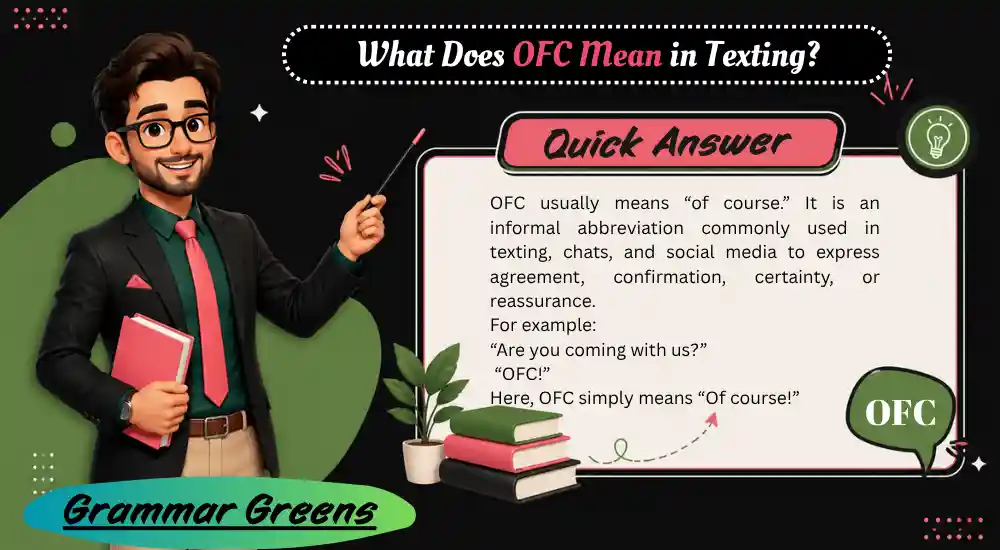
Quick Answer
OFC usually means “of course.” It is an informal abbreviation commonly used in texting, chats, and social media to express agreement, confirmation, certainty, or reassurance.
For example:
“Are you coming with us?”
“OFC!”
Here, OFC simply means “Of course!”
TL;DR
- OFC = “of course.”
- It is mainly used in texting, chats, and social media.
- It usually expresses agreement, confirmation, or reassurance.
- OFC is informal, so “of course” is better for professional or academic writing.
- OFC is not automatically rude or sarcastic; its tone depends on context.
- In fanfiction, OFC can also mean “Original Female Character.”
You Might Also Like That:
What Does OFC Mean in Texting?
In texting, OFC means “of course.” It is commonly used as a quick, informal response when someone wants to say yes, definitely, or certainly.
You may see it in text messages, group chats, direct messages, comments, and other casual online conversations. The abbreviation saves typing while keeping the conversation relaxed.
For example:
“Can you help me with this?”
“OFC!”
Here, OFC means “Of course!” or “Yes, definitely.”
How Is OFC Used in a Conversation?
OFC can perform slightly different functions depending on what the other person says. Most uses still connect to the basic idea of “of course.”
| Use | Example | Meaning |
| Agreement | “Want to come with us?” — “OFC!” | Definitely |
| Confirmation | “Can you send it later?” — “OFC.” | Yes, I can |
| Reassurance | “Are you still coming?” — “Ofc, don’t worry.” | Certainly |
| Certainty | “Will she know what to do?” — “OFC she will.” | Of course she will |
To Agree
“Do you want pizza tonight?”
“OFC!”
Here, OFC is a simple way to agree with the suggestion.
To Confirm
“Can you call me when you get home?”
“Ofc, I will.”
In this case, OFC confirms that the person agrees to the request.
To Reassure Someone
“You’re still coming with me, right?”
“Ofc. Don’t worry.”
The abbreviation can make the response feel quick and casual while still offering reassurance.
To Show Certainty
“Do you think they’ll understand?”
“OFC they will.”
Here, OFC emphasizes confidence in the answer.
You Might Also Like That:
What Does OFC Sound Like?
The basic meaning of OFC stays the same, but its tone can change with context. Capitalization, punctuation, emojis, and surrounding words can all affect how a message feels.
For example:
- “OFC!” can sound enthusiastic or emphatic.
- “ofc” usually feels casual and neutral.
- “ofc :)” can sound friendly or reassuring.
- “ofc…” may sound annoyed, hesitant, or sarcastic in some conversations.
- “OFC you did.” can be sincere or sarcastic depending on the situation.
These are not fixed rules. The same message can sound different depending on who is speaking, what happened earlier, and how the people normally communicate.
Is OFC Formal or Informal?
OFC is informal. It works best in casual communication, especially when people already use texting shorthand with each other.
| Context | Is OFC appropriate? |
| Texting friends | ✅ Yes |
| Casual group chats | ✅ Yes |
| Social media comments | ✅ Yes |
| Casual online conversations | ✅ Yes |
| Informal work chat | ⚠️ Depends on the workplace |
| Professional email | Usually avoid |
| Academic writing | ❌ Avoid |
| Formal documents | ❌ Avoid |
In professional or academic writing, spelling out “of course” is usually the better choice. The full phrase is standard written English, while OFC signals a casual digital style.
Is OFC Rude?
OFC is not inherently rude. In most casual conversations, it simply means “of course.”
However, a very short reply can sometimes feel blunt depending on the situation. Tone matters. For example, “OFC!” may sound enthusiastic, while “ofc…” could seem annoyed or sarcastic.
You Might Also Like That:
Consider this exchange:
“Can you help me?”
“ofc.”
One person may read that as a perfectly normal casual answer. Another might think the period makes it sound cold or dismissive. Neither interpretation is automatically correct—the surrounding conversation matters.
So, if you’re unsure about how your message will sound, writing “Of course!” gives you more room to express warmth clearly.
What Is the Difference Between OFC and “Of Course”?
OFC and “of course” have essentially the same basic meaning. The main difference is how they are used.
| Expression | Typical tone | Common setting |
| OFC | Casual, informal | Texts, chats, social media |
| of course | Neutral and more flexible | Everyday and formal-capable writing |
For example:
Casual:
“OFC I’ll be there.”
More formal:
“Of course, I’ll be there.”
The meaning is nearly identical. The full phrase simply works in a wider range of situations.
Can OFC Mean Something Else?
Yes. Context can give OFC a different meaning. In ordinary texting and online chat, “of course” is the most relevant interpretation. But OFC is also used in other communities and specialized contexts.
OFC = Original Female Character
In fanfiction and fandom discussions, OFC can mean “Original Female Character.” It refers to a female character created by the fanwork’s creator rather than a character that already exists in the original source material.
For example, if someone discusses creating an OFC for a fanfiction story, they are probably talking about an original female character, not the texting abbreviation.
Context makes the difference:
- “Are you coming tonight? — OFC!” → “of course”
- “My new story has an OFC.” → likely “original female character”
There are also specialized uses of OFC in other fields, so the surrounding topic is important when the meaning isn’t obvious.
OFC vs. Other Common Texting Abbreviations
OFC is part of a much larger group of abbreviations used in casual digital communication.
| Abbreviation | Meaning |
| OFC | Of course |
| IDK | I don’t know |
| BTW | By the way |
| TBH | To be honest |
| IMO | In my opinion |
| FR | For real |
These abbreviations are generally most useful when the people involved already understand casual online shorthand. In formal writing, spelling out the words is usually clearer.
You Might Also Like That:
Frequently Asked Questions About OFC
What does OFC mean in text?
OFC usually means “of course” in text messages. It is an informal way to express agreement, confirmation, certainty, or reassurance.
What does OFC stand for?
In texting and casual online communication, OFC stands for “of course.” In other contexts, the same letters can represent different terms.
Is OFC short for “of course”?
Yes. OFC is commonly used as a shortened form of “of course” in texting, chats, and social media.
Is OFC slang?
OFC is commonly used as informal digital shorthand and is often grouped with internet slang or texting abbreviations. It is better suited to casual communication than formal writing.
Is OFC rude?
Not by itself. OFC normally has a neutral or friendly meaning, but a short response can sound blunt, sarcastic, or dismissive depending on the context.
Can OFC be sarcastic?
Yes. OFC can sound sarcastic in certain contexts, especially when the surrounding words or punctuation suggest irony. For example, “OFC you did…” could have a very different tone from “OFC!”
Is OFC formal or informal?
OFC is informal. It is suitable for many casual texts and online conversations, but “of course” is usually a better choice for professional, academic, or formal writing.
What does OFC mean in fanfiction?
In fanfiction and fandom contexts, OFC can mean “Original Female Character.” It refers to a female character created by the fanwork’s author.
Does OFC have other meanings?
Yes. Although “of course” is the common meaning in texting, OFC can have other meanings in specialized contexts. The subject of the conversation usually helps determine which meaning is intended.
Final Takeaway
OFC usually means “of course” in texting, chat, and social media. It is an informal abbreviation used to express agreement, confirmation, certainty, or reassurance.
The abbreviation is not automatically rude or sarcastic. Its tone depends on the context, punctuation, surrounding words, and relationship between the people communicating. For formal or professional writing, use “of course” instead of “OFC.” And if OFC appears in a fandom or specialized context, check the surrounding topic because it may have another meaning.