
Who and whom are two of the most commonly confused words in English, and the difference can seem tricky at first. The basic who vs whom rule is simple: who usually refers to the person doing an action, while whom refers to the person receiving it. Once you understand the difference between a subject and an object, choosing the right word becomes much easier.
The good news is that you do not need to memorize complicated grammar rules. A simple he/she vs him/her test can help you decide whether to use who or whom in most sentences. In this guide, you’ll learn when to use who and whom, see clear examples, understand their use in questions and formal writing, and discover why modern English often favors who in everyday speech.
Who vs Whom: The Quick Answer
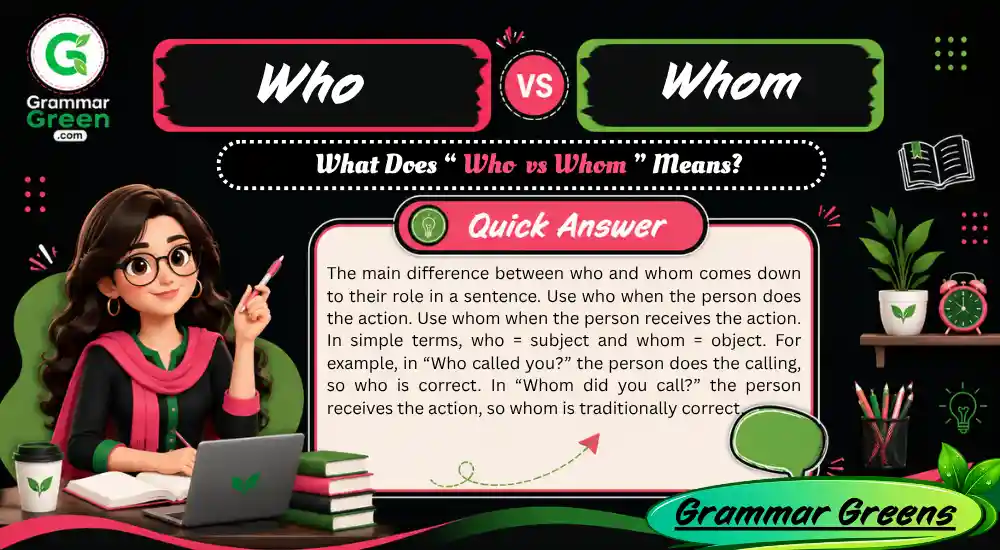
The main difference between who and whom comes down to their role in a sentence. Use who when the person does the action. Use whom when the person receives the action. In simple terms, who = subject and whom = object. For example, in “Who called you?” the person does the calling, so who is correct. In “Whom did you call?” the person receives the action, so whom is traditionally correct.
| Word | Role | Easy Test | Example |
| Who | Subject | he/she/they | Who called? |
| Whom | Object | him/her/them | Whom did you call? |
The good news is that you can use a quick he/she vs him/her test when you feel unsure. If you can replace the word with he, she, or they, choose who. If you can replace it with him, her, or them, choose whom. This simple rule works in many everyday sentences and helps you avoid common grammar mistakes without learning complicated terms.
Who vs Whom: TL;DR
Here’s the quick reference to remember the difference:
- 👤 Who = the person doing the action
- 🎯 Whom = the person receiving the action
- 🧩 Who works as a subject pronoun
- 📌 Whom works as an object pronoun
- 👨 He/She/They → Who
- 👤 Him/Her/Them → Whom
- 📝 Use whom more often in formal writing
- 💬 Use who naturally in casual speech
- 🔗 Use whom after a preposition in traditional formal grammar
- 💡 When unsure, use the he/she vs him/her test
The easiest who vs whom rule is: he/she = who, him/her = whom. Once you learn this shortcut, most who or whom questions become much easier.
You Might Also Like That: Otoe Meaning
What Is the Difference Between Who and Whom?
Who and whom are both pronouns, but they perform different jobs. Who normally works as a subject, meaning the person performs an action. For example, “Who opened the door?” asks which person performed the action. Whom normally works as an object, meaning the person receives the action. For example, “Whom did Sarah invite?” asks which person received Sarah’s invitation.
The traditional who vs whom grammar rule may sound difficult, but the idea remains simple. Think about the action first. Ask yourself, “Who is doing it?” for who, or “Who is receiving it?” for whom. Once you identify the person’s role, the correct word usually becomes clear.
When to Use Who
Use who when the person acts as the subject of a sentence or question. For example, “Who lives next door?” uses who because that person performs the action of living there. You can also use who as a relative pronoun when it introduces information about someone who performs an action.
Who as a Subject
Try replacing who with he, she, or they. If the sentence still makes sense, who usually fits. For example, “Who sent the email?” becomes “She sent the email.” You can also use who in sentences such as “The teacher who helped me was kind.” Here, the teacher performs the action of helping.
When to Use Whom
Use whom when the person acts as the object of a verb or preposition. For example, “Whom did you meet?” uses whom because someone receives the action of meeting. The same rule applies in formal writing when a person follows a preposition, such as “To whom did you speak?” Although whom remains grammatically correct, modern English often uses who in casual situations.
Whom as an Object
You can test whom by replacing it with him, her, or them. For example, “Whom did you invite?” becomes “I invited her.” The word “her” acts as an object, so whom works in the traditional form. You may see this structure in formal letters, academic writing, and professional communication.
The Easiest Who vs Whom Trick
The fastest who vs whom trick uses two small groups of pronouns: he/she/they and him/her/them. Replace the person’s name with one of these words and listen to which form fits. If he, she, or they works, use who. If him, her, or them works, use whom. This method gives you a practical answer without forcing you to remember complex grammar terminology.
The He/She vs Him/Her Test
Try this example: “Who/whom did you call?” Change the sentence to “I called her.” Because her works, whom fits the traditional rule. Now try “Who/whom called you?” The answer becomes “She called you.” Because she works, choose who. This he or she test and him or her test can help you solve most who vs whom questions quickly.
Who vs Whom in Questions
Questions often create the most confusion because the normal sentence order can change. Look for the person who performs the action. In “Who called the manager?” the unknown person performs the action, so who is correct. In “Whom did the manager call?” the manager performs the action, while the unknown person receives it, so traditional grammar uses whom.
When a question feels confusing, mentally rewrite it as a normal sentence. For example, “Whom did you invite?” becomes “You invited him.” Because him works, whom fits. In everyday speech, however, many people say “Who did you invite?” This difference shows how modern English usage can differ from traditional grammar rules.
You Might Also Like That: ICL Meaning
Who vs Whom After Prepositions
Traditional grammar usually uses whom after a preposition because the person becomes the object of that preposition. Common examples include to whom, with whom, for whom, by whom, and from whom. For example, “With whom did you travel?” follows the formal grammatical pattern. These structures often appear in professional, academic, or formal writing.
In casual English, speakers often move the preposition to the end and use who instead. For example, “Who did you travel with?” sounds natural in everyday conversation. Both forms communicate the same basic idea, but the first sounds more formal. This distinction can help you choose the right style for your audience.
Who vs Whom in Relative Clauses
A relative clause gives extra information about a person or thing. Use who when the person performs the action inside the clause. For example, “The woman who called me left a message.” The woman performs the action of calling. Use whom when the person receives the action: “The woman whom I called left a message.”
In everyday English, speakers often replace whom with who, especially in casual speech. They may also leave the object pronoun out completely: “The woman I called left a message.” This makes modern English more flexible than traditional grammar rules suggest.
Can You Use Who Instead of Whom?
Yes, in many situations, especially in informal English, people commonly use who where traditional grammar would use whom. For example, “Who did you meet?” sounds completely natural in everyday conversation, even though traditional grammar recommends “Whom did you meet?” The choice often depends on the situation, audience, and level of formality.
You should not think of who instead of whom as a simple right-or-wrong issue. In casual conversation, who usually sounds natural. In formal writing, whom can still provide a more traditional or formal tone. The important point is to understand both forms so you can make a confident choice.
Is Whom Still Used in Modern English?
Whom is still used, but people use it less often in everyday speech than they did in the past. Many speakers naturally choose who because it sounds simpler and more conversational. You will still see whom in formal writing, official documents, academic work, and fixed expressions. This makes whom less common, but it does not make the word incorrect or useless.
The best approach depends on context. In casual conversations, who often feels more natural. In formal writing, whom can still be useful, particularly after a preposition. Instead of asking whether whom is outdated, ask whether it fits the tone and purpose of your sentence.
To Whom It May Concern: Why Is It “Whom”?
“To Whom It May Concern” is a common formal expression used when you do not know the specific person who will read a letter or document. The word whom appears because it follows the preposition to and traditionally acts as its object. The phrase therefore follows the formal rule of using an object pronoun after a preposition.
You may also see whom in expressions such as “with whom,” “for whom,” “by whom,” and “from whom.” These forms are especially common in formal writing. In casual English, people often choose simpler structures, such as “Who are you writing to?” However, “To whom it may concern” remains a standard formal phrase.
You Might Also Like That: TS Meaning
Common Who vs Whom Mistakes
Many who vs whom mistakes happen because writers focus on the position of the word instead of its role. A word can appear near the beginning of a question and still act as an object. Always identify who performs the action and who receives it before choosing the pronoun.
- ❌ Whom called you?
- ✅ Who called you?
- ❌ Who did you invite? (formal traditional grammar)
- ✅ Whom did you invite?
- ❌ Whom is coming tonight?
- ✅ Who is coming tonight?
Remember that everyday English often accepts who in object positions. Avoid using whom simply because it sounds more formal. Use it when the grammar and context support it.
Who vs Whom Examples
Examples make the who vs whom difference much easier to understand. Compare these sentences:
| Example | Correct Form | Reason |
| Who called you? | Who | Subject |
| Whom did you call? | Whom | Object |
| Who helped Sarah? | Who | Subject |
| Whom did Sarah help? | Whom | Object |
| Who lives here? | Who | Subject |
| With whom did you travel? | Whom | Object of preposition |
For each sentence, ask whether the person does the action or receives the action. Then use the he/she or him/her test if you still feel unsure. In casual conversation, remember that native speakers frequently use who in places where formal grammar traditionally recommends whom.
Who vs Whom Quick Reference
Use this simple who vs whom cheat sheet whenever you need a quick answer:
- 👤 WHO = subject
- 🎯 WHOM = object
- Who → he, she, they
- Whom → him, her, them
- Who usually performs the action
- Whom usually receives the action
- Whom often follows a preposition in formal writing
- 💬 Who is common in everyday speech
- 📝 Whom is more common in formal writing
The easiest rule is: he/she → who; him/her → whom. If you can replace the word with they, choose who. If them fits, choose whom. This quick method works for many common sentences.
You Might Also Like That: Hard Words to Spell
Frequently Asked Questions About Who vs Whom
Is it who or whom?
Use who for a subject and whom for an object in traditional grammar. For example, “Who called?” uses who, while “Whom did you call?” uses whom.
When should I use whom?
Use whom when the person receives an action or follows a preposition in formal writing. For example, “Whom did you invite?” or “To whom did you speak?”
Is whom still grammatically correct?
Yes. Whom is still grammatically correct, although modern speakers use it less often in casual English.
Can I always use who instead of whom?
Not always. Who works naturally in many informal situations, but whom remains useful in formal writing and traditional grammatical structures.
Is “to who” grammatically correct?
In traditional formal grammar, to whom is preferred because whom acts as the object of the preposition to. However, “to who” can appear in informal modern English.
Is “with who” correct?
In formal grammar, with whom is preferred. In everyday speech, “Who did you go with?” sounds natural and is widely used.
Is whom outdated?
Whom is less common, but it is not outdated or incorrect. Writers still use it in formal, academic, professional, and fixed expressions.
How do I remember who vs whom?
Use the he/she vs him/her test. If you can replace the word with he, she, or they, use who. If you can replace it with him, her, or them, use whom.
Final Thought
The difference between who and whom may seem confusing at first, but the basic rule is easy to remember. Use who when someone performs an action and whom when someone receives an action. The he/she vs him/her test can help you make the right choice quickly.
Remember that modern English gives you some flexibility. People often use who instead of whom in casual and spoken English, while whom still appears in formal writing and phrases such as “To Whom It May Concern.” Focus on the situation, your audience, and the tone you want to create. With a little practice, choosing who vs whom will become much more natural.