
If you see “mk” in a text message, it usually means “okay” or “OK.” It is a casual, shortened response used to show acknowledgment, agreement, or acceptance. In some conversations, it can also represent “mm-kay,” a relaxed way of saying okay.
The meaning is usually simple, but the tone of “mk” depends on the conversation. A friendly exchange may make it sound neutral, while an argument or serious conversation can make the same two letters feel brief, cold, or dismissive.
Quick Answer
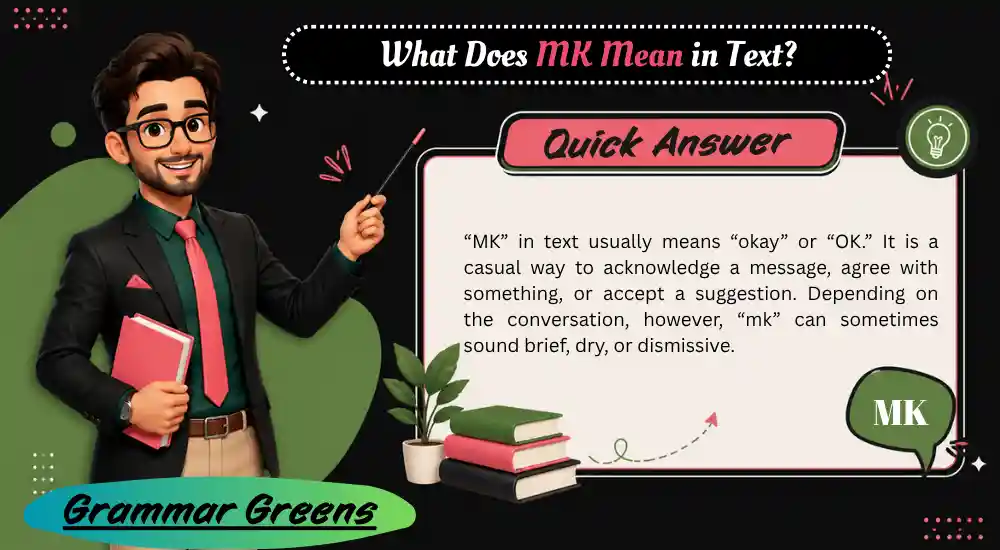
“MK” in text usually means “okay” or “OK.” It is a casual way to acknowledge a message, agree with something, or accept a suggestion. Depending on the conversation, however, “mk” can sometimes sound brief, dry, or dismissive.
TL;DR
- MK usually means “okay” in casual texting.
- It can show agreement, acknowledgment, or acceptance.
- “MK” is generally informal and common in texts and chats.
- It is not automatically rude, although it can sound cold depending on context.
- “K” can feel more abrupt than “MK,” while “OK” and “okay” are generally more neutral.
- The sender’s usual texting style and the surrounding conversation are important when interpreting the tone.
- If someone uses “MK” after an argument or serious message, don’t automatically assume they are angry.
- In other contexts, MK can have completely different meanings, such as Mortal Kombat, Mario Kart, or Mark.
You Might Also Like That:
What Does MK Mean in Text?
In texting, MK commonly means “okay.” Someone may use it when they want to acknowledge what you said without writing a full response.
For example, if someone texts, “I’ll send you the address tonight,” replying “mk” usually means “okay” or “got it.” It can also show agreement with a plan or acceptance of a request.
“MK” is informal, so it is more common in texts, chats, and direct messages than in professional or formal communication.
What Does MK Stand For?
In casual texting, MK is generally used as a shortened form of “okay,” sometimes associated with “mm-kay” or “mmkay.” It functions more like conversational shorthand than a formal acronym.
The exact feeling behind it depends on how the person normally communicates. Some people use “mk” simply because they prefer short replies, while others may use it when they do not have anything else to add.
What Does MK Mean Depending on the Context?
The word “okay” can communicate different feelings, and “mk” works in much the same way. The surrounding conversation can change how the response feels.
| Situation | What “mk” may communicate |
| Making plans | Agreement or confirmation |
| Receiving information | Acknowledgment |
| Accepting a request | Okay or acceptance |
| Responding to an apology | Acknowledgment or acceptance |
| During an argument | It may feel dismissive or irritated |
| Replying to a long message | It may seem unusually brief |
These are possible interpretations, not fixed rules. The sender’s usual texting style matters too. If they normally send short messages, “mk” may have no negative meaning at all.
You Might Also Like That:
Is “MK” Rude or Dismissive?
“MK” is not inherently rude. It normally just means “okay.” However, its short and informal form can sometimes make the response feel cold, dry, or dismissive.
For example, “Okay, sounds good!” gives you more emotional information than simply “mk.” If someone sends “mk” after a disagreement or an emotional message, you may interpret it as a sign that they do not want to continue the conversation. But you cannot know their intention from those two letters alone.
What Makes “MK” Sound Cold?
Several parts of the conversation can affect how “mk” comes across:
- The previous message: A serious message followed by “mk” may feel abrupt.
- The conversation’s tone: Tension can make a short reply seem more negative.
- Punctuation: Different punctuation can change the perceived tone.
- Emojis: An emoji can make a short response feel warmer or more playful.
- The sender’s normal style: Someone who always texts briefly may not intend anything negative.
- The relationship: A close friend may use “mk” casually, while the same reply from someone you are arguing with may feel different.
The safest approach is to consider the whole conversation, rather than treating “mk” as proof that someone is angry or annoyed.
MK Texting Examples
Real examples make the meaning easier to understand because the same abbreviation can work differently in different situations.
Example 1: Neutral acknowledgment
Alex: “I’ll send you the notes tonight.”
Sam: “mk”
Here, “mk” most likely means “okay” or “got it.” There is no obvious reason to interpret it negatively.
Example 2: Agreement with a plan
Alex: “Let’s meet at 7 instead.”
Sam: “mk”
In this situation, “mk” can simply mean “okay, that works.”
Example 3: After an apology
Alex: “I’m sorry I forgot to call you.”
Sam: “mk”
This could mean that Sam acknowledges the apology. However, because the response is so brief, it might also feel emotionally reserved. More context would be needed to know how Sam actually feels.
Example 4: A warmer version
Alex: “I’ll see you tomorrow!”
Sam: “mk 😊”
The emoji can make the short response feel more relaxed or friendly. This shows why the surrounding message matters when interpreting texting tone.
You Might Also Like That:
MK vs. K vs. OK vs. KK
These expressions can all communicate acknowledgment, but they may create slightly different impressions.
| Expression | Common impression | Typical use |
| Okay | Neutral and complete | Most casual conversations |
| OK | Concise and neutral | Texts, chats, everyday replies |
| MK | Casual and abbreviated | Informal texting |
| K | Very brief and sometimes abrupt | Very casual conversations |
| KK | Casual and often friendly | Informal chats |
These are general conversational impressions, not universal rules. A person’s texting habits can matter more than the abbreviation itself.
For example, one person may use “k” without any negative intention, while another person may use it when they are annoyed. The same principle applies to “mk.”
How Should You Respond to “MK”?
You do not always need to respond to “mk.” If it simply acknowledges your message and the conversation is finished, you can leave it there.
If you still need to continue the conversation, respond according to the situation:
- Confirming plans: “Sounds good. See you then!”
- Continuing casually: “Great, thanks!”
- Checking something important: “Just making sure—that works for you?”
- If the reply seems unusually cold: “Everything okay?”
- If no further response is needed: You can simply leave the message unanswered.
Try not to assume that a short “mk” is automatically negative. If the context is unclear and the conversation matters, asking a simple question is usually better than guessing.
What Does MK Mean on Snapchat, Instagram, or in Chat?
On platforms such as Snapchat, Instagram, WhatsApp, Messenger, and Discord, “mk” generally has the same basic casual meaning: “okay.”
The platform itself usually does not give the abbreviation a completely different meaning. What changes is the surrounding conversation. A short “mk” in a casual group chat may be nothing more than acknowledgment, while the same reply during a disagreement may feel more dismissive.
So when you see “mk” in a social media message, focus on what was said before it and how that person normally communicates.
Does MK Have Other Meanings?
Yes. MK can have other meanings outside casual texting, especially when it is capitalized.
Depending on the context, MK may refer to things such as:
- Mark — a formal abbreviation used in some contexts.
- Mortal Kombat — the video game and entertainment franchise.
- Mario Kart — the racing game series.
You Might Also Like That:
Context is therefore important. If you are looking at a casual text such as “mk, see you later,” “okay” is the likely interpretation. If you are reading a gaming discussion about a particular franchise, “MK” could mean something entirely different.
Frequently Asked Questions About MK
Does MK mean okay?
Yes. In casual texting, “mk” commonly means “okay” or “OK.” It can show acknowledgment, agreement, or acceptance. The exact tone depends on the conversation and the sender’s usual texting style.
Is MK short for okay?
In informal texting, “mk” is commonly used as a shortened way to communicate “okay.” It is also associated with the conversational form “mm-kay” or “mmkay.” It is best understood as casual texting shorthand rather than a formal abbreviation.
Is MK rude in texting?
Not necessarily. “MK” can be completely neutral. However, because it is short, it may sometimes feel dry, abrupt, or dismissive, especially after an emotional message or during an argument.
What does MK mean after an argument?
After an argument, “mk” could mean acknowledgment, acceptance, frustration, or a desire to end the discussion. There is no single guaranteed interpretation. Look at the messages before and after it, as well as the person’s normal communication style.
What is the difference between MK and K?
Both can be used to acknowledge something, but “K” is often perceived as more abrupt because it is only one letter. “MK” can feel slightly more conversational. Still, personal texting habits and context matter more than any fixed rule.
What is the difference between MK and OK?
Both commonly communicate “okay.” “OK” is a more standard written form, while “mk” is more casual texting shorthand. Neither one automatically indicates a particular emotion.
How should I respond to MK?
It depends on the conversation. If “mk” simply confirms a plan, you may not need to reply. If you need to continue the conversation, respond naturally. If the message seems unusually cold and the situation matters, you can ask whether everything is okay instead of assuming the sender is upset.
What does MK mean in social media messages?
In casual social media chats, “mk” usually means “okay.” The same basic interpretation can apply on Snapchat, Instagram, WhatsApp, Messenger, and other messaging platforms. The context determines whether the response feels neutral, friendly, or dismissive.
Final Thoughts
MK most commonly means “okay” in text messages. It is a simple piece of texting shorthand, but its tone can vary from neutral and casual to slightly dismissive.
The most important thing is to consider the context rather than the abbreviation alone. If the conversation is relaxed, “mk” probably means exactly what it appears to mean: okay. If the conversation is tense or emotional, the same two letters may carry a different impression.