Lore is a word you may see in books, games, movies, social media, and everyday conversations. At its simplest, lore means knowledge, stories, traditions, history, or background information connected to a person, subject, culture, or fictional world. People may talk about traditional lore, family lore, local lore, or the lore of a fictional character. The meaning changes slightly depending on the situation, but the main idea always involves information or stories connected to something.
Today, people also use lore in a more casual way online. On social media, gaming platforms, and messaging apps, personal lore can describe someone’s memorable experiences or backstory. You may see phrases like “my lore,” “your lore,” “the lore,” or “tell me the lore.” In fiction and gaming, lore usually describes the deeper history, characters, events, and world-building behind a story.
Quick Answer ⚡
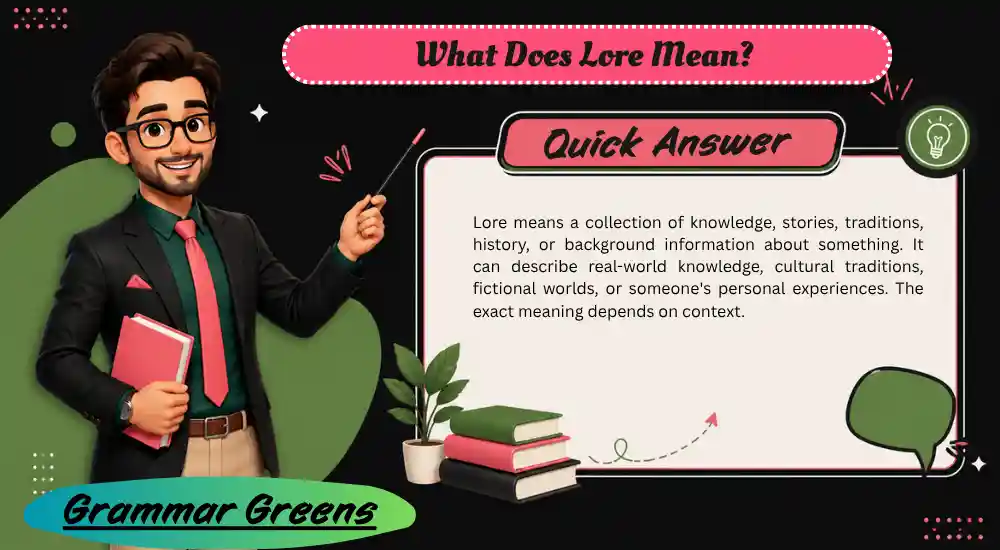
Lore means a collection of knowledge, stories, traditions, history, or background information about something. It can describe real-world knowledge, cultural traditions, fictional worlds, or someone’s personal experiences. The exact meaning depends on context.
For example, traditional lore may include myths, beliefs, customs, and stories passed down through generations. In gaming, game lore explains the history and background of a fictional world. On social media, personal lore often means memorable stories or experiences from someone’s life. In simple terms, lore gives you the background and details behind something.
TL;DR: Lore Meaning in Simple Words 📝
- 📚 Lore means knowledge, stories, history, or background.
- 🏛️ Traditional lore includes beliefs, customs, myths, and legends.
- 🎮 Gaming lore explains the history of a game world.
- 🎬 Fictional lore gives background to characters and fictional worlds.
- 👤 Personal lore means memorable stories about someone’s life.
- 📱 Online lore can describe shared internet stories or events.
- 💬 “Tell me the lore” means “Tell me the backstory.”
- 🧑 “My lore” means someone’s personal history or memorable experiences.
- 🌎 Lore can describe both real and fictional knowledge.
You Might Also Like That: Situationship Meaning
What Does Lore Mean? 🔎
The basic lore meaning is a body of knowledge, stories, traditions, or information connected to something. The word can describe information people pass down through generations, or it can describe the background of a fictional world or person.
For example, local lore can include stories about a town, while character lore can explain a fictional person’s past. Modern speakers also use lore casually when they discuss someone’s personal experiences. Because of this broad use, what does lore mean depends on where you see or hear the word.
Lore Definition at a Glance 📖
Lore is a noun that describes knowledge, stories, traditions, or background information. Its traditional meaning connects with learning and knowledge, while its modern meaning often focuses on stories and background.
| Feature | Meaning |
| Word | Lore |
| Part of speech | Noun |
| Basic definition | Knowledge, stories, traditions, or background |
| Traditional use | Cultural and traditional knowledge |
| Modern use | Personal or fictional backstory |
| Common contexts | Gaming, fiction, culture, social media |
You can use lore for real-world traditions, fictional universes, family stories, or personal experiences.
What Does Lore Mean in Simple Words? 💡
In simple words, lore means the information and stories behind something. It can tell you what happened before, where something came from, or why something matters.
For example, if your family has a funny story that everyone remembers, that story can become part of your family lore. If a video game has a detailed history explaining its characters and world, that information becomes game lore. This makes lore broader than a single story. It can include history, knowledge, memories, traditions, backstory, and shared experiences connected to a person, group, subject, or fictional world.
What Does Lore Mean in Traditional Usage? 🏛️
In traditional usage, lore refers to knowledge, beliefs, customs, and stories passed from one generation to another. People often connect it with folklore, oral tradition, myths, legends, cultural knowledge, and local traditions.
For example, a community may preserve stories about an old landmark through local lore. A family may pass down stories through family lore. Traditional lore does not always come from written records. People can preserve it through storytelling and shared experiences. This gives lore a strong connection with culture, heritage, history, beliefs, and traditional knowledge.
What Does Lore Mean in Fiction and Gaming? 🎮
In fiction and gaming, lore means the deeper background information that explains a fictional world. It can include character histories, important events, locations, cultures, conflicts, relationships, and hidden details.
For example, when someone says, “This game has deep lore,” they usually mean the game has a detailed history beyond its main plot. Character lore explains a character’s past, while world lore explains the history of the fictional universe. Books, movies, anime, and video games can all contain fictional lore that helps people understand the world more fully.
What Does Lore Mean in Slang and on Social Media? 📱
The modern lore meaning slang users see online usually refers to someone’s background, personal history, or interesting experiences. People use the word casually to make ordinary stories sound like part of a larger narrative.
You may see phrases such as “my lore,” “your lore,” “the lore,” and “tell me the lore.” For example, if someone mentions an unusual event from their past, a friend might respond, “Wait, tell me the lore.” Here, lore simply means the backstory or details behind the situation.
What Does Lore Mean in Texting? 💬
When people use lore in texting, they usually mean the background or story behind a person, event, relationship, or situation. The word does not have a completely different dictionary meaning in text messages. Instead, people use it in a casual way.
For example, someone might text, “Okay, I need the lore,” after hearing an interesting detail. Another person could say, “That is part of my lore,” when describing a memorable experience. In texting, lore often works as a short and playful way to ask for someone’s backstory, history, or explanation.
What Does Lore Mean on TikTok and Social Media? 📲
On TikTok and other social media platforms, lore often describes the stories or background details surrounding a person, creator, friend group, trend, or online event. Users may talk about someone’s internet lore when they know unusual details about that person’s online history.
For example, a viewer might comment, “I just discovered the lore,” after learning an older story about a creator. People can also use “the lore” to describe an ongoing series of events that followers already know. This modern usage makes lore a common word for online backstory and shared context.
What Does “My Lore” Mean? 👤
“My lore” usually means a person’s collection of memorable experiences, stories, habits, or unusual events. People often use this phrase humorously when they describe something from their past.
For example, someone might say, “Getting lost on that school trip is part of my lore.” They are not talking about traditional knowledge. They are describing a personal experience that became memorable enough to tell as a story. Similarly, “That is my lore” can mean, “That is one of the stories people know about me.”
What Does “Tell Me the Lore” Mean? 🗣️
“Tell me the lore” means “Tell me the backstory” or “Explain what happened.” People commonly use this phrase when they hear a small part of an interesting story and want to know the details.
For example, if a friend says, “I never talk to him anymore,” someone might reply, “Wait, tell me the lore.” The speaker wants to know what happened between them. Online, people use this phrase in comments, chats, and social media posts when they want more context, history, or personal background.
What Does “The Lore” Mean? 🌐
“The lore” usually refers to the collection of stories, facts, events, or background details connected to a person, group, topic, or fictional world. The phrase has become especially common online.
For example, friends might say “I know the lore” when they understand the history behind a situation. Gamers might use “the lore” to mean a game’s fictional history. Social media users can use the phrase for someone’s personal experiences. In each case, “the lore” points to the information that explains the bigger story behind something.
What Is Personal Lore? 👤
Personal lore means the collection of memorable stories, experiences, facts, and events connected to someone’s life. These stories can include funny moments, childhood memories, unusual experiences, friendships, relationships, or embarrassing situations.
For example, if someone once accidentally walked into the wrong classroom and still tells the story years later, that event can become part of their personal lore. People often use this phrase in a playful way. Instead of simply saying “my past,” they use personal lore to describe the stories that have become part of their identity or social history.
What Does “Part of My Lore” Mean? ⭐
“Part of my lore” means that something became a memorable part of someone’s personal history. People often use this phrase online when they describe an unusual, funny, embarrassing, or meaningful event.
For example, someone might say, “Missing that flight is part of my lore.” This does not mean the event has historical importance. It simply means the experience became a story they remember and may tell others. The phrase adds a humorous storytelling style to ordinary personal experiences and has become common in casual conversations and social media posts.
Common Types of Lore 🌎
Lore can appear in many forms, depending on the subject.
| Type of Lore | Meaning |
| 🏠 Family lore | Stories and traditions shared by a family |
| 🌎 Cultural lore | Knowledge connected to a culture |
| 📍 Local lore | Stories connected to a place |
| 🎮 Game lore | Background history inside a game |
| 🎭 Character lore | A fictional character’s history |
| 👤 Personal lore | Memorable stories about someone |
| 🌐 Internet lore | Shared online stories and background |
| 📖 Historical lore | Traditional knowledge about past events |
These types show that lore can describe real experiences, cultural traditions, fictional worlds, or online stories.
Lore Examples in Sentences ✍️
Here are some examples showing how people use lore in different contexts:
- 🏛️ “The village has fascinating local lore.”
- 🎮 “This game has deep lore.”
- 👤 “That embarrassing moment is part of my personal lore.”
- 📱 “Wait, tell me the lore behind that photo.”
- 🏠 “My grandmother knows a lot of family lore.”
- 🎬 “The film reveals more character lore in the second half.”
- 💬 “I finally learned the lore behind their friendship.”
These examples show that the word can describe traditional knowledge, fictional background, or modern personal stories.
Lore vs History: What Is the Difference? 🔎
Lore and history overlap, but they have different uses. History usually focuses on past events and the study or records of those events. Lore can include history, but it can also include stories, beliefs, traditions, legends, and background information.
For example, a town’s history may describe documented events and dates. Its local lore may include stories that people have shared for generations. In fiction, people can also create lore about events that never happened in real life. So, history usually focuses on the past, while lore has a broader meaning.
Lore vs Folklore, Myth, and Legend 📚
Lore, folklore, myth, and legend have related meanings, but each word has a different focus.
| Term | Simple Meaning |
| Lore | Knowledge, stories, traditions, or background |
| Folklore | Traditional beliefs, customs, and stories |
| Myth | A traditional or fictional story, often involving important figures |
| Legend | A traditional story often connected with historical elements |
Lore works as the broadest term here. It can include traditional stories and beliefs, but it can also describe fictional world-building or personal background. This is why people use lore in both traditional and modern contexts.
Lore vs Backstory: Are They the Same? 🎭
Lore and backstory often appear together, especially in games, books, movies, and anime. However, they do not always mean exactly the same thing.
A backstory usually explains what happened before the main story or describes a character’s past. Lore can cover that information but also includes the wider history of a fictional world, its cultures, characters, locations, events, and rules. In simple terms, backstory can be part of lore, but lore can cover much more than one character’s past.
Lore vs LMK: What Is the Difference? 💬
Lore and LMK are completely different terms and do not serve the same purpose in a message. Lore means background information, stories, history, or personal experiences. LMK is an internet abbreviation that means “let me know.”
For example, someone might text, “Tell me the lore,” when they want the story behind something. They might then say, “LMK what happened next,” meaning “let me know what happened next.” So, lore describes information or a story, while LMK is a request for someone to provide information.
Where Does the Word Lore Come From? 📜
The word lore has a long history in English. It comes from the Old English word lār, which was connected with learning, teaching, and knowledge. Over time, the word developed into the modern English noun lore.
Its connection with learning helps explain why lore can describe a body of knowledge. Today, the word has expanded into many areas. People use it for cultural traditions, historical stories, fictional worlds, video games, personal experiences, and online communities. The older idea of knowledge still remains at the heart of the word.
How Do You Use Lore in a Sentence? ✍️
You can use lore when you want to describe stories, knowledge, history, or background information connected to something. Common expressions include “the lore of,” “local lore,” “game lore,” “personal lore,” and “part of my lore.”
For example, you can say, “The game has deep lore,” when it contains a detailed fictional history. You can also say, “That story is part of my lore,” when discussing a memorable personal event. In casual online conversations, “Tell me the lore” means “Tell me the backstory.”
Frequently Asked Questions About Lore ❓
What does lore mean?
Lore means a collection of knowledge, stories, traditions, history, or background information connected to a person, subject, culture, or fictional world.
What does lore mean in slang?
In slang, lore often means someone’s personal history, memorable experiences, or backstory. People commonly use it in casual online conversations.
What does lore mean in gaming?
In gaming, lore means the history, characters, events, locations, and background details that create or explain the game’s fictional world.
What does personal lore mean?
Personal lore means the memorable stories, experiences, and details connected to someone’s life, personality, or past.
What does “tell me the lore” mean?
“Tell me the lore” means “Tell me the backstory” or “Explain what happened.” People often use it when they want more context.
Is lore the same as backstory?
No. Backstory usually focuses on previous events, while lore can include backstory plus wider information about a world, subject, or person.
Is lore the same as history?
Not exactly. History focuses mainly on past events, while lore can include history, traditions, beliefs, stories, and fictional background.
What is fictional lore?
Fictional lore is the background information behind an invented world, including its characters, history, events, cultures, and locations.
What is family lore?
Family lore means stories, traditions, memories, and experiences that family members share or pass down over time.
Final Thoughts🌟
The meaning of lore is simple when you focus on its main idea: it describes the knowledge, stories, history, traditions, or background behind something. Traditional lore can include cultural beliefs, legends, customs, and stories passed between generations.
Modern usage has made the word even more flexible. People now talk about game lore, fictional lore, internet lore, personal lore, and family lore. Phrases such as “my lore,” “the lore,” and “tell me the lore” usually point to someone’s backstory or memorable experiences. Whether you see the word in a game, book, conversation, or social media post, context tells you which meaning applies.