

If you have seen FYI in a text, email, or chat, you may wonder what it means. FYI stands for “For Your Information,” and people use it when they want to share something that they think you should know. You may see this common abbreviation in casual messages, workplace chats, emails, and online conversations.
The FYI meaning can stay the same across different situations, but its tone can change depending on the context. Sometimes it simply means “just so you know,” while other messages use it to share an update, reminder, or useful detail. Understanding how people use FYI can help you read messages correctly and use the abbreviation naturally yourself.
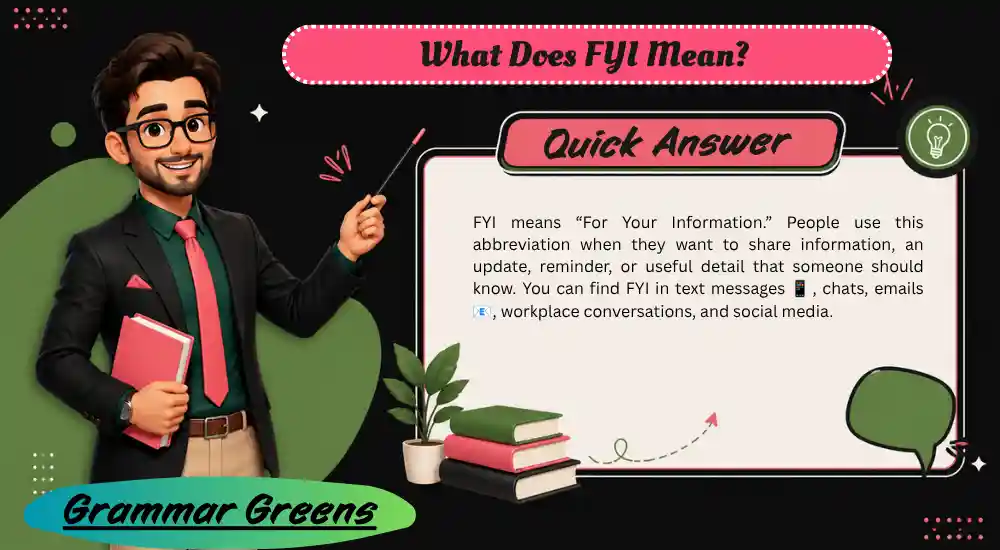
Quick Answer ⚡
FYI means “For Your Information.” People use this abbreviation when they want to share information, an update, reminder, or useful detail that someone should know. You can find FYI in text messages 📱, chats, emails 📧, workplace conversations, and social media.
In simple words, FYI means “just so you know.” It usually shares information rather than asking a question or making a request. However, the meaning can feel slightly different depending on the situation. A friendly text may sound casual, while an FYI in a work email can sound more professional and direct.
TL;DR 📌
- FYI stands for “For Your Information.”
- It means “just so you know” in many casual situations.
- People use FYI in texts, chats, emails, and workplace messages.
- FYI is an abbreviation, not simply internet slang.
- It can sound casual, neutral, or professional depending on context.
- An FYI message usually shares information and may not need a response.
- The words around FYI can affect its tone.
- You can use FYI when sharing an update, reminder, or useful detail.
You Might Also Like That: SYBAU Meaning
What Does FYI Mean? 💡
FYI meaning is “For Your Information.” It is a common abbreviation that people use when they want to give someone information without necessarily asking them to do something. For example, you might say, “FYI, the meeting starts at 3 PM.” Here, you simply want the other person to know about the time.
The phrase can work in both casual and professional communication. You may see it in a text from a friend or an email from a coworker. The basic meaning stays the same: you are sharing information that may be useful or important to the reader.
What Does FYI Mean in Texting? 📱
FYI meaning in text is usually simple: “For Your Information” or “just so you know.” People often use it at the beginning of a message to quickly introduce an update or detail. For example, “FYI, I left your book on the table.” The sender does not necessarily expect an answer.
In texting and chat, FYI can make a message shorter and easier to understand. You might use it to tell a friend about a schedule change, remind someone about an event, or share something they may find useful. Its exact tone depends on the rest of the message.
How Is FYI Used in Everyday Conversations? 💬
People use FYI in everyday conversations when they want to pass along information. You can use it when telling someone about a change, sharing a reminder, or giving an extra detail. For example, “FYI, Sarah is coming with us tonight.” The sentence simply keeps the other person informed.
You do not need to use FYI in every message. In very casual conversations, phrases such as “just so you know” may sound more natural. Still, FYI works well when you want to communicate something quickly and clearly, especially in short messages or group chats.
Examples of FYI in Everyday Conversations
| Situation | Example |
| 📅 Schedule | FYI, the class starts at 9 AM. |
| 📦 Delivery | FYI, your package arrived. |
| 🎉 Plans | FYI, Mike is joining us tonight. |
| 🌧️ Weather | FYI, it may rain later. |
How Is FYI Used in Emails? 📧
FYI in email works in much the same way as it does in texting. You can use it when sharing an update, document, announcement, or piece of information that the recipient should see. For example, “FYI, I attached the updated report.” The message tells the reader about the report without directly asking for an action.
You may also see FYI in an email subject line, such as “FYI: Updated Meeting Schedule.” This tells the recipient that the email mainly provides information. In professional communication, FYI can save space while making the purpose of the message clear.
Is FYI Formal or Informal? 📝
FYI can be both formal and informal. People commonly use it in casual texts with friends, but they also use it in workplace emails and professional messages. The surrounding words and the relationship between the people often determine how it sounds.
For example, “FYI, the movie starts at 8” feels casual. Meanwhile, “FYI, I have attached the revised document” fits a workplace setting. If you communicate with someone who may not know the abbreviation, writing “For Your Information” may provide more clarity.
Is FYI Slang or an Abbreviation? 🔤
People sometimes call FYI slang because they often see it in texts, chats, and online conversations. However, FYI is more accurately described as an abbreviation or initialism for “For Your Information.” It also appears in professional and formal written communication, so it does not belong only to internet slang.
FYI has been used in written communication for decades, long before today’s social media and texting culture. Modern digital communication has simply made the abbreviation more common and visible. So, when someone asks “Is FYI slang?”, the simple answer is that it is an established abbreviation used across different communication settings.
Does FYI Sound Rude? 🤔
FYI does not automatically sound rude. Most of the time, it simply introduces information. However, the message around it can change how the reader understands the tone. A short message such as “FYI, the deadline changed” may sound neutral, while a sharply worded message could feel blunt.
Some people may also read FYI as passive-aggressive when it appears in an argument or criticism. Context matters more than the abbreviation itself. If you want your message to sound friendly, add polite wording and enough context instead of relying on FYI alone.
Neutral vs. Potentially Blunt FYI
- 🙂 Neutral: “FYI, the meeting has moved to Friday.”
- 👍 Helpful: “FYI, I sent the file to your email.”
- ⚠️ Blunt: “FYI, you missed the deadline.”
- 💬 Friendlier: “Just FYI, the deadline was moved to Friday.”
Does FYI Require a Response? 📩
An FYI message usually does not require a response because the main purpose is to share information. For example, “FYI, the office closes at 5 PM” gives the reader useful information but does not ask them to reply or take action.
However, FYI does not always mean “no response needed.” The rest of the message can include a request. For example, “FYI, the meeting moved to 3 PM. Can you update the calendar?” The first part shares information, while the second part clearly asks for action.
FYI Examples in Texts, Emails, and Conversations 📱📧
Examples make the FYI meaning easier to understand because the abbreviation can appear in many situations. The basic idea remains the same: someone wants to keep another person informed.
Text Message Examples 📱
- FYI, I’m running 10 minutes late.
- FYI, the store closes early today.
- FYI, your package is at the front desk.
Email Examples 📧
- FYI, I attached the final report.
- FYI, tomorrow’s meeting has been canceled.
- FYI, the updated schedule is ready.
Workplace Examples 💼
- FYI, the client changed the meeting time.
- FYI, the new policy starts Monday.
- FYI, I have shared the presentation with the team.
Common Ways to Use FYI Correctly ✅
You can use FYI when you want to provide information without making the message unnecessarily long. It works especially well when the reader needs to know something but does not necessarily need to take immediate action.
Common uses include:
- 📢 Sharing an announcement
- 📅 Giving a schedule update
- 🔔 Providing a reminder
- 📄 Sharing a document
- 💬 Giving someone an important detail
- 📧 Forwarding useful information
- 👥 Keeping coworkers informed
The key is to make the message after FYI clear. If you need someone to do something, state the request directly instead of expecting them to guess.
FYI vs. “Just So You Know”: What’s the Difference? 🔎
FYI and “just so you know” often communicate a similar idea. Both expressions can introduce information that the other person may find useful. For example, “FYI, the store closes at 6” and “Just so you know, the store closes at 6” have nearly the same basic meaning.
The main difference comes from style and context. FYI feels shorter and works well in emails, workplace messages, and quick chats. “Just so you know” often sounds more natural in everyday conversation. Neither expression always means that the reader must take action.
Common Mistakes People Make With FYI ⚠️
People sometimes misunderstand FYI meaning because they focus on the abbreviation instead of the full message. One common mistake involves assuming that every FYI message requires no action. The sender may still include a request after sharing the information.
Another mistake involves using FYI too often. Repeating it in every email or text can make your writing feel less natural. You should also avoid assuming that FYI sounds rude. Its tone depends on the complete message, punctuation, relationship, and situation.
Quick Tips for Better FYI Usage
- ✅ Use FYI when sharing information.
- ✅ Add clear details after the abbreviation.
- ✅ Use polite wording in professional messages.
- ❌ Do not assume FYI always means “no action needed.”
- ❌ Do not use it when a direct request would be clearer.
Frequently Asked Questions About FYI ❓
What does FYI stand for?
FYI stands for “For Your Information.” People use it when they want to share information, an update, reminder, or useful detail with someone.
What does FYI mean in texting?
In texting, FYI usually means “For Your Information” or “just so you know.” It often introduces information that the sender wants the recipient to know.
What does FYI mean in email?
In an email, FYI usually tells the recipient that the message contains information they should see or know. It can introduce an update, document, announcement, or reminder.
Is FYI slang?
FYI is better described as an abbreviation or initialism than ordinary slang. People use it in both casual and professional communication.
Is FYI formal or informal?
FYI can be formal or informal. You can use it in casual texts, workplace chats, emails, and other written communication.
Is FYI rude?
FYI is not inherently rude. However, the surrounding wording and context can make a message sound neutral, blunt, or unfriendly.
Does FYI require a response?
Usually, an FYI message simply shares information and does not require a response. However, the message may include a separate request that needs action.
What does “just FYI” mean?
“Just FYI” usually means “just so you know.” People use it to share an extra piece of information without making a direct request.
How do you use FYI in a sentence?
You can place FYI before information you want someone to know, such as “FYI, the meeting starts at 2 PM.”
Final Thoughts 🌟
FYI means “For Your Information,” and its main purpose is to share information with someone. You can use it in texts, chats, emails, workplace communication, and everyday conversations. While the basic meaning stays the same, the tone can change depending on the wording and context.
If you remember one simple rule, remember this: FYI tells someone something they should know. Use it when sharing an update, reminder, document, or useful detail. When you need the other person to take action, make that request clear instead of relying on FYI alone.