If you have ever heard a soft whisper, gentle tapping, or slow sounds that made you feel calm or gave you a pleasant tingling sensation, you may have experienced ASMR. The term ASMR meaning refers to Autonomous Sensory Meridian Response, a sensory experience that some people feel in response to certain sounds, movements, or personal-attention triggers. The word “ASMR” can also describe the relaxing videos and audio created to produce this response.
But what is ASMR exactly, and what does ASMR stand for? In simple terms, ASMR describes a relaxing response that can cause tingling, often around the scalp, head, neck, or upper spine. People experience it differently, and not everyone gets ASMR. This guide explains its meaning, common triggers, what it feels like, why people watch ASMR videos, and what research says about it.
Quick Answer: What Does ASMR Mean?
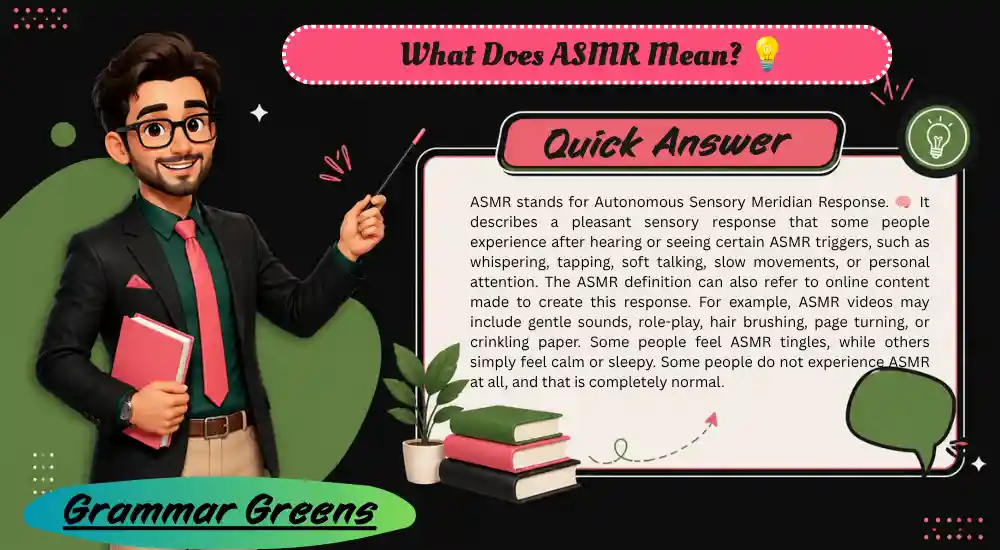
ASMR stands for Autonomous Sensory Meridian Response. 🧠 It describes a pleasant sensory response that some people experience after hearing or seeing certain ASMR triggers, such as whispering, tapping, soft talking, slow movements, or personal attention.
The ASMR definition can also refer to online content made to create this response. For example, ASMR videos may include gentle sounds, role-play, hair brushing, page turning, or crinkling paper. Some people feel ASMR tingles, while others simply feel calm or sleepy. Some people do not experience ASMR at all, and that is completely normal.
TL;DR: ASMR Meaning in Simple Words
- 🧠 ASMR full form: Autonomous Sensory Meridian Response
- ✨ ASMR meaning: A relaxing sensory response triggered by certain sounds or visuals
- 🎧 Common triggers: Whispering, tapping, typing, soft talking, and personal attention
- 😌 Common feeling: Pleasant tingling, calmness, relaxation, or sleepiness
- 📺 ASMR videos: Online videos designed around sounds, movements, or visual triggers
- 👂 Not everyone experiences it: ASMR is a personal sensory experience
- 🔬 Research: Studies suggest measurable responses, but researchers are still learning how ASMR works.
You Might Also Like That: IMSG Meaning
What Does ASMR Stand For?
ASMR is an abbreviation for Autonomous Sensory Meridian Response. Each word helps describe the experience. “Autonomous” means the response can happen naturally, “sensory” relates to the senses, “meridian” refers to a peak or pleasant point, and “response” means the reaction your body and mind have to a trigger.
In everyday language, you can think of ASMR as a calming or tingling reaction to specific sounds, sights, or actions. The term autonomous sensory meridian response is the formal name, while “ASMR” is the short form most people use online. 📱
ASMR Full Form Explained
The ASMR full form is Autonomous Sensory Meridian Response. You may see this phrase in dictionaries, health articles, research papers, and explanations about ASMR meaning. When people search “what does ASMR stand for,” they are usually asking for this full form and a simple explanation of the experience.
What Is ASMR?
What is ASMR? Simply put, ASMR is a sensory experience that may produce a pleasant tingling or calming feeling after certain auditory or visual stimuli. The sensation often starts around the scalp or back of the head and may move toward the neck or upper spine. Some people describe it as a gentle, static-like feeling.
ASMR can also describe the videos, sounds, and other content created to encourage this response. 🎧 These may include whispering, tapping, slow movements, personal attention, or repetitive actions. However, not everyone experiences ASMR, and people can respond to different triggers.
What Does ASMR Feel Like?
What does ASMR feel like? People commonly describe it as a pleasant tingling sensation around the scalp, back of the head, neck, or upper spine. Some may feel tingling down the spine or even in their arms and legs. Others mainly notice deep relaxation, calmness, or sleepiness.
The experience can vary from person to person. One person may react strongly to whispering, while another may prefer tapping or hair brushing. Some people experience only relaxation without noticeable tingling. Others may not experience ASMR at all.
What Triggers ASMR?
ASMR triggers are sounds, movements, visuals, or situations that may create an ASMR response. 🎧 Common ASMR sounds include whispering, soft talking, tapping, typing, scratching, crinkling paper, and other crisp or repetitive noises.
Visual triggers can also play a role. Slow hand movements, eye contact, smiling, makeup application, page turning, and careful task demonstrations may create a calming response. Personal attention is another popular trigger, especially in ASMR role-play videos. Because ASMR is highly personal, there is no single trigger that works for everyone.
Common ASMR Triggers
Some popular ASMR trigger examples include:
- 🗣️ Whispering and soft talking
- 👆 Tapping and typing
- 📄 Crinkling paper and page turning
- 💇 Hair brushing and hair touching
- 💆 Massage and personal attention
- 🎭 Role-play and task demonstrations
- ✏️ Scratching and repetitive movements
- 🍎 Crunching and other crisp sounds
Different people may prefer different combinations of audio and visual triggers.
Why Do People Watch ASMR Videos?
People watch ASMR videos for different reasons. 😌 Some use them to relax after a busy day, while others watch them as part of a bedtime routine. Soft voices, repetitive movements, and gentle sounds may help some viewers create a calm environment before sleep.
Others simply enjoy the sounds and visuals. ASMR content has become a large online category, especially on YouTube, where creators make videos around whispering, tapping, role-play, personal attention, and satisfying sounds. However, ASMR does not affect everyone in the same way, so viewers often search for specific triggers that work best for them.
What Are ASMR Videos?
ASMR videos are recordings designed around sounds, movements, or situations that may trigger ASMR or create relaxation. 📺 Some videos focus mainly on audio, while others use close-up visuals to make the experience more immersive. Many viewers use headphones to hear small sounds more clearly.
Popular ASMR video types include whispering, soft speaking, role-play, haircuts, makeup application, personal-attention scenes, tapping, eating sounds, page turning, and object demonstrations. The online ASMR community has grown around creators who produce different styles of content, allowing viewers to explore many ASMR triggers and formats.
Types of ASMR Content
Common types of ASMR content include:
- 🎧 Sound-focused ASMR
- 🗣️ Whispering and soft-speaking videos
- 🎭 ASMR role-play
- 💇 Personal-attention videos
- 👋 Visual trigger videos
- 📄 Tapping, scratching, and crinkling
- 😴 ASMR videos for sleep
- 🧘 Relaxing ASMR videos
Does Everyone Experience ASMR?
No, not everyone experiences ASMR. Some people feel strong tingling sensations, while others experience only relaxation or calmness. Some people do not notice any special response when they hear common ASMR sounds. This difference is one reason researchers describe ASMR as a subjective sensory experience.
Your response can also depend on the trigger. Someone may love whispering but dislike chewing sounds, while another person may enjoy tapping or repetitive movements. If ASMR does not work for you, there is nothing unusual about that. People simply have different sensory preferences. 👂
Is ASMR Scientifically Proven?
Research into ASMR science is still developing. Studies have reported measurable changes in some people while they experience ASMR, including changes related to heart rate and skin conductance. These findings suggest that ASMR can involve real physiological responses for people who experience it.
However, researchers are still working to understand how ASMR works, why certain triggers cause a response, and why some people experience it while others do not. 🔬 It is important to separate personal reports from established medical evidence. ASMR may feel helpful or relaxing to some people, but that does not automatically make it a proven medical treatment.
What Are the Possible Benefits of ASMR?
People often use ASMR for relaxation, sleep, stress relief, and winding down. 😌 Some research has explored whether ASMR may be linked with changes in mood, relaxation, heart rate, and other physiological responses. Many viewers also report feeling calmer after watching their preferred ASMR content.
Still, the possible ASMR benefits can differ from person to person. Research has not established ASMR as a treatment for medical conditions. It is better to view it as a personal relaxation tool rather than a replacement for professional care. If an ASMR video helps you relax or settle before bed, it may simply be part of your personal routine.
ASMR vs. Similar Sensory Experiences
ASMR can look similar to other sensory experiences, but they are not exactly the same. For example, frisson often describes chills or goosebumps caused by music, emotional moments, or other intense experiences. ASMR usually involves a more gentle, calming response connected with specific triggers.
ASMR is also different from general relaxation. You can feel relaxed without experiencing ASMR tingles. 🧠 Likewise, meditation and white noise may help people relax, but they do not automatically produce an ASMR response. Understanding these differences makes the ASMR meaning easier to understand.
ASMR vs. Misophonia
ASMR and misophonia can involve strong reactions to sounds, but the experiences are very different. ASMR triggers may create calmness or pleasant tingling, while misophonia involves strong negative emotional reactions to particular sounds. A sound that relaxes one person may irritate another.
Can ASMR Be Unpleasant?
Yes. Not every ASMR trigger feels relaxing to everyone. Some people may find chewing, breathing, scratching, or tapping sounds irritating rather than calming. Others may dislike close personal-attention videos or certain repetitive movements. 👂
This shows why ASMR is a personal experience. People have different levels of ASMR sensitivity, and some may prefer only certain sounds or visual triggers. If a video makes you uncomfortable, you do not need to continue watching it. Finding ASMR is about discovering what feels pleasant to you, not forcing yourself to enjoy a particular trigger.
How to Find Your ASMR Triggers
Finding your preferred ASMR triggers can take some simple experimenting. 🎧 Start with popular options such as whispering, soft talking, tapping, typing, crinkling paper, page turning, or slow hand movements. Try both audio and visual content to see whether one style feels more relaxing.
You can also keep track of the sounds or videos that create calmness, tingling, or sleepiness. If one trigger feels unpleasant, move on to another. ASMR for beginners does not require special equipment. A quiet space and headphones can help, but the most important thing is finding content that feels comfortable and enjoyable.
Where Did the Term ASMR Come From?
The ASMR origin is closely connected to internet communities. The term Autonomous Sensory Meridian Response was created to give a name to a sensation that people had already been discussing online. Before the term became popular, people often struggled to describe the unusual tingling or calming feeling they experienced from certain sounds and situations.
ASMR later became strongly connected with YouTube and online video culture. 📱 Creators began producing videos specifically for people who wanted relaxing sounds, personal attention, role-play, and visual triggers. Today, ASMR videos are a major part of online sensory content.
ASMR and YouTube
YouTube played an important role in making ASMR content widely known. Creators developed many formats, from whispering and tapping to role-play and personal-attention videos. This helped introduce ASMR meaning and its different triggers to a much larger audience.
ASMR FAQs
What does ASMR mean?
ASMR means Autonomous Sensory Meridian Response. It describes a pleasant sensory response that some people experience after specific sounds, movements, or visual triggers.
What does ASMR stand for?
ASMR stands for Autonomous Sensory Meridian Response. 🧠 It is the full form of the abbreviation.
What is ASMR in simple words?
In simple words, ASMR is a calming or tingling response that some people experience from certain sounds, visuals, or personal-attention situations.
What does ASMR feel like?
It may feel like pleasant tingling around the scalp, head, neck, or upper spine. Some people mainly feel calm, relaxed, or sleepy.
What are common ASMR triggers?
Popular triggers include whispering, tapping, typing, soft talking, hair brushing, crinkling paper, scratching, page turning, and personal attention. 🎧
Why is ASMR relaxing?
Certain ASMR triggers may create a calming sensory response. People also use ASMR videos as part of their relaxation or bedtime routines.
Does everyone get ASMR?
No. ASMR is not universal. Some people experience strong tingles, some mainly feel relaxed, and others do not experience the response.
Is ASMR real?
For people who experience it, ASMR is a genuine subjective sensation. 🔬 Researchers are studying the physiological responses connected with the experience.
Does ASMR help you sleep?
Some people use ASMR for sleep because it helps them feel calm or relaxed before bed. However, individual results vary.
Is ASMR good for you?
ASMR may be a useful relaxation tool for some people, but research is still developing. It should not replace professional medical care.
Is ASMR a type of therapy?
ASMR is not automatically a form of therapy. Some people may use it for relaxation or stress relief, but its therapeutic effects require more research.
Why don’t I get ASMR?
You may simply not experience ASMR, or you may not have found your preferred triggers yet. Everyone responds differently to sensory stimuli.
Can ASMR be uncomfortable?
Yes. Some sounds or visuals can feel irritating instead of relaxing. 👂 Stop watching content that makes you uncomfortable and try different triggers if you want to explore ASMR.
Final Thought
The simplest ASMR meaning is a calming or tingling sensory response that some people experience after specific sounds, movements, or visual triggers. ASMR stands for Autonomous Sensory Meridian Response, and the term now also commonly describes videos and audio created around these triggers.
From whispering and tapping to personal attention and slow movements, there are many ways ASMR content can look and sound. 😌 Some people experience strong tingles, while others feel only relaxation or nothing at all. The key point is that ASMR is a personal sensory experience, and different triggers can affect different people in different ways.