
DEI is a term you may see in workplaces, schools, businesses, and public discussions, but its meaning can seem unclear if you only know the acronym. Understanding DEI meaning starts with knowing what each letter represents and how the three ideas connect. DEI stands for Diversity, Equity, and Inclusion, three related concepts that focus on differences among people, fair access and opportunities, and participation in an environment where people feel respected and valued.
In this guide, we’ll explain what DEI means, what each part of Diversity, Equity, and Inclusion involves, and how organizations use DEI in everyday settings. We’ll also look at common related terms and differences between DEI, equality, and other approaches.
Quick Answer: What Does DEI Stand For?
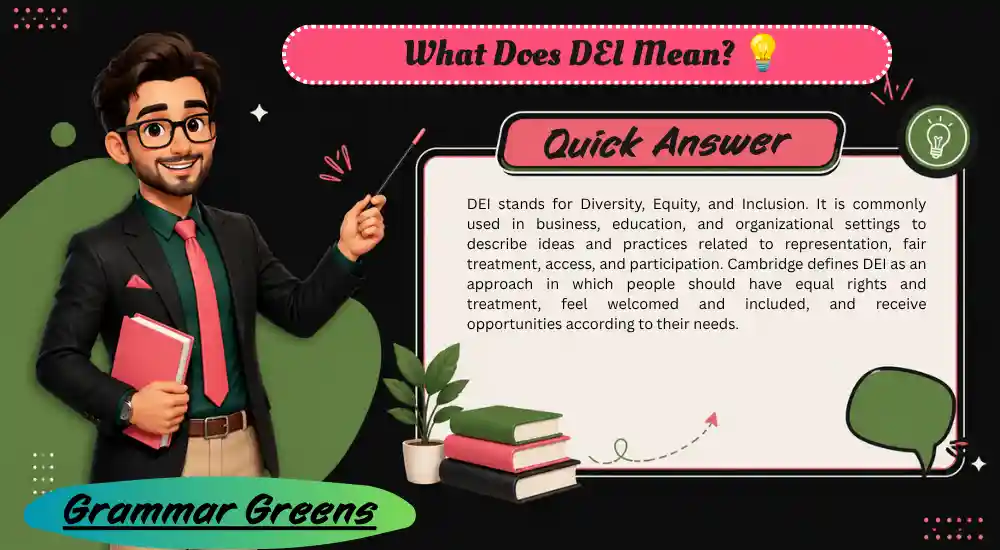
DEI stands for Diversity, Equity, and Inclusion. It is commonly used in business, education, and organizational settings to describe ideas and practices related to representation, fair treatment, access, and participation. Cambridge defines DEI as an approach in which people should have equal rights and treatment, feel welcomed and included, and receive opportunities according to their needs.
In simple terms, diversity focuses on differences among people, equity focuses on fair access and opportunities, and inclusion focuses on creating an environment where people can participate and feel respected. Together, these three ideas form the basic meaning of Diversity, Equity, and Inclusion.
TL;DR: DEI Meaning in Simple Words
- 🔹 DEI means Diversity, Equity, and Inclusion.
- 👥 Diversity means recognizing and including people with different backgrounds, experiences, and perspectives.
- ⚖️ Equity focuses on fair access, treatment, and opportunities.
- 🤝 Inclusion means creating an environment where people feel welcomed, respected, and able to participate.
- 🏢 DEI can apply to workplaces, businesses, schools, universities, and organizations.
- 📚 DE&I is another common way to write the same three concepts.
- 🌍 EDI can refer to Equality, Diversity, and Inclusion, especially in UK usage.
You Might Also Like That: IDC Meaning
What Is DEI?
DEI is a broad term for Diversity, Equity, and Inclusion. It describes a way of thinking about how people with different backgrounds and experiences can receive fair treatment, access opportunities, and take part in an environment. The term appears often in workplaces, education, business, and organizational discussions.
DEI can include policies, programs, training, hiring practices, accessibility efforts, and workplace culture. However, DEI does not describe one single program. Different organizations can use different DEI strategies, initiatives, and policies depending on their goals and needs.
What Does Each Part of DEI Mean?
The three words in DEI describe related but different ideas. Diversity looks at who is represented, equity looks at whether people have fair access and support, and inclusion looks at whether people can participate and feel respected. Understanding these three terms separately makes the DEI definition much easier to understand.
Diversity
👥 Diversity refers to the differences among people within a group, community, school, or organization. These differences can include background, experiences, education, culture, age, gender, race, ethnicity, disability, and other characteristics. Diversity can also include differences in ideas, skills, and perspectives.
In the workplace, workplace diversity can mean having employees with different experiences and viewpoints. A diverse group may bring different ways of thinking and problem-solving. Diversity mainly asks a simple question: Who is represented?
Equity
⚖️ Equity focuses on fairness, access, and opportunity. It recognizes that people may have different circumstances or needs, so giving everyone exactly the same thing does not always create the same level of opportunity.
For example, an organization might provide different forms of support to help employees access the same opportunities. This idea makes equity vs. equality an important distinction. Equality often focuses on the same treatment, while equity considers what people may need to participate fairly.
Inclusion
🤝 Inclusion means creating an environment where people can participate, contribute, and feel respected and valued. Having a diverse group does not automatically mean everyone feels included.
For example, a workplace may have employees from many backgrounds but still need practices that encourage participation and respectful communication. An inclusive workplace aims to make people feel that their voices matter. Inclusion therefore connects closely with belonging, participation, accessibility, and workplace culture.
How Do Diversity, Equity, and Inclusion Work Together?
The three parts of DEI work together because they address different parts of the same broader goal. Diversity considers representation, equity considers fair access and support, and inclusion considers participation and belonging. One part does not automatically create the others.
For example, an organization can have a diverse workforce but still need to improve inclusion if some employees do not feel heard. Similarly, providing equal rules to everyone may not address different barriers that affect access. DEI therefore brings these ideas together rather than treating diversity, equity, and inclusion as completely separate topics.
What Are Some Examples of DEI?
DEI can appear in many everyday practices rather than one specific program. Examples can include:
- 👥 Inclusive hiring and recruitment practices
- ♿ Accessibility improvements
- 📚 Equal access to learning resources
- 🤝 Mentorship and employee development
- 🗣️ Encouraging different perspectives
- 🏢 Creating an inclusive workplace culture
- 📋 Reviewing policies for fair access
- 🌱 Supporting employee participation and belonging
The exact form of a DEI initiative can vary by organization. Some organizations may focus on recruitment, while others may focus on accessibility, training, career development, or workplace culture.
What Does DEI Look Like in the Workplace?
In the workplace, DEI can cover areas such as recruitment, hiring, career development, workplace culture, accessibility, and employee participation. Organizations may create DEI policies, programs, or strategies to address specific workplace goals. Cambridge also gives workplace examples when explaining DEI and DE&I.
Common workplace examples include inclusive recruitment, employee development, mentorship, accessibility improvements, and efforts to create a respectful environment. The goal and design of each initiative can differ, so DEI does not look exactly the same in every company or organization.
What Does DEI Mean in Education?
🎓 DEI in education refers to applying the ideas of diversity, equity, and inclusion in schools, colleges, universities, and other learning environments. This can involve access to education, inclusive classrooms, accessibility, student participation, and support for different needs.
For example, an educational institution may review whether students can access learning materials and participate fully in classroom activities. Cambridge specifically identifies education and higher education as contexts in which diversity, equity, and inclusion are discussed.
What Is the Difference Between Equity and Equality?
⚖️ Equity and equality are related, but they do not always mean the same thing. Equality generally focuses on giving people the same rights, treatment, or opportunities. Equity considers differences in circumstances and needs when thinking about fair access and opportunity.
A simple way to remember it is:
| Term | Basic Focus |
| Equality | Same treatment or opportunity |
| Equity | Fair access based on different needs or circumstances |
This distinction helps explain why equity has its own place in the DEI framework. Cambridge’s definition also connects opportunities with people’s needs.
DEI vs. D&I: What’s the Difference?
D&I stands for Diversity and Inclusion. It focuses on representation and creating an environment where people feel welcomed and included. DEI adds Equity to the framework, bringing greater attention to fairness, access, and opportunity.
Both terms can appear in workplace and education discussions. Cambridge lists D&I as a related term and distinguishes it from DEI.
In simple terms, D&I asks about diversity and inclusion, while DEI adds equity as a third focus.
What Is DE&I?
DE&I means Diversity, Equity, and Inclusion, just like DEI. The ampersand does not add another concept; it simply changes how the abbreviation appears in writing.
You may see DEI or DE&I in company policies, educational resources, articles, and workplace discussions. Cambridge currently lists DE&I as another form of DEI.
So, if someone asks “What does DE&I stand for?”, the answer is Diversity, Equity, and Inclusion. The two forms generally refer to the same three concepts.
What Is EDI?
EDI commonly stands for Equality, Diversity, and Inclusion, particularly in UK usage. Cambridge identifies EDI as the UK equivalent of the US term DEI in this context.
The wording differs because EDI uses Equality, while DEI uses Equity. The terms can overlap in their broader goals, but you should not automatically assume that every organization uses them in exactly the same way. Also, EDI has another meaning in technology: Electronic Data Interchange, so context matters.
What Is DEIB and How Is It Different From DEI?
DEIB adds Belonging to Diversity, Equity, and Inclusion. The added “B” highlights whether people feel accepted, connected, and valued within a group or organization.
You may therefore see DEIB in workplace or organizational discussions when belonging receives specific attention. The basic structure becomes:
DEI: Diversity + Equity + Inclusion
DEIB: Diversity + Equity + Inclusion + Belonging 🌱
DEIB is best understood as an expanded version of the DEI framework, rather than a completely separate concept.
What Is DEIA?
DEIA adds Accessibility to the DEI framework. The acronym can therefore refer to Diversity, Equity, Inclusion, and Accessibility.
Accessibility focuses on whether people can fully access environments, information, services, tools, and opportunities. ♿ For example, organizations may consider physical access, digital accessibility, communication formats, or other barriers.
DEIA shows how organizations can expand the basic DEI framework to highlight a specific area. It does not mean that accessibility is unrelated to traditional DEI; instead, it gives accessibility a more visible place within the framework.
Why Is DEI Sometimes Controversial?
DEI has become a subject of public and political debate, especially around specific workplace, education, hiring, and organizational policies. Different people and groups disagree about the goals, methods, and effects of particular DEI initiatives. These disagreements concern specific policies and practices rather than changing the basic meaning of the acronym.
For a DEI meaning question, it helps to separate the definition from those debates. DEI means Diversity, Equity, and Inclusion regardless of whether people support or criticize a particular program. This distinction keeps the definition clear while recognizing that specific DEI policies can generate disagreement.
Frequently Asked Questions About DEI
What does DEI stand for?
DEI stands for Diversity, Equity, and Inclusion. The three terms focus on differences among people, fair access and opportunities, and meaningful participation.
What does DEI mean?
DEI means Diversity, Equity, and Inclusion. It describes a broad framework used to discuss representation, fairness, access, participation, and inclusion in settings such as workplaces and education.
What is an example of DEI?
Examples include inclusive recruitment, accessibility improvements, mentorship, employee development, and practices that encourage participation from people with different backgrounds and experiences.
Why is DEI important?
DEI can help organizations think about representation, fair access, participation, and inclusion. The specific goals and practices vary between organizations.
What does DEI mean in the workplace?
In the workplace, DEI can refer to practices involving hiring, career opportunities, workplace culture, accessibility, employee participation, and inclusion.
What does DEI mean in education?
In education, DEI can involve access to learning, inclusive classrooms, accessibility, representation, student participation, and support for different needs.
Is DEI the same as equality?
Not exactly. Equality generally emphasizes the same treatment or opportunities, while equity considers different circumstances and needs when addressing fair access.
Is DEI the same as affirmative action?
No. DEI and affirmative action are related but not interchangeable terms. DEI is a broad framework covering diversity, equity, and inclusion, while affirmative action refers to specific policies or practices in particular legal and organizational contexts.
What does DE&I stand for?
DE&I stands for Diversity, Equity, and Inclusion. It generally refers to the same three concepts as DEI.
What does DEIB stand for?
DEIB stands for Diversity, Equity, Inclusion, and Belonging. It adds belonging as an additional focus.
Final Thoughts
The simplest answer to “What does DEI stand for?” is Diversity, Equity, and Inclusion. 👥 Diversity focuses on differences and representation, ⚖️ equity focuses on fair access and opportunity, and 🤝 inclusion focuses on participation, respect, and belonging.
You may encounter DEI in workplaces, businesses, schools, universities, and other organizations. You may also see related terms such as DE&I, D&I, EDI, DEIB, and DEIA. Understanding these basic differences makes it much easier to understand what people mean when they use the term DEI.