
If you see “WTV” in a text, chat, or social media message, it usually means “whatever.” It is an informal abbreviation used in casual digital conversations.
Depending on the context, WTV can mean “I don’t mind,” “any choice is fine,” or “I don’t care.” It can also sound dismissive or annoyed when used by itself. The surrounding conversation is important when deciding what the sender means.
Quick Answer
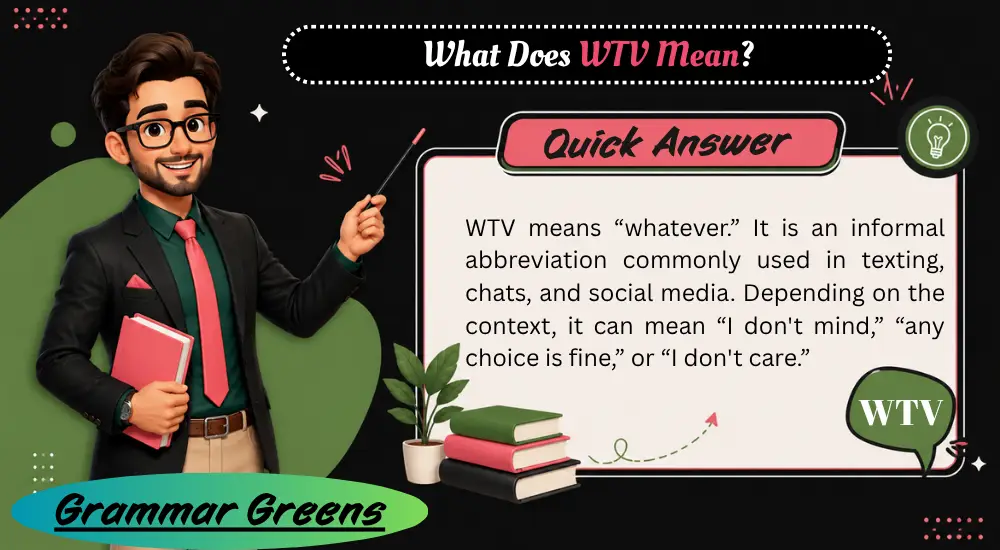
WTV means “whatever.” It is an informal abbreviation commonly used in texting, chats, and social media. Depending on the context, it can mean “I don’t mind,” “any choice is fine,” or “I don’t care.”
TL;DR
- WTV = “whatever.”
- 💬 Commonly used in texting, chats, and social media.
- 🙂 It can express flexibility or indifference.
- 😒 A standalone “WTV” can sometimes sound dismissive or annoyed.
- ✍️ It is informal, so it is generally better to avoid it in professional or academic writing.
- 📌 Context matters: “WTV works for me” sounds different from simply “WTV.”
You Might Also Like That: EYP Meaning in Text
What Does WTV Mean?
WTV means “whatever.” It is a shortened form commonly used in texting, online chats, and other casual conversations.
People often use WTV when they do not have a strong preference. For example, “WTV you want is fine” means that any option the other person chooses is acceptable.
WTV can also show indifference. In some situations, it may suggest that the person does not want to continue discussing a topic. That is why the tone of a WTV message depends heavily on context.
What Does WTV Stand For?
WTV stands for “whatever.” It is an informal texting abbreviation rather than a phrase normally used in formal writing.
You may see it written as WTV or wtv. Capitalization usually does not change its basic meaning.
What Does WTV Mean in Texting?
In texting, WTV is a quick way to say “whatever.” It can save time and make a message feel more casual.
For example:
“WTV you want to watch is fine with me.”
This means:
“Whatever you want to watch is fine with me.”
WTV is most common in informal conversations with friends, family, or other people who are comfortable with texting abbreviations. The meaning normally stays the same across text messages, chats, and social media.
You Might Also Like That: OMP Meaning
How Is WTV Used?
WTV can have several closely related uses in casual conversation:
- To show flexibility: You are fine with any option.
- To express indifference: You do not have a strong opinion.
- To let someone else decide: You are leaving the choice to them.
- To dismiss a topic: You do not want to keep discussing something.
- To give a casual response: You are responding without much concern.
The exact meaning comes from the sentence and the conversation around it. A WTV used inside a friendly sentence may sound completely different from a one-word “WTV.”
What Tone Does WTV Have?
WTV does not have one fixed tone. It can sound neutral, casual, indifferent, playful, or dismissive depending on how it is used.
For example, “WTV works for me” usually sounds flexible. On the other hand, replying with only “WTV” during an argument may sound like the person is annoyed or does not want to continue the conversation.
You Might Also Like That:
Neutral or Flexible
“WTV time works for me.”
Here, WTV means that the sender has no strong preference. They are happy with whatever time the other person chooses.
Indifferent or Dismissive
“WTV.”
A standalone WTV can sound more dismissive. Depending on the conversation, it may suggest “I don’t care,” “whatever,” or “I’m done talking about it.”
Playful or Casual
“WTV you pick 😂”
With friendly wording or an emoji, WTV may simply be a relaxed way of saying that the other person can choose.
⭐ Important: Do not assume that WTV is rude every time you see it. Context, wording, punctuation, and the relationship between the people can all affect its tone.
Is WTV Rude?
WTV is not inherently rude, but it can sound rude or dismissive in some contexts.
You Might Also Like That: Elicit vs Illicit
A longer sentence can make the meaning clearer and more neutral. For example, “WTV works for me” usually suggests that the person is flexible. A short response such as “WTV.” may sound more like “I don’t care.”
| Message | Likely tone |
| “WTV you want is fine.” | Flexible or neutral |
| “WTV works for me.” | Casual and indifferent |
| “WTV.” | Potentially dismissive |
| “WTV 😂” | Potentially playful or casual |
If you are unsure how someone intended WTV, look at the messages before and after it instead of judging the abbreviation alone.
WTV Examples in Text Messages
Here are some common ways WTV can appear in a conversation.
💡 Example 1 — Flexible
A: “Do you want pizza or burgers?”
B: “WTV you want.”
Meaning: The person does not mind which option you choose.
You Might Also Like That: Rizz Meaning
💡 Example 2 — Making plans
A: “Should we meet at 6 or 7?”
B: “WTV works.”
Meaning: Either time is acceptable.
💡 Example 3 — Dismissive
A: “Can we please talk about what happened?”
B: “WTV.”
Meaning: Depending on the situation, the response may suggest “whatever” or “I don’t want to discuss this.”
💡 Example 4 — Casual
A: “What movie should we watch?”
B: “WTV you pick 😂”
Meaning: The sender is happy to let the other person choose.
These examples show why context matters more than the abbreviation itself.
WTV vs. Whatever and Other Texting Abbreviations
WTV and “whatever” generally communicate the same basic idea, but WTV is much more informal. It is designed for quick, casual digital communication.
Other texting abbreviations can look similar but have different meanings:
| Expression | Meaning | Typical use |
| WTV | Whatever | Indifference or flexibility |
| Whatever | Whatever | Full word; can be casual or dismissive |
| IDC | I don’t care | Directly expresses lack of concern |
| IDK | I don’t know | Expresses uncertainty |
| NVM | Never mind | Signals that a topic or request is being dropped |
For example, IDK means “I don’t know,” so it should not be confused with WTV. Similarly, IDC is more directly about not caring, while WTV can also mean that any option is acceptable.
Can You Use WTV in Formal Writing?
WTV is generally best for informal communication.
📌 WTV is usually fine in:
- Casual text messages
- Conversations with friends
- Group chats
- Informal social media messages
- Other relaxed online conversations
📌 It is better to avoid WTV in:
- Academic assignments
- Professional emails
- Job applications
- Official documents
- Formal business communication
In formal situations, write “whatever” or use a more precise phrase instead. The issue is not that “whatever” is always informal; the shortened form WTV is what makes the expression unsuitable for many formal settings.
You Might Also Like That: EYP Meaning in Text
What Does WTV Mean From a Girl or Guy?
WTV has the same basic meaning regardless of whether a girl or guy sends it. There is no standard definition that changes based on the sender’s gender.
If someone texts you “WTV,” look at the context instead. Consider what you were discussing, whether you had been arguing, and whether the person added other words or emojis.
For example, “WTV you want is fine” usually sounds flexible, while a standalone “WTV” after an argument could sound dismissive. One abbreviation by itself is not enough to determine whether someone is angry, uninterested, or upset.
Frequently Asked Questions About WTV
What does WTV mean?
WTV usually means “whatever.” It is an informal abbreviation commonly used in texting, chats, and social media.
What does WTV stand for?
WTV stands for “whatever.”
Is WTV short for whatever?
Yes. In casual digital communication, WTV is commonly used as a shortened form of “whatever.”
Is WTV slang?
WTV is commonly used as informal texting shorthand or internet slang. It is generally associated with casual digital communication rather than formal writing.
Is WTV rude?
Not necessarily. WTV can be neutral or casual, but it may sound dismissive when used alone or during an argument. The context determines the tone.
What does WTV mean in texting?
In texting, WTV usually means “whatever.” It can express flexibility, indifference, or dismissal depending on the message.
How do you use WTV in a sentence?
You can use WTV in a casual sentence such as:
“WTV you choose is fine with me.”
This means “Whatever you choose is fine with me.”
Can WTV be used in formal writing?
It is generally better to avoid WTV in formal writing. Use “whatever” or a more specific expression instead.
What does WTV mean on social media?
On social media, WTV generally has the same meaning: “whatever.” The tone can still change depending on the context.
Final Takeaway
WTV means “whatever” and is mainly used in casual texts, chats, and social media. It can express flexibility, indifference, or dismissal, so the exact tone depends on the surrounding conversation.
If someone sends you “WTV,” do not automatically assume they are being rude. Look at the full message and the context. A phrase such as “WTV works for me” can simply mean “I don’t mind,” while a standalone “WTV” may sound more dismissive.
For casual texting, WTV is a convenient abbreviation. For professional or formal communication, spelling out “whatever” is usually the better choice.