

If you’ve seen “ISTG” in a text, DM, comment, or group chat, it usually means “I swear to God.” It is an informal initialism people use to add emphasis to what they are saying. Depending on the context, ISTG can show sincerity, frustration, surprise, excitement, disbelief, or strong emotion.
The meaning is usually easy to understand once you look at the rest of the message. For example, “ISTG I didn’t do it” sounds like a strong denial, while “ISTG this movie is amazing” shows enthusiasm. The abbreviation itself does not automatically mean that someone is angry.
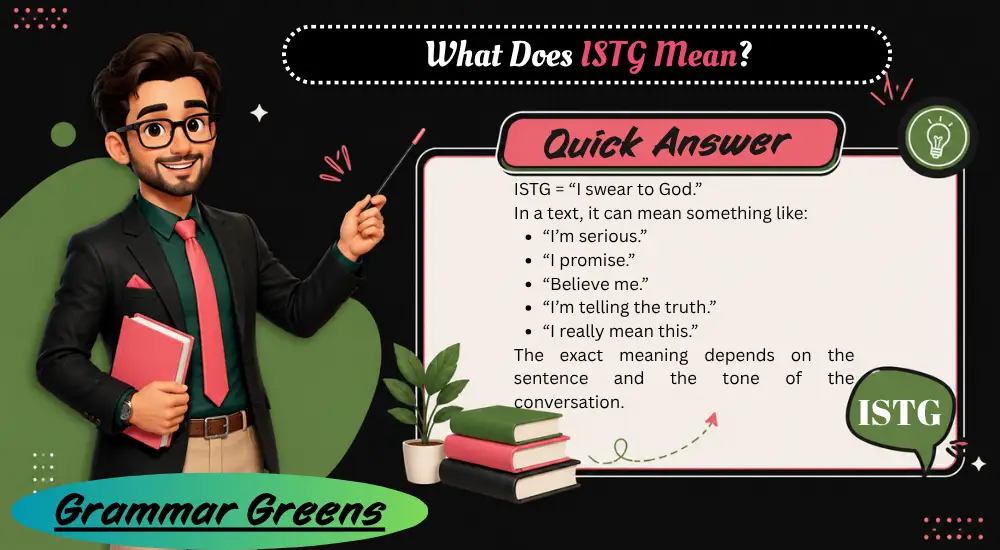
⭐ Quick answer
ISTG = “I swear to God.”
In a text, it can mean something like:
- “I’m serious.”
- “I promise.”
- “Believe me.”
- “I’m telling the truth.”
- “I really mean this.”
The exact meaning depends on the sentence and the tone of the conversation.
TL;DR
- ISTG means “I swear to God.”
- It is mainly used in texts, DMs, chats, and social media.
- It can show seriousness, sincerity, frustration, surprise, excitement, or humor.
- ISTG does not automatically mean someone is angry.
- The exact tone depends on the context and surrounding message.
- It is informal, so it is usually better to avoid it in professional or academic writing.
- ISTG and STG have very similar meanings.
- If someone texts you “ISTG,” your response should depend on the situation and their tone.
You Might Also Like That: Effect vs Affect
What Does ISTG Mean?
ISTG stands for “I swear to God.” In texting and online communication, it is commonly used as an informal way to emphasize a statement or show that the sender is being serious. Dictionary.com also describes ISTG as a way to express strong feelings such as seriousness, exasperation, or surprise.
ISTG is more accurately described as an initialism because its letters are normally read individually rather than pronounced as one word. In everyday online conversation, however, most people simply think of it as texting slang or an abbreviation.
What Does ISTG Mean in Texting?
In texting, ISTG is usually used to make a message stronger or more emotional. Someone might use it when they want you to believe them, emphasize an opinion, or show a strong reaction.
You may see ISTG in text messages, DMs, group chats, comments, and other informal online conversations. The basic meaning does not normally change from one platform to another. What changes is the tone created by the surrounding words.
| Context | What ISTG may communicate |
| Insisting on something | “Believe me.” |
| Making a strong statement | “I’m serious.” |
| Showing frustration | Strong annoyance |
| Showing excitement | Strong enthusiasm |
| Showing surprise | Strong disbelief |
Because ISTG is informal slang, it is generally better suited to casual conversations than professional or academic writing.
What Does ISTG Mean in Different Contexts?
The same abbreviation can have different emotional effects depending on the message around it. This is why you should not assume that every ISTG message is angry or confrontational.
ISTG to Show Sincerity or Honesty
Someone may use ISTG when they strongly want you to believe what they are saying.
Example:
“ISTG I didn’t take your charger.”
Here, ISTG emphasizes the person’s denial. The sender is essentially saying, “I swear I’m telling the truth.”
ISTG to Show Frustration
ISTG can also make a frustrated statement sound stronger.
Example:
“ISTG, stop doing that.”
In this context, the abbreviation adds intensity. The person is clearly annoyed, but the surrounding message—not ISTG alone—creates the stronger angry tone.
ISTG to Show Surprise or Disbelief
People may use ISTG when they are surprised by something or strongly believe that something happened.
Example:
“ISTG I just saw him downtown.”
Here, ISTG emphasizes how strongly the person believes what they are saying.
You Might Also Like That: What Does WYF Mean
ISTG to Show Excitement or Strong Emotion
ISTG is not limited to negative emotions. It can emphasize excitement or enthusiasm too.
Example:
“ISTG this is the best pizza I’ve ever had.”
In this case, the phrase adds dramatic emphasis to a positive opinion.
ISTG as a Joke or Dramatic Emphasis
Friends may also use ISTG playfully, especially when exaggerating a reaction.
Example:
“ISTG 😂 I can’t stop laughing.”
The laughing emoji and surrounding message make the playful tone clear. Here, ISTG does not necessarily sound like a serious oath.
ISTG Examples in Text Messages
Seeing ISTG in different sentences makes its meaning easier to understand.
| Text example | Likely meaning |
| “ISTG I already told you.” | Strong insistence |
| “ISTG this song is amazing.” | Enthusiasm |
| “ISTG, leave me alone.” | Frustration |
| “ISTG 😂 that was hilarious.” | Playful emphasis |
| “ISTG I thought I saw her.” | Surprise or strong belief |
The important point is that ISTG does not have one fixed emotional tone. The words around it, punctuation, emojis, and the previous conversation can all affect how it sounds.
For example, “ISTG 😂” may be playful, while “ISTG, don’t do that again” may sound much more serious.
Does ISTG Mean Someone Is Angry?
No. ISTG does not automatically mean someone is angry.
It can appear in an argument, but people also use it when they are excited, surprised, joking, or simply trying to emphasize that something is true.
📌 To understand the tone, look at:
- The words immediately after ISTG.
- The punctuation used in the message.
- Any emojis or reaction words.
- What the people were discussing before the message.
- The relationship between the people having the conversation.
For example, “ISTG this is amazing!” sounds enthusiastic, while “ISTG, stop texting me” sounds frustrated. The surrounding words provide the emotional context.
Is ISTG a Bad Word or Is It Rude?
ISTG is informal, so it may not be appropriate in every situation. The full expression, “I swear to God,” can also be viewed as inappropriate or disrespectful by some people because of its religious wording.
You Might Also Like That: What Does SMH Mean in Text
Whether an ISTG message is rude depends largely on the context. “ISTG this cake is incredible” is very different from “ISTG, leave me alone.” The first emphasizes enthusiasm; the second can sound confrontational.
For professional, academic, or formal communication, it is usually better to write clearly without using texting slang.
How Do You Use ISTG in a Sentence?
ISTG works best in casual conversations where informal language is expected. It can appear at the beginning, middle, or end of a message.
💡 Examples:
- “ISTG, I left my keys right here.”
- “This is the funniest thing ever, ISTG.”
- “ISTG I’m going to miss this place.”
- “ISTG, don’t make me wait another hour.”
The position of ISTG can slightly change the rhythm of the message, but the basic function remains the same: it adds emphasis to the statement.
When using it, think about the tone you want. A message such as “ISTG, don’t do that again” can sound much more intense than “ISTG this is so funny 😂.”
How Do You Respond to ISTG?
There is no single correct response to ISTG. Your reply should depend on why the person used it.
| Situation | Possible response |
| They are insisting they are telling the truth | “Okay, I believe you.” |
| They are frustrated | “I understand what you mean.” |
| They are joking | Match their humor |
| You disagree with them | Explain your side calmly |
| They are making a promise | Acknowledge what they said |
For example, if someone says “ISTG I didn’t send that message,” you might respond, “Okay, I believe you.” If a friend says “ISTG 😂 that was the funniest thing ever,” a playful response may fit better.
The best response comes from understanding the context and tone, rather than reacting to the abbreviation alone.
ISTG vs. STG: What’s the Difference?
ISTG and STG are closely related texting abbreviations.
| Abbreviation | Meaning | Typical function |
| ISTG | I swear to God | Emphasis or sincerity |
| STG | Swear to God | Emphasis or sincerity |
Both can be used to emphasize a statement, insist that something is true, or express a strong reaction.
The main difference is simply the wording represented by the letters. ISTG includes the “I” from “I swear,” while STG leaves it out.
You do not need to use both terms interchangeably in every situation, though. Individual speakers may have their own preferences.
Is ISTG Appropriate for Formal Communication?
ISTG is best treated as informal texting and internet slang.
Usually appropriate
- Texting friends
- Casual group chats
- Informal DMs
- Casual social-media conversations
- Conversations with people who regularly use texting slang
Usually avoid
- Business emails
- Academic assignments
- Job applications
- Formal reports
- Official documents
There is nothing inherently wrong with knowing or using ISTG, but the setting matters. In formal communication, phrases such as “I’m serious,” “I assure you,” or “I can confirm” are usually clearer and more appropriate.
You Might Also Like That: TS Meaning in Text
Frequently Asked Questions About ISTG
What does ISTG mean in text?
ISTG means “I swear to God.” In texting, it is commonly used to emphasize sincerity, seriousness, frustration, surprise, excitement, or another strong emotion.
What does ISTG stand for?
ISTG stands for “I swear to God.” It is an informal initialism commonly found in texts and online conversations.
Does ISTG mean angry?
Not necessarily. ISTG can sound angry when used in a frustrated or confrontational message, but it can also express excitement, surprise, sincerity, or humor.
Is ISTG rude?
ISTG can sound rude or confrontational in some contexts, especially during an argument. However, it is not automatically rude. The surrounding message determines much of its tone.
Is ISTG a bad word?
ISTG is informal slang based on the phrase “I swear to God.” Some people may consider the expression inappropriate because of its religious wording, so it is best used with awareness of the audience and setting.
Can ISTG be used jokingly?
Yes. Friends often use ISTG for humorous or dramatic emphasis. An emoji or playful wording can make the intended tone easier to recognize.
How do I respond to ISTG?
Respond according to the context. If someone is insisting on the truth, you might say “Okay, I believe you.” If they are joking, a playful response may be more natural. If they are frustrated, acknowledging their feelings may work better.
What is the difference between ISTG and STG?
Both relate to “swear to God.” ISTG means “I swear to God,” while STG generally means “swear to God.” Both are informal expressions used for emphasis or sincerity.
⭐ Final Takeaway
ISTG means “I swear to God.” In texts and online conversations, people usually use it to add emphasis rather than as a literal oath. It can express sincerity, insistence, frustration, surprise, excitement, or humor, depending on the context.
So, if someone sends you an ISTG message, don’t assume they are angry. Read the entire message and consider the conversation around it. That context usually tells you what they really mean.